
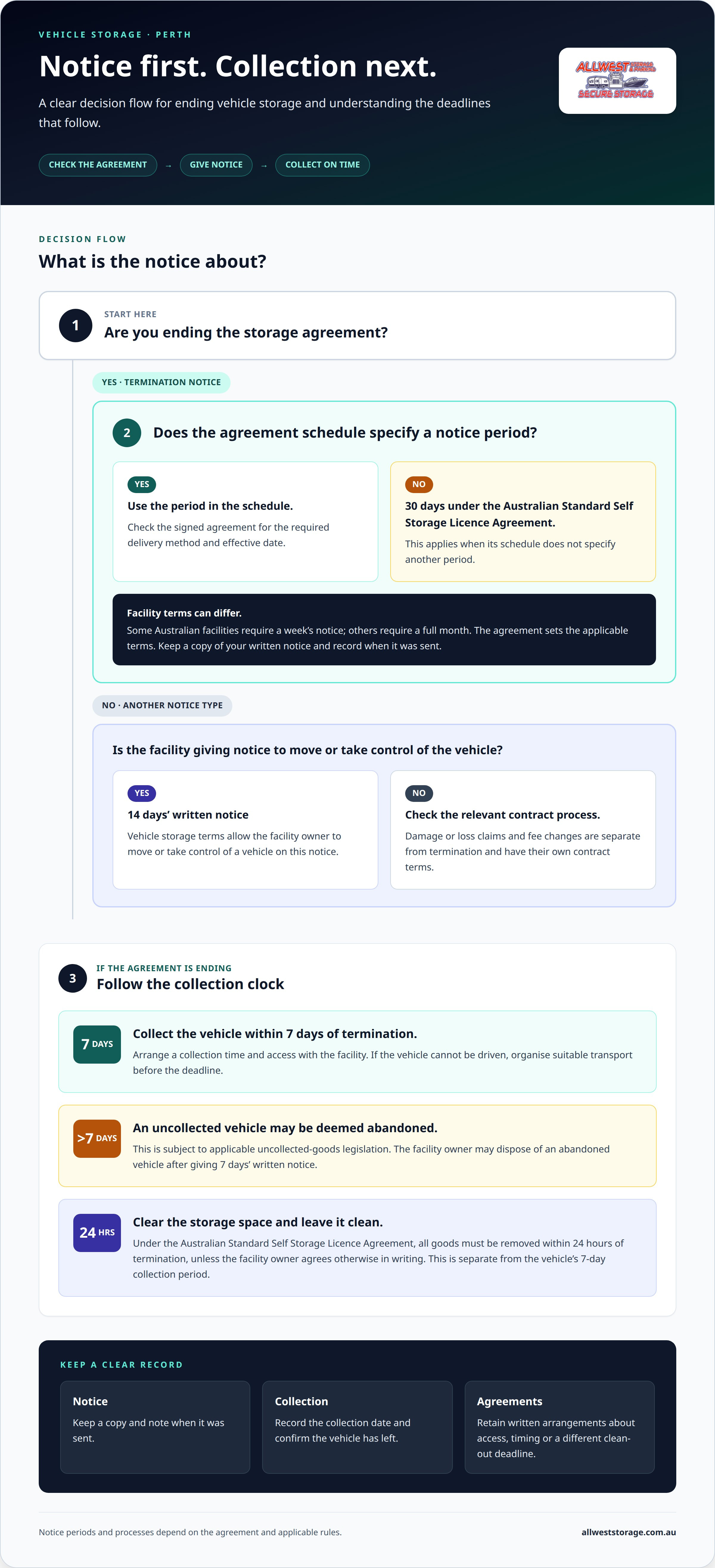
A 30-day notice period applies under the Australian Standard Self Storage Licence Agreement when its schedule doesn’t specify another period. The notice period for vehicle storage therefore depends first on the agreement’s schedule. After any fixed storage period ends, either party may terminate by giving written notice of at least the specified notice period.
A notice date is only one part of ending vehicle storage. Some Australian facilities require a week’s notice, while others require a full month; the agreement sets the applicable terms. Planning the collection and understanding any written notice about moving a vehicle can make the final steps clearer.
This guide explains how written notice works in Perth, what to consider when arranging collection after termination, and how notice relates to moving a stored vehicle. It gives you a practical sequence for ending the agreement and taking the next step with your car, caravan, boat, truck or trailer.
Key Takeaways
- Keep termination notice in writing and record when it was sent, so you can track the notice period in your agreement.
- Arrange collection promptly. Vehicle storage terms require collection within 7 days of termination.
- Know the consequences of leaving a vehicle behind: after more than 7 days, it may be deemed abandoned, subject to applicable uncollected-goods legislation.
- Read any relocation notice carefully. Vehicle storage terms allow the facility owner to move or take control of a vehicle on 14 days’ written notice.
Written notice to terminate the storage agreement
Written termination notice tells the other party that the storage agreement is ending. In Perth, the required period depends on the contract terms and any applicable rules.
Termination notice and contract terms
A termination notice is a written request to end the storage contract. Under the Australian Standard Self Storage Licence Agreement, the notice period is 30 days if the schedule specifies no period. After the fixed storage period ends, either party may terminate by giving written notice of at least the specified period.
Some Australian facilities require a week’s notice; others require a full month. Check the period, delivery method and effective date in your signed agreement. Keep a copy of your notice and record when you sent it. This creates a clear record if there is later a disagreement about timing.
Notice for different vehicle categories
The vehicle category describes what is stored, while the agreement sets the termination process. Don’t assume the same notice period applies to abandoned, unregistered or impounded vehicles.
A vehicle left uncollected after an agreement ends may be treated as abandoned under the applicable terms and legislation. That rule concerns collection after termination, not a universal notice period for every abandoned vehicle. For an unregistered or impounded vehicle, the applicable agreement and circumstances affect the process.
A damage or loss notice records a claim about the stored vehicle, rather than ending the agreement. Send the operator a written description of the damage or loss, when it occurred, and the outcome you’re seeking. Keep copies of photographs, correspondence and any incident records. Follow the claim process and deadlines stated in the contract.
A fee-change notice explains a proposed change to storage charges. The contract’s fee-change clause sets how notice is delivered and when a change takes effect. Read that clause alongside any applicable Western Australian consumer requirements. If you believe the operator has given inadequate notice, raise the issue in writing, identify the relevant contract term, and keep the response with your agreement.
Notice periods can vary between Australian states and territories because applicable rules and contract terms may differ. In Perth, consult Western Australian government consumer advice and compare it with your agreement. This helps distinguish the termination period from separate requirements for damage claims, fee changes or uncollected vehicles.
Collection of a vehicle after termination
Vehicle collection is the process of removing the stored vehicle once the agreement ends. Under the vehicle storage licence terms, the vehicle must be collected within 7 days of termination. Treat that as a deadline for arranging access and transport, not as an extension of the termination notice period.
Start by agreeing on a collection time with the facility and planning how the vehicle will leave the site. If it can’t be driven, arrange suitable transport before the collection deadline. Have the keys and any access details ready, and allow time to locate the vehicle and complete the handover. These practical steps can help avoid a last-minute collection problem.
Collection also involves clearing the storage space. Under the Australian Standard Self Storage Licence Agreement, all goods must be removed and the space left clean within 24 hours of termination, unless the facility owner agrees otherwise in writing. This is a separate timeframe from the vehicle storage terms’ 7-day collection period. Put any written agreement about a different arrangement with your contract records.
Keep a simple handover record. Note the collection date, confirm the vehicle has left the facility, and retain any messages about access or timing. If someone else is collecting it, arrange the handover details with the facility in advance. A written record can help clarify whether the vehicle and other goods were removed by the relevant deadlines.
For a smooth collection, work through these steps:
- Use the termination date to plan collection within 7 days.
- Arrange transport if the vehicle cannot be driven.
- Remove other stored goods and leave the space clean within 24 hours, unless the facility owner agrees otherwise in writing.
- Keep written records of the collection and any agreed arrangements.
If you’re planning storage for a vehicle after collection, review the vehicle storage options available for your next arrangement.
Vehicle removal after termination
Vehicle removal after termination means the owner takes the vehicle from the facility once the storage agreement ends. The vehicle storage licence terms require collection within 7 days of termination. This collection deadline is separate from the notice period used to end the agreement.
An abandoned vehicle is one left uncollected for more than 7 days after termination under these terms. That status is subject to applicable uncollected-goods legislation. The facility owner may dispose of an abandoned vehicle after giving 7 days’ written notice. The terms do not set out a separate sale process, so distinguish disposal notice from the original termination notice.
Before the deadline, arrange to remove the vehicle. If it can’t be driven, organise suitable transport and agree on access arrangements with the facility. Keep written records of the collection date and any communications about removal. For example, a message confirming a tow truck’s arrival time can help document the planned handover.
A storage charge is an amount payable under the storage agreement. The agreement determines how charges are handled when storage ends, so don’t assume an uncollected vehicle can remain without further cost. Read the relevant terms and ask for any account details or removal arrangements in writing. A clear record can help resolve questions about the end date and outstanding obligations.
Use this sequence to reduce the risk of missing a required step:
- Record the termination date and calculate the 7-day collection deadline.
- Arrange access and transport before that deadline, especially if the vehicle is not roadworthy or cannot be driven.
- Remove the vehicle and any other goods, then keep written confirmation of the handover.
- If the vehicle remains, retain any written notice received and note its date and stated action.
Where a vehicle remains uncollected, written notices matter. The stated terms require 7 days’ written notice before disposal of an abandoned vehicle. Keep that notice with the agreement and related correspondence.
Notice for moving a stored vehicle
A vehicle-movement notice is written advice that the facility owner plans to take control of or move a stored vehicle. Under the vehicle storage licence terms, the owner may do this on 14 days’ written notice, including for relocation. This notice is separate from a termination notice: it concerns the vehicle’s location or control, not the end of the storage agreement.
A storage-space inspection notice covers access to inspect the area for maintenance, repair or relocation. The terms require 14 days’ written notice for these inspections, and the storer has the right to be present. For example, if relocation requires checking the vehicle’s space, the notice should identify the planned inspection and its purpose. Use the written notice to understand what is proposed and when.
In specified circumstances, the facility owner may take control of or move a vehicle immediately without prior notice. The terms then require written notice of the event as soon as practicable, unless the law prohibits it. The immediate-action exception does not remove the separate requirement to send that follow-up notice when permitted.
When you receive a movement or inspection notice, keep the document and note its date, stated purpose and proposed action. If the notice involves an inspection, you can use your stated right to be present. If you need to discuss access or timing, reply in writing and keep the response with your agreement. This creates a record of practical arrangements without confusing relocation with termination.
Before a planned move, use these steps:
- Record when the written notice arrived and the action it describes.
- For a planned move or inspection, note the 14-day notice period.
- If the owner moves the vehicle immediately under specified circumstances, retain the follow-up written notice and its date.
- Keep correspondence about the move with the storage agreement.
Need a storage arrangement for a vehicle after a move? Discuss vehicle storage arrangements.
Allwest Storage & Parking
Allwest Storage & Parking provides vehicle storage in Perth when your current agreement ends or circumstances change. Once you’ve reviewed the termination terms and planned collection or relocation, a new storage arrangement can help keep your vehicle off the road and out of the way. Options include car, boat, caravan and campervan, truck and trailer storage, with undercover and hardstand choices.
Choose the storage option that suits your vehicle and needs. The agreement for the new arrangement should set out its terms, including how notice works, so you know what to expect before storing your vehicle.
If you need storage for a vehicle in Perth, contact Allwest Storage & Parking to discuss your requirements.
Plan your next storage arrangement
Use the transition between agreements to match your next storage arrangement to your plans for the vehicle. Consider how long you expect to store it, where it needs to be kept, and what practical access you’ll need. Clear written terms can make future changes easier to manage.
Before making a new arrangement, keep the notice period for vehicle storage in mind as part of your timing. Set out the expected start and end dates, how written changes will be handled, and what you’ll need to do when storage ends. These details help you plan ahead without relying on assumptions.
If you’re ready to discuss your next vehicle storage arrangement, contact Allwest Storage & Parking. A clear plan can help you move forward with confidence.
Frequently Asked Questions
What is the notice period for vehicle storage in Australia?
Under the Australian Standard Self Storage Licence Agreement, the period is 30 days if the schedule specifies no period. This is not a universal term for every Australian storage agreement. Some facilities require a week’s notice, while others require a full month. In Perth, the relevant period depends on the written terms that apply to your storage arrangement.
How much notice is required to end a vehicle storage agreement?
The agreement’s schedule sets the required notice period. Under the Australian Standard agreement, after the fixed storage period ends, either party may terminate by giving written notice of at least the specified period. For example, if your schedule sets a month, plan your intended end date around that requirement and allow time for delivery using the method stated in your contract.
What do Australian vehicle storage contracts say about notice periods and termination?
Contracts explain how and when either party can end storage, including any fixed period, notice requirement and renewal terms. Many Australian self-storage contracts run month to month and automatically renew, so look for the clauses governing the next renewal date. Read those terms together: the notice deadline may affect whether storage ends at the current period or continues into another one.
How should a vehicle storage notice be given, and when does the notice period start?
Give notice in writing using the delivery method and address or contact details stated in your agreement. The contract’s terms determine when notice takes effect, so don’t assume the period starts when you draft or send it. Keep a copy, record the date and method of delivery, and note the effective date stated in the agreement to plan your vehicle’s next steps.
Leave A Comment