

There’s no single price for vehicle storage in Perth. The cost depends on the vehicle, the storage arrangement and how long it needs to be stored. The available vehicle storage payment options, including when payment is due and which methods are accepted, depend on the booking terms.
It’s sensible to understand the full cost before committing, especially if you’ll need storage for weeks or months. This guide explains what affects the fee, what to check in the payment schedule and how to compare payment methods. It also covers how extended-stay discounts and advance payments can affect the total, so you can choose terms that suit your storage needs.
Key Takeaways
- Storage costs depend on the vehicle, the storage arrangement and the length of the stay, so compare the terms that shape your total.
- Understand when payment is due and whether a booking requires an initial payment before you commit.
- Check how any long-stay or advance-payment discount affects the total and the flexibility of your arrangement.
- Match the storage option to your vehicle, whether it’s a car, boat, caravan, campervan, truck or trailer.
Reservation fees and payment due at booking
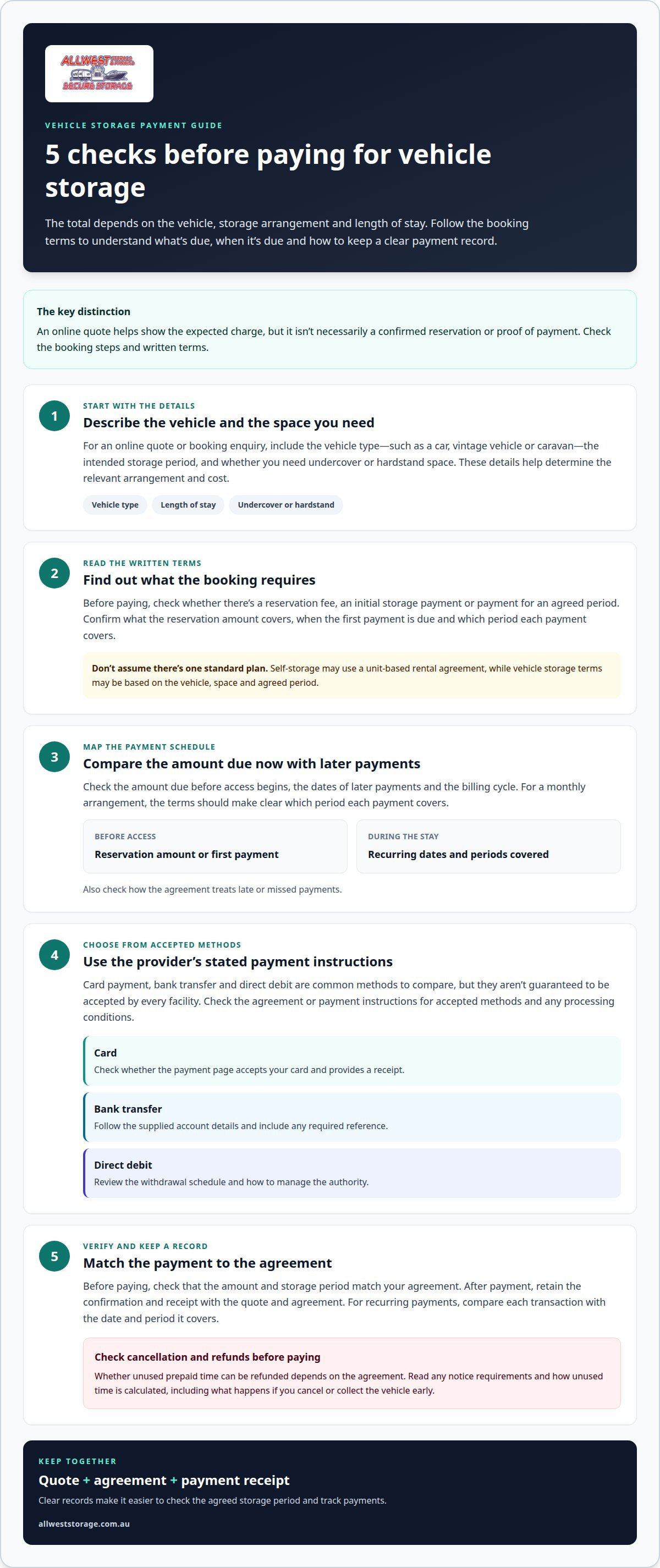
A booking can involve a reservation fee, an initial storage payment or payment for an agreed period. The written terms show what is due, when it’s payable and how cancellation affects prepaid time.
Booking and Payment Steps
Start with an online quote or booking enquiry that identifies the vehicle type, such as a car, vintage vehicle or caravan. Include the intended storage period and whether you need undercover or hardstand space. These details help determine the relevant arrangement and its cost. Before paying, read the booking terms for any reservation fee, the first payment date and the billing cycle. A monthly arrangement, for example, should make clear which period each payment covers.
Provider Payment Terms
Self-storage facilities and dedicated vehicle storage providers can structure bookings differently. A facility may use a unit-based rental agreement, while a vehicle storage arrangement may set terms around the vehicle, storage space and agreed period. Neither label alone tells you when payment falls due. Compare the written booking conditions: the reservation amount, first payment timing, recurring schedule and treatment of late or missed payments. Those details matter more than assuming every Australian facility follows one standard plan.
Online booking can make it easier to enter vehicle details and select a proposed storage period. An online quote helps you understand the expected charge, but it isn’t necessarily a confirmed reservation or proof of payment. Follow the booking steps shown, then retain the confirmation and payment receipt. For caravans or other larger vehicles, check that the quote reflects the vehicle category and selected storage arrangement.
To compare vehicle storage payment options, look at the amount due before access begins and the dates of later payments. A reservation fee can secure a booking, but its purpose and whether it forms part of the storage charge depend on the written terms. Keep the quote, agreement and receipt together so the agreed period and payment record are easy to reference.
Whether you can cancel and receive a refund for unused prepaid time depends on the agreement’s cancellation and refund terms. Read them before paying, including any notice requirements and how unused time is calculated.
Payment methods for storage fees
Payment methods affect how easily you can manage recurring storage costs. The agreement or payment instructions should identify accepted methods, any processing conditions and how you’ll receive confirmation. Don’t assume a storage unit and vehicle space use identical payment systems. Read the terms before selecting a method, particularly if payments repeat during a longer storage period.
Common methods to compare include card payment, bank transfer and direct debit. A card payment uses a card account, a bank transfer is sent from your bank, and direct debit authorises scheduled withdrawals. These are examples, not a guarantee that every facility accepts them. Use a method listed in the provider’s payment instructions.
- Card: Check whether the payment page accepts your card and provides a receipt.
- Bank transfer: Follow the supplied account details and include any required reference.
- Direct debit: Review the withdrawal schedule and how to manage the authority.
For recurring payments, match each transaction to the period it covers. Save receipts with your storage contracts, then compare the payment date and amount against the agreement. If you’re paying for a vehicle kept away from your driveway, clear records make it easier to track storage spending alongside insurance and other vehicle costs.
Online payment can be convenient, but use the payment channel provided with your booking. Before paying, check that the amount and storage period match your agreement, then keep the confirmation. A documented payment process helps you track costs, but you still need to understand the terms.
Storage spaces differ, and weather exposure may influence whether you choose undercover or hardstand storage. Payment arrangements should remain clear whichever space suits your vehicle. Compare the accepted methods, scheduled dates and transaction records before committing, especially when a contract covers a longer stay.
For a vehicle storage arrangement in Perth, explore vehicle storage options and consider which space suits your needs.
Storage discounts for multiple units, long stays and upfront payments
Discounts depend on the booking and storage period. Compare the full cost and terms, not just the advertised reduction.
Upfront Payment Discounts
Paying upfront can make budgeting more convenient, but a lower total depends on the terms offered. Compare the upfront amount with the cost of paying over the same storage period. Check whether the payment covers the full stay and how cancellation or early collection affects unused time. A discount is useful only if the commitment suits your plans.
Monthly and Long-Term Plans
Australian vehicle storage providers can use monthly billing or longer booking periods. Long-term car storage arrangements often involve contracts or discounted rates. Read the agreement for the billing cycle, any minimum stay, and how the total changes if your plans shift. A monthly plan can suit an uncertain end date; a longer commitment can suit a vehicle stored for an extended period.
If you’re storing multiple vehicles, compare the total for each booking and ask whether a discount applies across them. A car and caravan need different amounts of space from two cars. Check that the terms account for each vehicle and don’t assume a combined rate reduces every part of the cost.
Storage type also matters. Undercover and hardstand options suit different needs, so consider the vehicle and intended storage period when comparing costs. Terms can also differ between self-storage and dedicated vehicle storage. Focus on what the agreement includes, not just the discount.
Do Australian providers offer monthly or long-term payment plans? Both approaches are used, though terms vary by provider and booking. Before choosing, compare the payment schedule, minimum period, discount conditions and cancellation terms. That makes it easier to judge whether a lower upfront total is worthwhile or a monthly arrangement better fits your plans. For a long stay, we recommend calculating the full cost across the agreed period.
Advance payment for storage
Paying ahead can make storage costs easier to plan when your vehicle will be stored for an agreed period. The value depends on the booking length, payment schedule and any discount for an extended stay. Compare the prepaid total with the cost of paying in instalments over the same period.
Before paying, read the agreement and note the dates it covers. A payment for a long stay should clearly identify the start and end of the paid period, what happens if you collect the vehicle early, and whether unused time can be refunded or credited. These terms matter if your travel plans, vehicle use or storage needs change.
Advance payment may suit a vehicle with a planned storage end date, such as a car kept away during an extended trip. More frequent payments may offer flexibility if the collection date could change. The right choice depends on how certain your plans are, not just whether a reduced rate is available.
Keep the agreement, payment confirmation and details of the period covered. If you’re storing more than one vehicle, such as a car and caravan, make sure the paperwork shows which booking each payment relates to. Clear records help you track payments and arrange collection without confusion.
Security and payment schedules are separate considerations. CCTV monitors the storage area, but it doesn’t determine how prepaid time is handled. Check the agreement for payment, cancellation and collection terms, and keep a copy with your receipt.
Choose the payment approach that fits your planned storage period and cash-flow needs. For a long stay, compare the full prepaid commitment with payments made over time. Plan your vehicle storage booking around the period you expect to need.
Allwest Storage & Parking
Allwest Storage & Parking helps Perth vehicle owners plan storage for cars, boats, caravans, campervans, trucks and trailers. Hardstand and undercover options give you a choice of storage arrangements, with short-term and long-term stays available.
When comparing payment arrangements, consider how long you expect to store the vehicle and whether you prefer a flexible stay. Allwest offers flexible rates and no lock-in contracts, which can suit changing storage plans. Its site also has 24/7 CCTV monitoring.
For details relevant to your vehicle and intended storage period, contact Allwest Storage & Parking.
Choose a plan that fits your next move
Choosing vehicle storage payment options starts with matching the schedule to your expected storage period and the flexibility you need. Consider what might change, such as a trip running longer or plans to use the vehicle sooner. That helps you focus on terms that suit your circumstances rather than choosing based only on a headline offer.
Before making a decision, keep your intended storage period and preferred payment rhythm in mind. Use them to guide a clear discussion about the arrangement for your vehicle. Allwest Storage & Parking provides storage for cars, boats, caravans and campervans, giving Perth vehicle owners a local option to consider.
Take the next step at your pace. Contact Allwest Storage & Parking to discuss your vehicle storage needs and consider an arrangement that fits your plans.
Frequently Asked Questions
How much does vehicle storage cost?
Vehicle storage costs depend on the vehicle’s size, storage option and length of stay. A car and caravan, for example, need different amounts of space. In Perth, compare quotes for the same vehicle and storage period, then check what each arrangement includes. Comparing like-for-like terms gives you a clearer picture than looking at a headline rate alone.
What happens if my payment is late?
What happens after a missed payment depends on the terms in your storage agreement. Review the clauses covering overdue amounts, any applicable charges and access to your vehicle. If a payment date is approaching and you expect a delay, follow the payment instructions for your booking. Keep notices and receipts together to track what you’ve paid.
What payment methods do you accept?
Allwest Storage & Parking charges recurring lease payments for allocated vehicle parking spaces on a weekly or monthly basis. This describes the billing schedule, not whether payment is made by card, bank transfer or another method. Follow the payment instructions for your booking and keep the confirmation so you can match each payment to its storage period.
What payment methods do vehicle storage facilities in Australia accept?
Vehicle storage payment options vary between Australian facilities, so don’t assume one method will be accepted everywhere. Your booking’s payment instructions identify the available method and any details needed to complete payment. For example, a bank transfer may require a payment reference. Keep the receipt with your agreement for easy reference.
How much does vehicle storage cost per week or month in Australia?
There isn’t one weekly or monthly amount that applies across Australia. The charge depends on the vehicle’s size, storage type and agreed duration. A larger vehicle, for example, may need a different allocated space from a car. Compare quotes using the same billing period and storage option to assess equivalent terms.
Are deposits, admin fees, or setup charges required for vehicle storage in Australia?
Whether a deposit or separate charge applies depends on the booking terms, not a single rule for every Australian storage facility. Review the quote and agreement for any amount due before storage starts, and check whether it is a deposit or part of the storage charge. This distinction helps clarify both the initial payment and ongoing cost.
Leave A Comment