Does comprehensive insurance still cover a car while it’s in storage? Some standard Australian policies cover vehicles kept off-road in a secured facility, but some exclude unregistered vehicles. For storing a vehicle for 6 months in Perth, check how your policy treats the car’s storage location and registration status before it’s parked away.
Six months is long-term storage, so choosing a suitable space is only part of the decision. Perth weather, battery care and how the vehicle is parked all matter when you want it ready to use again.
This guide covers the main storage options and what to consider when choosing one. It also explains how to prepare for a six-month stay, including protecting the vehicle from the elements, planning battery care and arranging checks. You’ll be better placed to choose storage that suits your vehicle and review any insurance conditions that may apply.
Key Takeaways
- Match undercover or hardstand parking to your vehicle’s value and the level of weather protection you want.
- Consider how site security and monitoring affect your confidence while the vehicle is stored.
- Plan battery and parking brake arrangements before leaving the car for an extended period.
- Perth conditions make airflow, cover choice and the parking environment important parts of protecting your vehicle.
What should I prepare before placing a car in long-term storage?
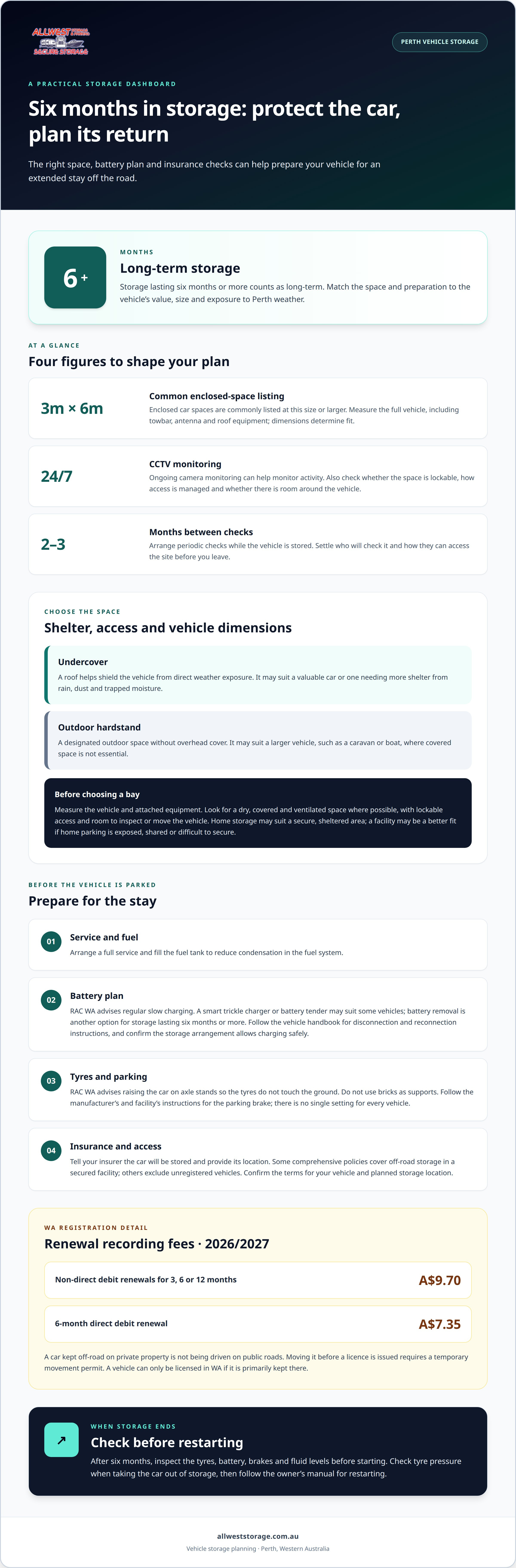
Storage lasting 6 months or more counts as long-term storage. For storing a vehicle for 6 months in Perth, match the space and preparation to the vehicle’s value, size and exposure to weather.
Choosing a secure storage space
A dry, covered and ventilated space helps limit exposure to rain, dust and trapped moisture. Lockable access and room around the vehicle make inspection and movement easier. Measure the car, including its towbar, antenna and roof equipment, before selecting a bay. Enclosed car spaces are commonly listed at 3m x 6m or larger, but the vehicle’s full dimensions determine fit. Outdoor parking is another option; price depends on space type, vehicle size and storage term, and is provided after a quote request.
Choosing home or professional storage
Home storage may suit a car if you have a secure, sheltered parking area with enough room to access it. A storage facility can be a better fit when home parking is exposed, shared or difficult to secure. Consider your vehicle’s value, its protection needs and how easily you need to access it. For boats, caravans and other vehicles, make sure the space and access arrangements suit their dimensions.
Before long-term storage, arrange a full service and fill the fuel tank to reduce condensation in the fuel system. RAC WA advises regular slow charging for the battery and raising the car on axle stands so its tyres don’t touch the ground. Don’t use bricks as supports. Tell your insurer the car will be in storage and provide its location. Some comprehensive policies cover off-road storage in a secured facility, while others exclude unregistered vehicles.
In WA, light vehicle licence renewal recording fees are A$9.70 for non-direct debit renewals of 3, 6 or 12 months, and A$7.35 for a 6-month direct debit renewal in 2026/2027. A car kept off-road on private property isn’t being driven on public roads; moving it before a licence is issued requires a temporary movement permit. A vehicle can only be licensed in WA if it is primarily kept there.
After 6 months, inspect the tyres, battery, brakes and fluid levels before starting the car. Check tyre pressure when taking it out of storage, then follow the owner’s manual for restarting. Arrange periodic checks every 2-3 months while it is stored.
What kinds of vehicle storage do you offer?
Vehicle storage usually means choosing between undercover space and outdoor hardstand parking. Undercover storage puts a roof over the vehicle, while hardstand storage provides a designated outdoor space. Choose based on the vehicle, its value, how much weather exposure you’re comfortable with and the protection it needs during storage.
Security matters for a car kept away from home. A facility with 24/7 CCTV monitoring provides ongoing camera monitoring across the storage site. CCTV can help monitor activity, but it isn’t a substitute for checking the full arrangement. Consider whether the vehicle’s space is lockable, how access is managed and whether there’s room to move around it without disturbing neighbouring vehicles. A garage-style space may suit a vehicle needing more weather protection; outdoor parking may suit a vehicle where covered space isn’t essential.
- Undercover: A roof helps shield a vehicle from direct weather exposure.
- Hardstand: An outdoor parking area provides a designated space without overhead cover.
- Vehicle-specific storage: Cars, boats, caravans, campervans, trucks and trailers have different footprints and access needs.
Registration and insurance are separate from facility security. A stored vehicle’s registration status can affect what you need to arrange before driving it again. Insurance terms also vary, including how a policy covers a vehicle kept off-road. Review your arrangements with the storage location and planned term in mind.
For a six-month stay, weigh protection against access and vehicle dimensions. An undercover space may better suit a valuable car or one that needs shelter from weather. A hardstand bay may fit a larger vehicle, such as a caravan or boat. Measure the vehicle and attached equipment so the space allows practical access. Explore vehicle storage options that match your vehicle type and preferred level of cover.
What to know about battery and parking brake preparation before storage
A vehicle parked for six months needs a battery plan and a secure parking arrangement. The right approach depends on the battery type, the vehicle maker’s instructions and whether anyone can access it during storage. If you’re going overseas, record the battery and parking-brake arrangements before leaving the keys with someone.
For longer storage, RAC WA advises arranging regular slow charging. A smart trickle charger or battery tender may suit some vehicles, while battery removal is another option to consider for storage lasting 6 months or more. The vehicle’s handbook can clarify battery disconnection and reconnection requirements, including whether settings or systems need attention afterwards. A professional should follow those instructions rather than assume every car uses the same procedure.
Settle battery access before the vehicle is parked. If you plan to charge it, make sure the storage arrangement allows the equipment to be used safely. If you remove the battery, decide who will store and refit it, and how the vehicle will be checked before collection. These details are especially useful if someone will collect it after a long absence.
Plan the parking brake for the specific vehicle. There is no single setting that suits every car, caravan or trailer in storage. Follow the manufacturer’s instructions and the facility’s parking procedure. Tell the storage provider about any known brake fault or unusual starting or movement procedure. The vehicle must be secured against unintended movement without improvised supports.
- Before storage: Note the vehicle model, battery requirements and parking-brake instructions.
- During storage: Arrange the agreed battery care and periodic checks.
- Before collection: Allow time to reconnect or charge the battery, then confirm the brakes operate normally before driving.
For a six-month stay, clear handover instructions help avoid surprises when you need the vehicle again.
Perth weather and vehicle protection
For a six-month stay in Perth, choose protection for the vehicle’s finish, interior and exposed components. An indoor space can reduce direct exposure to weather, while outdoor parking leaves the vehicle more exposed. A classic car may need a higher level of protection than a regularly used work vehicle. Balance that need against the storage term and the space available.
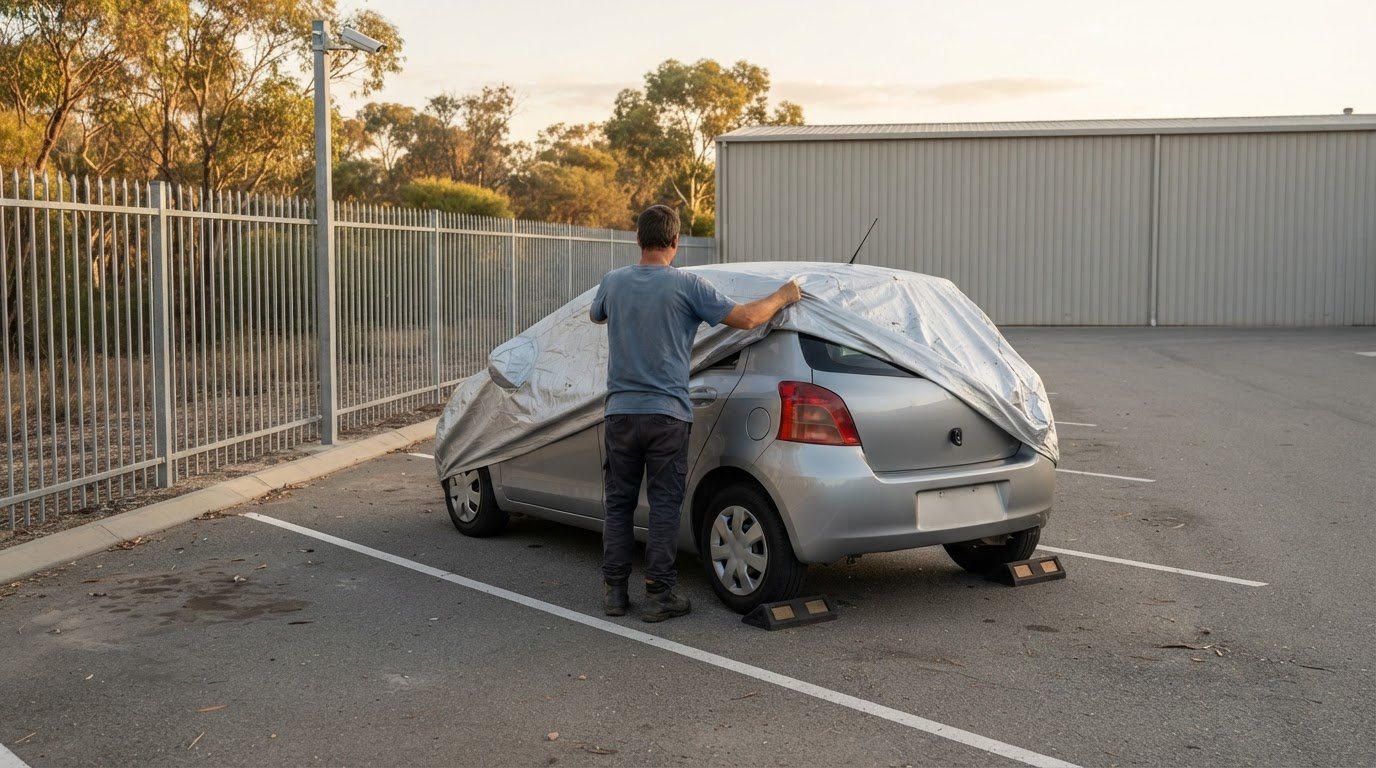
A breathable vehicle cover is preferable to plastic sheeting, which can trap moisture against the paint. Choose a cover designed for the vehicle rather than a loose sheet that could rub against the finish. Clean and dry the surface before covering it, so dirt isn’t held against the paint.
Consider how rain, dust and changing temperatures could affect the parking space. A roof blocks direct weather, but airflow still matters. RAC WA recommends a dry, covered and well-ventilated area for car storage. Leave enough room to inspect and move around the vehicle instead of squeezing it between walls or stored items.
Preparation also depends on the engine. For a petrol vehicle stored for more than 3 months, use fuel stabiliser as part of its storage preparation. A full tank can help minimise condensation in the fuel system. Follow the vehicle maker’s instructions for the correct product and procedure, particularly for a classic car with a different fuel or engine setup.
- Indoor space: Consider it for a vehicle needing greater shelter from direct weather.
- Outdoor space: Use a suitable breathable cover and keep access clear for inspection.
- Any storage unit: Prioritise ventilation and a parking position that allows movement around the car.
Affordable storage still needs to suit the vehicle. Choose the protection level according to its condition, value and exposure, not price alone. Plan a suitable vehicle storage space for the full term.
Allwest Storage & Parking
Allwest Storage & Parking provides vehicle storage for people leaving a vehicle in Perth for an extended period. Its hardstand and undercover options let you choose between outdoor parking and a covered space, with 24/7 CCTV monitoring across the facility.
Whether you need car storage or space for a caravan, boat, truck or trailer, choose an option that suits the vehicle’s size and protection needs. Allwest Storage & Parking offers short-term and long-term storage, flexible rates and no lock-in contracts. This can suit changing plans, such as an overseas trip with an uncertain return date.
To discuss a storage option for your vehicle, contact Allwest Storage & Parking.
Plan your vehicle’s return before it goes into storage
If you’re storing a vehicle for six months in Perth, plan how you’ll collect and use it again. A return date can change, so decide who may access the vehicle and what handover details they’ll need. Keep those details with your storage arrangements instead of relying on memory after months away.
If someone else may collect the vehicle, agree on who will hold the keys and what instructions they need. If you plan to drive it straight away, leave time to check it before setting off. That gives you a chance to address any issues before a long drive or a busy first day back.
Allwest Storage & Parking offers Car Storage, Caravan & Campervan Storage and Boat Storage in Perth, with hardstand and undercover options. Request a quote with your vehicle’s dimensions and expected storage period to find an arrangement that suits your plans.
For a straightforward next step, contact Allwest Storage & Parking to discuss your vehicle storage needs. A clear plan now can make returning to your vehicle simpler.
Frequently Asked Questions
Does your insurance cover a stored vehicle?
Some Australian comprehensive policies cover cars stored off-road in a secured facility, but cover depends on the policy. Unregistered vehicles may be excluded. Before storing your car for six months, read the policy wording for conditions about storage, location and registration. Check whether you need to notify your insurer of the storage address or any change in use.
Are wash down facilities or power available in vehicle storage bays?
Don’t plan your storage around washing or charging at the bay. Arrange any wash before drop-off, and make a battery-care plan that doesn’t depend on access to power. If your preferred preparation requires water or electricity on site, include that need when arranging the storage space. This avoids relying on facilities that may not form part of a vehicle parking arrangement.
How much does vehicle storage cost in Perth for 6 months?
The cost depends on the vehicle’s size, the storage space selected and the length of the stay. A six-month term can be priced differently for a compact car than for a larger vehicle needing more room. Allwest Storage & Parking provides rates after a quote request, so share the vehicle type, dimensions and expected storage period to receive relevant pricing.
What secure indoor and outdoor vehicle storage options are available in Perth?
Perth vehicle owners can choose between undercover storage and outdoor hardstand parking. Allwest Storage & Parking offers both options, with 24/7 CCTV monitoring across the facility. Undercover space provides a roof over the vehicle, while hardstand is an outdoor parking option. The right fit depends on your vehicle’s size, the shelter you want and how you plan to access it.
What should I prepare before placing a car in storage for 6 months?
Before drop-off, remove valuables and loose items, and organise the keys and vehicle documents. Photograph the car’s condition, including existing marks, and record the fuel level and odometer reading. Share access and collection instructions with the person responsible for the vehicle. These records make handover clearer, especially if someone else will collect the car.
What battery care should I arrange while my car is in long-term storage?
Plan battery care for the full storage period, not just collection day. For a six-month stay, discuss slow charging or a suitable battery tender with the person responsible for the car, and follow the manufacturer’s instructions. If the battery is disconnected or removed, record how to reconnect it. Arrange a battery check before anyone attempts to start the vehicle.
Leave A Comment