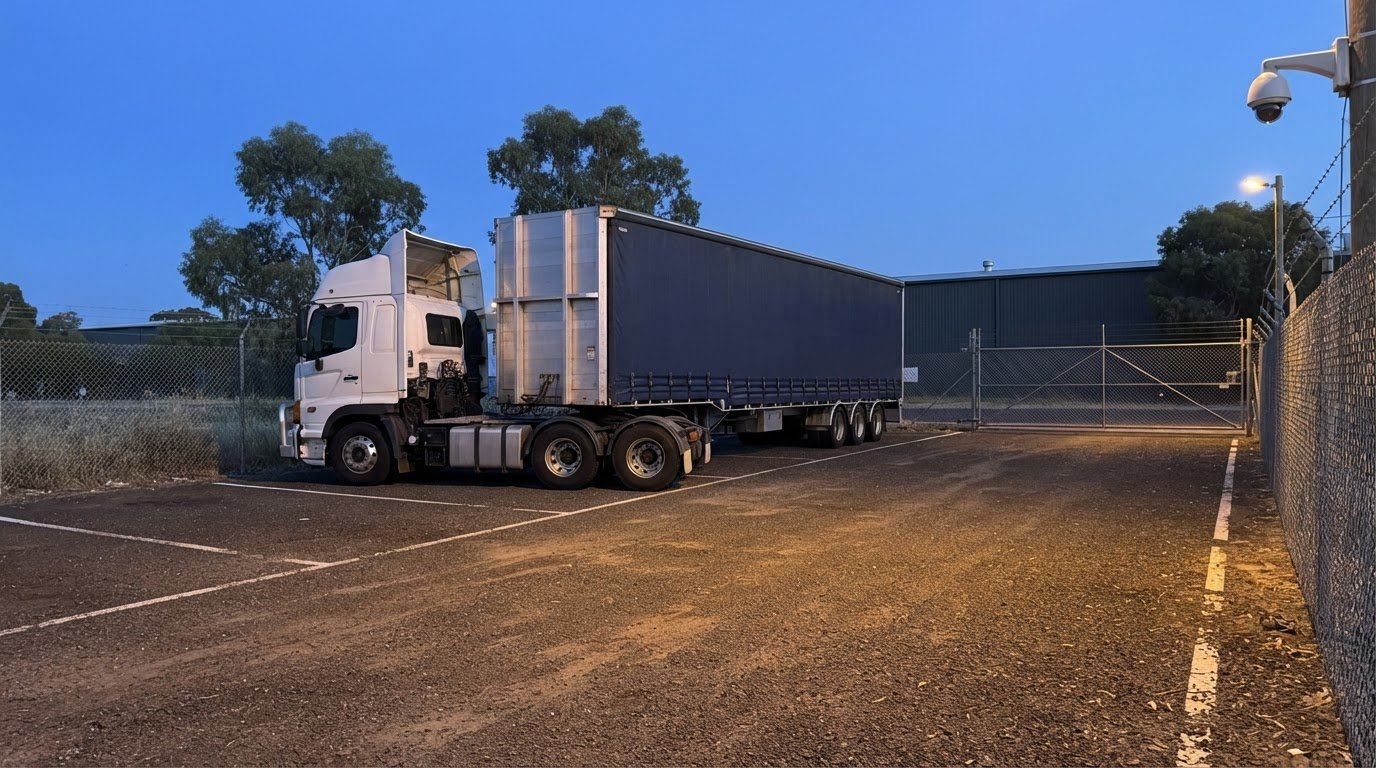
A legal parking spot isn’t automatically a permitted overnight stay. To find a safe place to park my truck overnight in Perth, use a site where overnight stays are allowed and follow its signs and time limits. Local rules can vary, so a spot that works in one area may not be suitable in another.
Finding a safe place to park your truck overnight in Perth means looking beyond whether you can stop there. Check the site’s access arrangements and security measures, as well as whether overnight parking is permitted. This guide explains what to consider before choosing a space.
We’ll cover local parking rules, where overnight stays may be permitted, and how to assess truck access and security. You’ll also see when dedicated truck storage may be more practical than leaving your vehicle in a public area.
Key Takeaways
- Read parking signs and local council rules carefully; no sign does not automatically mean an overnight stay is allowed.
- Choose a rest area that clearly permits overnight stays, and follow its posted time limit.
- Assess site access arrangements and security measures to see whether they suit your truck and overnight plans.
- Compare public overnight parking with a dedicated truck storage option when you need a more suitable place to leave your vehicle.
1. Checking signs and local rules
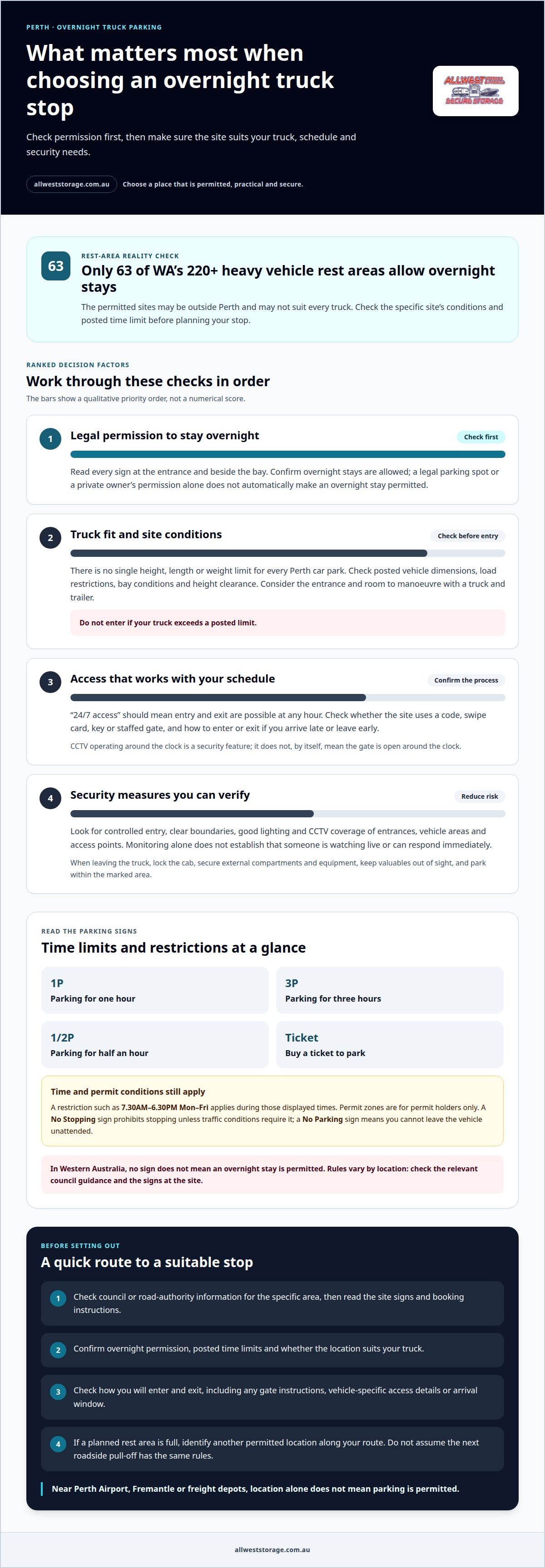
Start by reading every sign at the entrance and beside the parking bay. In Australia, a 1P sign allows parking for one hour, while 3P allows three hours. A 1/2P sign allows half an hour. A time restriction such as 7.30AM-6.30PM Mon-Fri applies during those displayed times. A sign marked Ticket means you must buy a ticket; permit zones are for permit holders only.
Check whether signs allow overnight parking, not just daytime stopping. A No Stopping sign prohibits stopping unless traffic conditions require it. A No Parking sign means you cannot leave the vehicle unattended. In Western Australia, no sign does not mean overnight camping is permitted. Rules vary by location, so check the relevant council’s current guidance and the signs at the site.
If Perth truck stops are full, look for a designated rest area that clearly permits overnight stays. Across Western Australia, 63 rest areas allow overnight stays, but they may be outside Perth and may not suit every truck. Follow the posted time limit and leave when it expires. A private owner’s permission alone does not automatically make an overnight stay legal.
There is no single height, length or weight limit for every Perth car park. Check signs for vehicle dimensions, load restrictions and bay conditions. Do not enter if your truck exceeds a posted limit.
To find overnight parking, check council or road-authority information for the specific area, then read the site signs and booking instructions. Use the stated booking channel if reservations are required or offered. Near Perth Airport, Fremantle or freight depots, location alone does not mean parking is permitted. Confirm the site allows overnight stays and suits your truck.
2. 24/7 Site access
“24/7 access” should mean you can enter and leave at any hour, not simply park overnight. Confirm what the term covers before planning a late arrival or early departure. CCTV operating around the clock is a security measure; it does not, by itself, mean the gate is open around the clock. Treat access and monitoring as separate features.
Check the site’s entry process against your arrival time. Find out whether access uses a code, swipe card, key or staffed gate, and how authorised drivers receive entry details. If your run ends after midnight, for example, make sure the entry method works at that time. Also check how you can exit, so an early departure does not depend on finding staff.
Read the access instructions before setting out. Note the entrance address, gate location, lane direction and any posted height clearance. If your truck and trailer need to turn inside, consider the entry route and manoeuvring space. A narrow entrance or locked secondary gate can delay access even when the site is open.
Plan for a failed code or access card. Find the process for reporting an entry problem and keep the instructions in the cab. Do not assume a phone number means someone is on site or can open a gate at any hour. Follow the stated procedure, and avoid blocking a road or neighbouring entrance while resolving the issue.
Before choosing a facility, make sure its access arrangements suit your schedule. Check whether visiting drivers can enter, whether access details are vehicle-specific and whether an arrival window applies. Note your permitted parking area and any exit requirements. These details matter if a delivery time changes or you need to leave before dawn.
3. Security measures and monitored access
An unattended truck can be exposed to theft, tampering or accidental damage. Reduce the risk by choosing a designated parking area with controlled entry, clear boundaries and good lighting. Before leaving, lock the cab, secure external compartments and keep valuables out of sight. These steps do not replace choosing a suitable site.
Check what security features are actually operating at the facility. For example, 24/7 CCTV monitoring can help record activity across the site. Camera coverage is most useful when entrances, vehicle areas and access points are visible. Monitoring alone doesn’t establish that someone is watching live or can respond immediately, so understand what the stated arrangements mean.
Look for a clear process for controlling entry. A gate, access code or authorised-entry procedure can limit casual access, while designated parking areas help keep trucks organised. Check how visitors and delivery drivers are admitted, and whether access credentials are individual or shared. Shared codes can make it harder to identify who entered, so follow the facility’s instructions carefully.
If access conditions allow, walk around the parking area before leaving your truck. Check lighting, blind corners, nearby activity and any obstructions. Park within the marked area, away from entrances and traffic paths. Secure trailers and equipment with suitable locks, and note the vehicle’s condition on arrival. A quick photo can record its position and visible condition.
For an overnight stay in Perth, consider security alongside legal permission and practical access. A public roadside stop may not have the same monitoring or entry controls as a managed parking site. Choose a location with clearly described security measures, then use them consistently: lock the truck, secure equipment and keep access instructions handy.
4. Where can I legally park a truck overnight in Perth, Western Australia?
Finding a safe place to park my truck overnight in Perth starts with choosing a location that clearly allows overnight stays. Western Australia has more than 220 heavy vehicle rest areas, but only 63 allow overnight stays. Their conditions vary: some are for short breaks, while others permit 24-hour stays or are designed for touring vehicles. Check the rules for the specific site before planning your stop.
A highway rest area is not automatically suitable for an overnight stay. Use one only where overnight parking is clearly permitted, and follow its posted time limit. If a planned stop is full, do not assume the next roadside pull-off has the same rules. Identify another permitted location along your route before continuing.
In and around Perth, local councils may manage town and foreshore parking. Restrictions can apply to beachside car parks, boat ramps, marinas, public reserves, lookouts, residential streets and town centres. Permission from a private property owner does not automatically make an overnight stay legal. Confirm the specific site permits your stay and suits a heavy vehicle.
In Western Australia, camping in national parks and reserves is allowed only in designated campgrounds. These may not suit every truck, so consider vehicle access and campground conditions. Bookings may be required, particularly during peak travel periods. A safe place to park your truck overnight in Perth must suit both the vehicle and your planned stay.
If public stopping places don’t fit your routine, consider a dedicated parking arrangement instead. The choice depends on permitted use, vehicle access and how long you need to leave the truck. For a dedicated place to leave a truck, explore overnight truck storage options.
Western Australia has more than 1,600 parking bays and rest areas, but their availability alone does not establish permission for an overnight stay. Main Roads WA manages a large number of 24-hour rest stops around Western Australia. Check whether a particular stop clearly allows overnight stays, and observe its time limit.
Local councils commonly manage town, beach and foreshore areas and may restrict overnight camping. Restrictions can cover foreshore and beachside car parks, boat ramps and marinas, public reserves and lookouts, residential streets and town centres. Check the local rules before stopping.
Allwest Storage & Parking: Truck & Trailer Storage
Allwest Storage & Parking offers Truck & Trailer Storage for drivers needing a dedicated place to leave a truck between runs or outside working hours. Choose hardstand or undercover storage, with 24/7 CCTV monitoring. Short-term and long-term storage are available, with flexible rates and no lock-in contracts.
A storage site can be a practical alternative to public parking when you need to leave a truck in one place. Unlike roadside rest areas, dedicated storage is not a temporary stop subject to posted overnight permissions and time limits. Choose an option that suits your vehicle and parking needs.
Contact Allwest Storage & Parking to discuss Truck & Trailer Storage.
Plan your next parking move
Plan overnight parking as part of your route, rather than deciding after a long shift. If you need to leave your truck between jobs or while it is off the road, dedicated storage can be a practical alternative to searching each night for a permitted public stop. Choose a space that suits your vehicle and routine.
Allwest Storage & Parking also offers Caravan & Campervan Storage, Boat Storage and Car Storage. For drivers looking for a safe place to park their truck overnight in Perth, Truck & Trailer Storage provides a dedicated option for the vehicle.
Take the next step by discussing your truck storage needs with Contact Allwest Storage & Parking. A clear parking plan can make your next run easier to organise.
Frequently Asked Questions
Do you have any space available?
Request a quote from Allwest Storage & Parking for a suitable truck space. Include whether you need storage for a truck alone or with a trailer, your preferred storage period, and whether you want hardstand or undercover storage. These details help match your enquiry to your vehicle and parking requirements.
How much to park my truck?
The cost depends on your vehicle’s size and how long you need storage. Request a quote from Allwest Storage & Parking with those details, including whether you need space for a trailer. You can also outline whether you’re considering short-term or long-term storage, so the quote can reflect your intended arrangement. No price is quoted here.
Need Parking Information?
For Allwest Storage & Parking information, explain whether you need a truck space and what storage arrangement you’re considering. A useful distinction: 24/7 CCTV monitoring describes security monitoring, not round-the-clock physical access. For a public street or rest area, parking permission depends on the specific site’s signs and local rules. Keep those details separate when planning your overnight stop.
Leave A Comment