
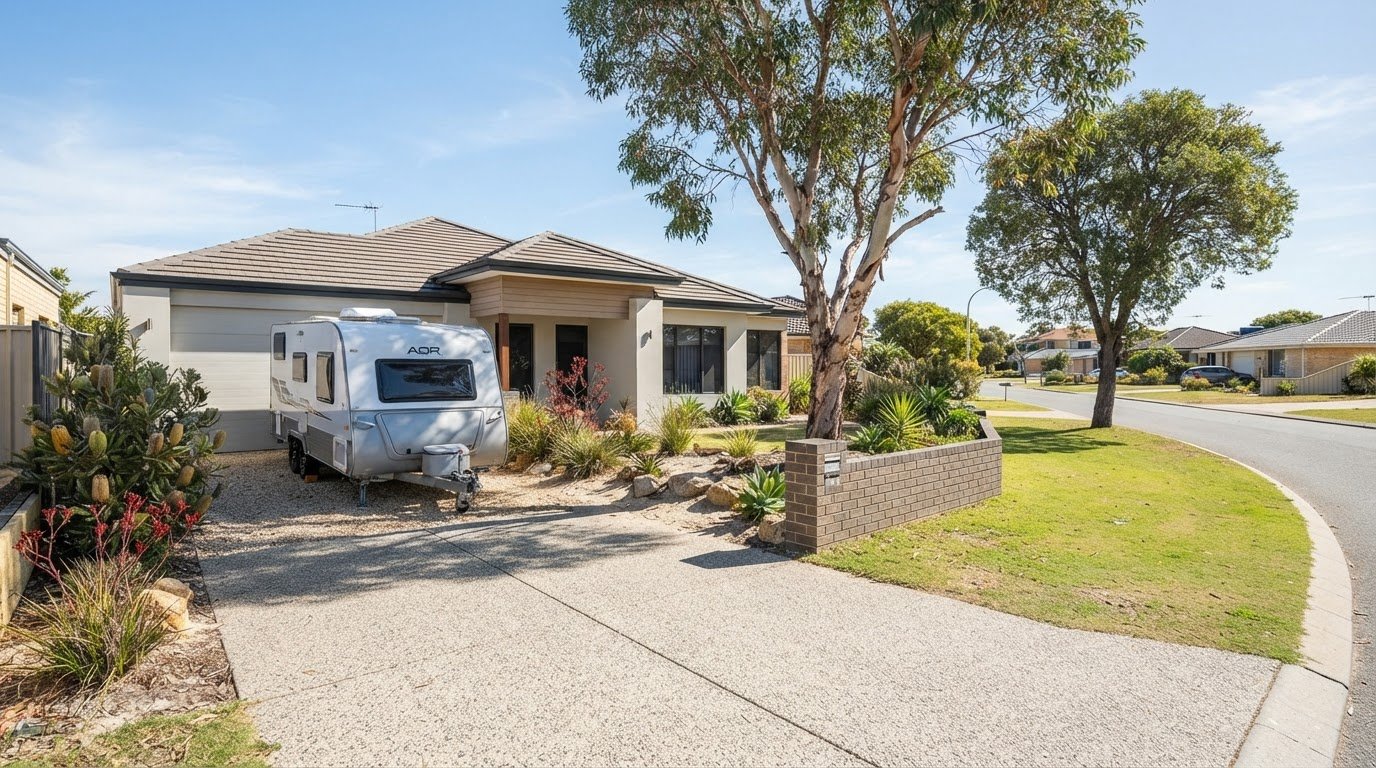
Can you leave a caravan at home in Perth without breaching local rules? Searching for “council rules caravan parking at home perth” quickly reveals the key issue: the answer depends on your local government area and where the caravan is parked.
A driveway, private yard, verge and street may be treated differently. Parking a caravan is also different from using it for overnight stays or as temporary accommodation, which can involve separate requirements.
This guide explains how to identify your local council and find its current requirements. It also covers what to check before parking at home, including the caravan’s location, whether it is attached to a vehicle and how long it will stay there. If home parking isn’t practical, Allwest Storage & Parking offers Perth caravan storage, with open-air hardstand and undercover options for short- or long-term arrangements.
Key Takeaways
- Identify the local government area for your address, then check its current official requirements.
- Check the specific parking location: driveway, private yard, verge or public street.
- Look for requirements about how the caravan is parked, including whether it is attached to a vehicle and how long it can remain there.
- Check WA Government guidance separately if anyone will sleep in the caravan or use it as temporary accommodation.
- If home parking is impractical, compare it with off-site caravan storage.
Can you park a caravan at home in Perth? Start with the location
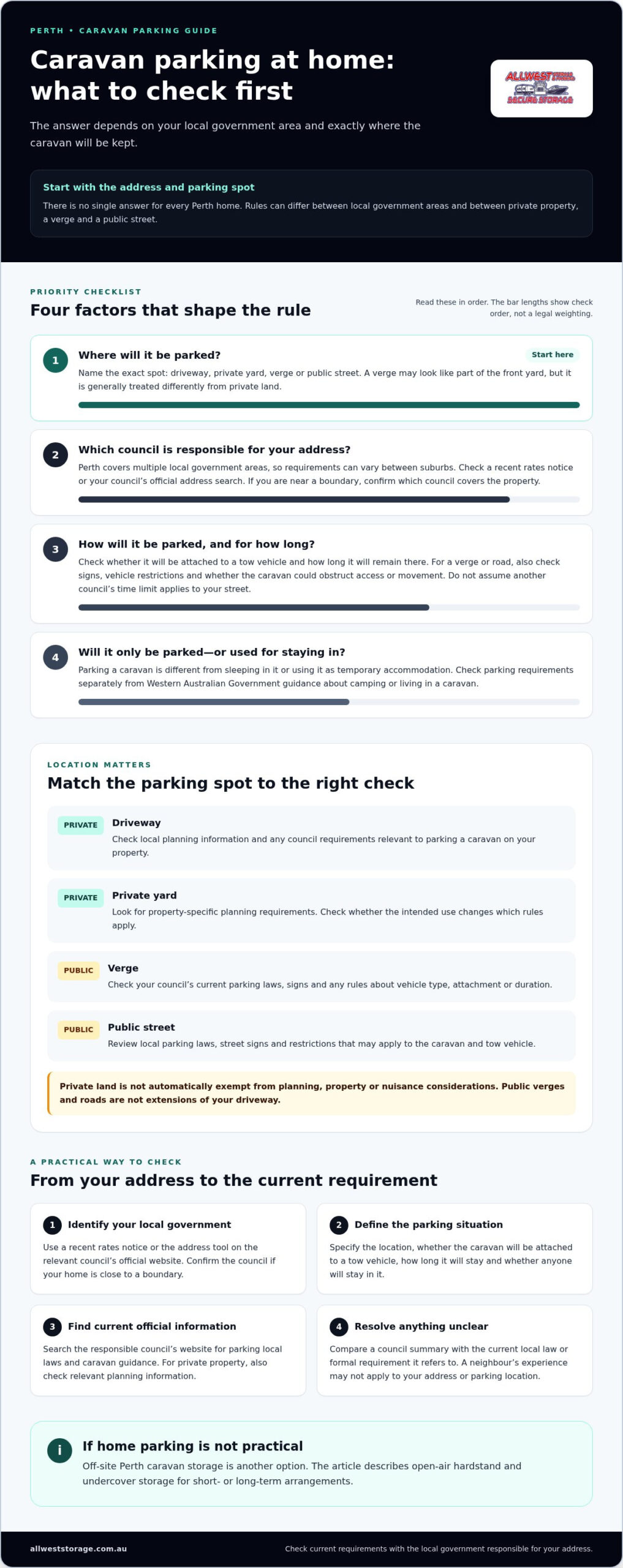
There isn’t one answer for every Perth home. Requirements depend on where the caravan is parked and which local council is responsible for the address. Perth covers multiple local government areas, so rules can differ between suburbs.
Start by identifying the space you plan to use. Private property is land within your property boundary, such as a driveway or backyard. A public road is used by traffic. A verge is the strip between the road and the property boundary, often with a footpath, grass or street trees. Although it may look like part of your front yard, a verge is generally treated differently from private land.
A caravan is designed to be towed by a vehicle. For the rules that apply at home, its location and use are more important than the general definition.
Why the driveway, verge and street can have different rules
Parking on a street or verge involves public space, so local parking rules may apply. Parking within your property raises different questions. A driveway or backyard isn’t automatically exempt from requirements, and the details may depend on the property and the relevant council’s rules. Don’t assume a rule or time limit you’ve heard about applies across Perth or to every parking location.
Parking and staying in the caravan are separate questions. Leaving it at home is not the same as using it for overnight stays or temporary accommodation. Check the guidance for both its parking location and its intended use.
Which council area is your Perth home in?
Check your local government area on a recent rates notice or use the address search tool on the relevant local government’s official website. If your property is close to a council boundary, confirm which council is responsible for it before relying on a rule. Then look for current official information about the specific place you plan to park: private property, verge or road.
Your street address matters more than the word “Perth” because it identifies which local government’s requirements to check. Once you know the responsible council and parking location, you can narrow down the relevant rules.
Perth caravan parking rules depend on where the van is kept
Match the caravan’s location to the relevant rule. A driveway or backyard is private property; a verge and public street are public spaces. The council rules caravan parking at home Perth residents need to check can vary by location and local government area, so don’t assume one answer covers all four.
| Location | What to look up |
|---|---|
| Driveway | Check local planning information and any council requirements relevant to parking a caravan on your property. |
| Private yard | Look for property-specific planning requirements and consider whether the intended use changes what rules apply. |
| Verge | Check your council’s current parking laws, signs and any rules for vehicle type, attachment or duration. |
| Public street | Review local parking laws, street signs and restrictions that may apply to the caravan and tow vehicle. |
Parking on a driveway or within a private yard
Private land doesn’t automatically remove planning, property or nuisance considerations. The right check depends on the address, the part of the property being used and whether the caravan will simply be parked or used for another purpose. Look up your council’s current local planning information for the property and intended use. Don’t assume approval is always needed, or that it’s never needed.
Parking on a verge or public street
A verge or road isn’t an extension of your driveway. These are public spaces, where council parking laws, signs and vehicle restrictions may apply. Check the rules for your council and location. Where relevant, note the caravan’s dimensions, whether it’s attached to a tow vehicle, how long it will remain there and whether it obstructs access or movement. Don’t apply a time limit from another council to your street.
Keep parking rules separate from accommodation requirements. Western Australian Government guidance covers camping or living in a caravan, not every situation where one is stored at home. Use that guidance for questions about its use, and check current local-government information for parking. If home parking isn’t practical, Perth caravan storage offers an alternative to leaving your caravan on the street or verge.
How to check the caravan parking rule for your Perth address
Use your address and the exact parking location to find the rule that applies. A neighbour’s experience may be a useful starting point, but it may not apply across a council boundary or to a different part of your property.
- Identify your local government. Check your rates notice or use the address tool on the relevant council’s official website. If your home is near a boundary, confirm which council is responsible for your address.
- Define where the caravan will be kept. Specify whether it will be on a driveway, rear yard, verge or public street. Note whether it will be attached to a tow vehicle, how long you plan to leave it there and whether anyone will stay in it.
- Find the current official requirements. Search the responsible council’s website for parking local laws, caravan guidance and, for private property, relevant planning information. Search terms such as “council rules caravan parking at home perth” can help you find useful pages, but rely on official material to check the answer.
- Resolve anything unclear before relying on it. Compare the council’s summary with the current local law or other formal requirement it refers to. If the wording doesn’t settle your situation, ask the council about your exact address, location and intended use.
Find and read the relevant local law or council guidance
Read beyond a search result or short web summary. Check when the information was published or updated, how it defines terms such as “vehicle”, “caravan” and “parking”, and whether it covers a verge, road or private property. Look for conditions, exemptions and any approval process mentioned. A council webpage may explain a rule without including every detail in the underlying local law, so follow the linked source before drawing a conclusion.
Scope matters. A rule about parking a vehicle on a public road may not answer whether a caravan can sit in a rear yard. Similarly, guidance about using a caravan for accommodation may not settle a parking question. Don’t assume one provision answers both.
What to clarify with the council
If the written material doesn’t clearly cover your situation, describe it precisely. Ask about the specific location, such as a verge rather than a driveway, and provide relevant details about the caravan, whether it is attached to a tow vehicle and the planned parking period. State separately whether anyone intends to sleep in it or use it as accommodation.
Keep a note of the response, including when and how you received it. If guidance is given verbally, compare it with the current written requirements before acting. This helps distinguish general advice from the rule that applies to your address.
Parking a caravan is not the same as camping or living in it
A caravan can be stored at home without being used as accommodation, and those situations can raise different questions. Leaving it in a driveway or yard is a parking matter. Sleeping in it, using it as a temporary dwelling or camping on the property may bring Western Australian camping and accommodation requirements into play.
This distinction matters when working out the council rules caravan parking at home Perth residents need to understand. Don’t treat a rule about where a caravan may be parked as permission to stay in it. Equally, guidance about temporary accommodation doesn’t by itself settle whether the caravan can be parked in a particular place.
When a parked caravan becomes an accommodation question
Consider the intended use, how long it will be used for and the circumstances. A caravan kept at home between trips is different from one used for overnight stays or as someone’s temporary dwelling. The relevant requirements may therefore differ, even at the same address.
The Western Australian Government’s guidance on temporary accommodation and camping outside caravan parks explains the camping and accommodation framework. Use it for questions about staying in a caravan, alongside your local council’s current requirements for the property. Check the latest wording directly, as guidance and applicable rules may be updated.
What exemptions and approvals do, and don’t, tell you
The WA guidance describes approval requirements for camping outside a licensed caravan park. It states that approval for a stay of up to three nights is needed from the property owner. For a stay of up to three months, approval is required from the property owner and local government. A stay between three and 12 months requires approval from the property owner, local government and the Minister for Local Government.
These conditions relate to camping outside a licensed caravan park. They aren’t a general parking timetable, and they don’t automatically establish whether a caravan can be left on a verge, street, driveway or in a yard. Check the official publication for relevant exemptions and exact conditions, then confirm how they apply to your circumstances with the responsible council.
Permission to park a caravan doesn’t automatically mean permission to occupy it or camp in it. Check each question separately, especially if someone plans to stay overnight or use the caravan as a temporary dwelling.
If you need a place to keep your caravan when it’s not in use, explore Perth caravan storage options, including hardstand and undercover storage.
If home parking will not work, consider a practical Perth storage alternative
If your caravan won’t fit on your property, or council requirements make home parking impractical, off-site storage is another option. First check the rule for the intended location and assess whether your property can accommodate the caravan. Then choose a suitable parking arrangement. Storage doesn’t replace checking council requirements if you’re considering leaving a caravan on a verge or public street.
When off-site caravan storage may suit your situation
A narrow driveway, shared household parking or limited rear-yard space can make keeping a caravan at home inconvenient. Off-site storage may also suit owners who take occasional trips and don’t need the caravan parked at home between outings.
Allwest Storage & Parking provides caravan and campervan storage in Perth, with open-air hardstand and undercover options. Hardstand storage is open-air, while an undercover bay provides shelter overhead. The facility has 24/7 CCTV monitoring. Consider which setting better suits your needs, and remember that storage doesn’t remove the need to follow relevant rules when moving or parking the caravan elsewhere.
For more detail on keeping a caravan off-site, read the guide to secure caravan storage in Perth.
Choose a next step that fits your parking needs
Keep a written record of the council guidance that applies to your address and intended parking location, including any conditions about where the caravan can be kept. Then consider how often you use it, how long you expect to store it and whether open-air hardstand or undercover storage better fits your plans.
Allwest Storage & Parking offers flexible short- and long-term caravan storage options, with no lock-in contracts. If you’re weighing up how long to store your vehicle, compare long-term versus short-term vehicle storage in Perth. A clear plan can keep the caravan off-site while leaving your driveway and household parking available for everyday use.
Make a clear plan for your caravan
Start with your address and where you intend to keep the caravan. Check your local council’s current requirements for that specific location, whether it’s a driveway, private yard, verge or street. If anyone will stay in the caravan, check accommodation guidance separately. Parking and living in it are different questions.
This address-first approach makes the council rules caravan parking at home Perth owners need to follow easier to identify. If your property can’t comfortably accommodate the caravan, or home parking doesn’t suit your circumstances, off-site storage is a practical alternative.
Allwest Storage & Parking provides caravan and campervan storage in Perth, with hardstand and undercover options, 24/7 CCTV monitoring, flexible short- and long-term arrangements, and no lock-in contracts. Explore caravan storage options in Perth and choose an arrangement that fits your plans.
With the right council information and a suitable place to keep your caravan, you can make your next decision with confidence.
Frequently Asked Questions
Can I park a caravan in my driveway in Perth?
Possibly, but don’t assume every driveway has the same requirements. A driveway is private property, so check your local council’s current planning information and any requirements relevant to your property and intended use. Storing a caravan is a separate question from using it for overnight stays or accommodation. If the written guidance doesn’t clearly cover your situation, ask the council about your address and keep a record of its response.
Can I park my caravan on the verge outside my Perth home?
Check with your local council before leaving a caravan on a verge. A verge is public space, where parking laws, signs or restrictions on vehicle type, attachment and duration may apply. Requirements differ between Perth councils, so don’t rely on a neighbour’s experience or a rule from another suburb. Look up your council’s current official requirements for that verge and clarify anything unclear before parking there.
Do Perth councils have one rule for caravan parking?
Don’t assume one local rule applies across Perth. The relevant council depends on your address, and requirements may also depend on whether the caravan is on private property, a verge or a public street. The phrase “council rules caravan parking at home perth” is a useful starting point for research, but confirm the answer in your council’s current official material. A neighbour’s council requirements may not apply across a boundary.
Can someone sleep in a caravan parked at home in Western Australia?
Sleeping in a caravan can raise accommodation or camping requirements separate from parking. Western Australian Government guidance states that camping outside a licensed caravan park may require approvals, with requirements depending on the length of the stay. For up to three nights, the property owner’s approval is needed; longer stays involve additional approvals. Check the current government guidance and ask your local council how it applies to your circumstances before anyone stays in the caravan.
How do I find out which council rules apply to my caravan?
Identify the local government responsible for your address using your rates notice or the council’s official address search. Then specify where the caravan will be kept, such as a driveway, rear yard, verge or street. Search the council website for current parking local laws and relevant planning guidance. Check definitions, dates, location scope and conditions. If the rule is unclear, ask the council about your situation and keep its written response.
Can I keep an unregistered caravan on my property in Perth?
Don’t assume registration status alone settles whether or where you can keep a caravan. Requirements may depend on the location, local council rules and whether the caravan will be used as accommodation. Check the current official requirements for your property and ask your council how they apply to an unregistered caravan. If you’re unsure about registration obligations, verify those separately through the relevant Western Australian Government vehicle licensing information.
What can I do if there is no room to park my caravan at home?
Off-site storage is a practical alternative if your driveway or yard can’t accommodate your caravan. Allwest Storage & Parking provides Perth caravan and campervan storage, with open-air hardstand and undercover options, 24/7 CCTV monitoring, short- and long-term arrangements, and no lock-in contracts. Storage doesn’t replace checking council requirements for any verge or street parking. Keep a record of the applicable guidance, then choose an arrangement that suits how often you use your caravan.
Leave A Comment