
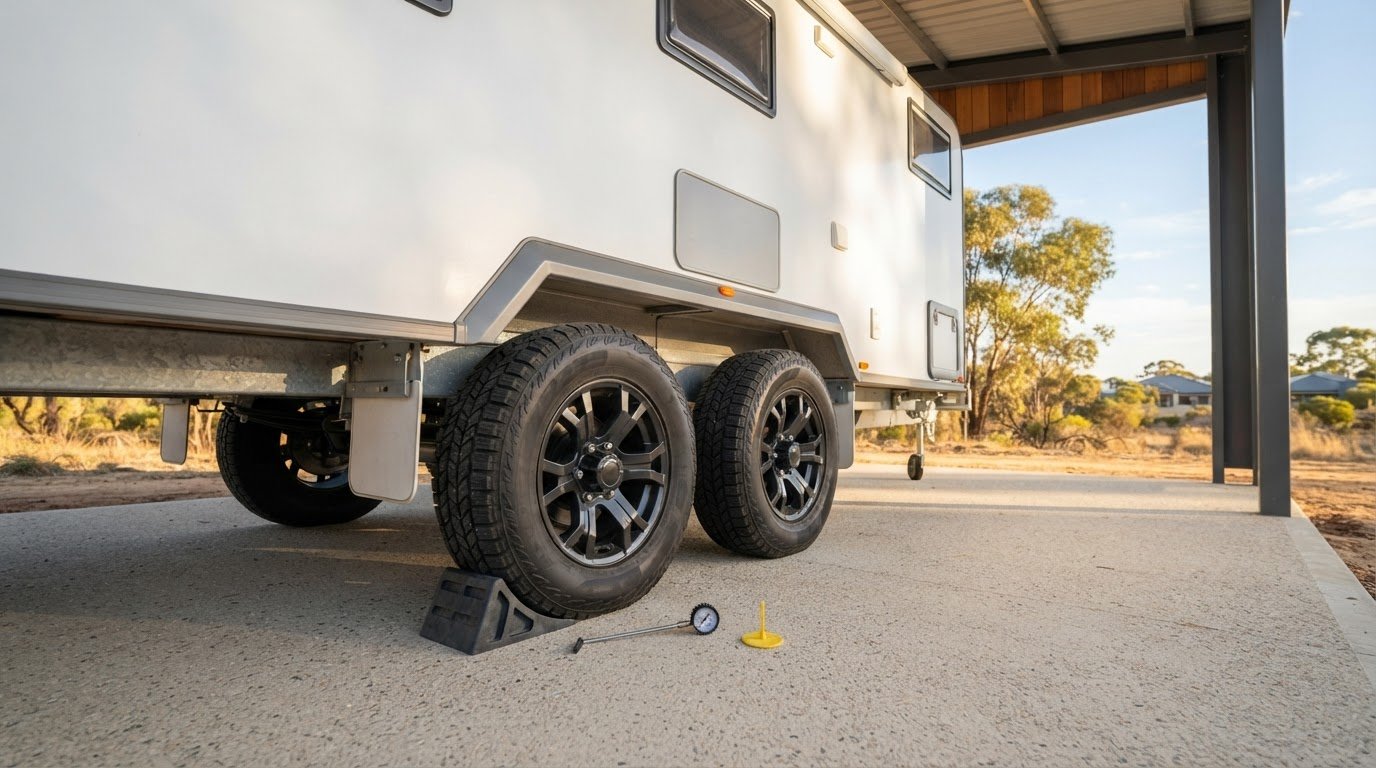
A covered bay won’t prevent flat spots if a caravan’s weight stays on the same part of each tyre for months. To reduce the risk, manage tyre load as well as choosing a suitable storage space. If you’re wondering how to prevent tyre flat spots during caravan storage, start with the guidance for your specific caravan and tyres rather than relying on one-size-fits-all pressure advice.
It’s understandable to be unsure how long-term parking affects tyres, whether to adjust pressure, or whether the caravan should be moved periodically. Flat spotting can depend on load, temperature, storage duration and under-inflation. The right approach varies, so check the caravan and tyre manufacturers’ current recommendations before making changes.
This guide explains why flat spots develop and how to reduce the risk while your caravan is parked. You’ll learn which pressure guidance to follow, what to check before towing, and when visible damage or persistent vibration calls for advice from a tyre professional. A storage space can support your preparation, but it can’t replace tyre care.
Key Takeaways
- Understand which storage conditions can increase the chance of a flat spot and why tyre condition matters.
- Use your caravan handbook and tyre manufacturer’s cold-pressure guidance to prepare tyres before parking.
- Choose covers, undercover storage or repositioning for their specific benefits, but don’t rely on them to remove tyre load.
- Before towing, check pressure, tyre condition and the wheel area. Seek tyre-professional advice if anything looks damaged or unusual.
- To prevent tyre flat spots caravan storage needs a tyre-care plan as well as a suitable space. Perth hardstand and undercover options can support storage, but don’t replace tyre preparation.
What causes flat spots on caravan tyres during storage?
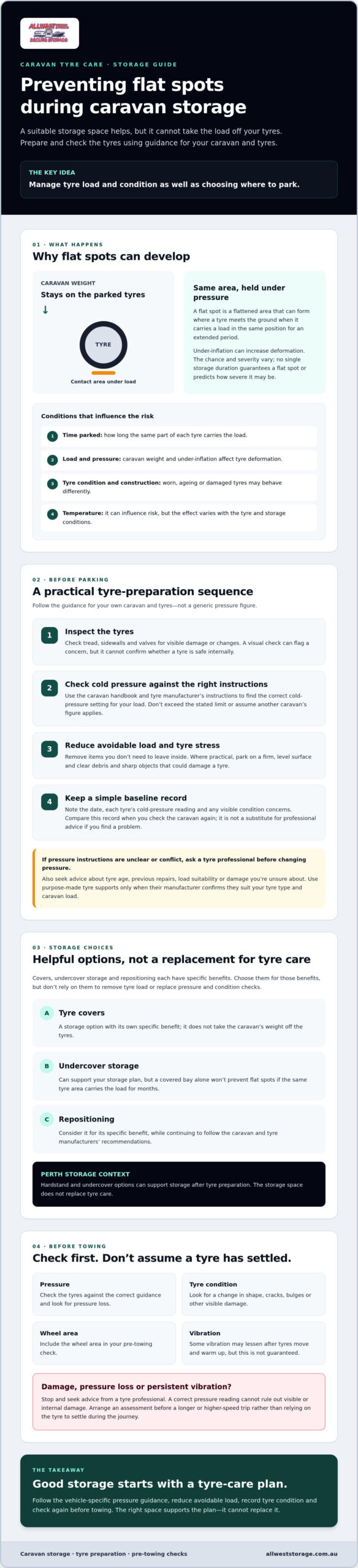
A tyre flat spot is a flattened area that can develop when a tyre carries a load in the same position for an extended period. The stationary weight can deform the tyre where it meets the ground. The risk depends on how long the caravan is parked, its load, tyre pressure and condition, and temperature. No single storage period guarantees that a flat spot will form or indicates how severe it may be.
For a concise overview of the mechanism, see What causes flat spots. Understanding the cause helps explain why choosing a storage site alone won’t prevent tyre flat spots during caravan storage. Tyre load and condition still matter.
How a parked caravan places load on its tyres
When a caravan is stationary, its weight rests on the small area where each tyre contacts the ground. The longer that same part supports the load, the longer it remains under pressure. Under-inflation can increase deformation, while the caravan’s load, tyre construction and existing condition also affect how a tyre behaves. Temperature can influence the risk, but the effect varies with the tyre and storage conditions.
A tyre in good condition may respond differently from one that is worn, ageing or already damaged. Don’t assume all tyres will develop flat spots at the same rate, or that a particular storage duration is safe for every caravan.
Temporary flat spotting or a tyre that needs inspection?
Some vibration after a caravan has been parked may lessen once the tyres have moved and warmed up. That isn’t guaranteed, and vibration shouldn’t be dismissed if it continues. A correct pressure reading is useful, but it can’t rule out visible or internal damage.
Before towing, check for changes in the tyre’s shape, cracks, bulges or other visible damage, and look for pressure loss. Stop and seek advice from a tyre professional if you notice any of these signs or if vibration persists. Arrange an assessment before a longer or higher-speed trip, rather than relying on the tyre to settle during the journey.
How to prepare caravan tyres before storage
A short preparation routine helps you spot concerns before the caravan is parked and gives you a useful record to check later. Work through the steps in order: inspect, check pressure, confirm loading, then plan where and how to store the van. To prevent tyre flat spots caravan storage preparation should follow the guidance for your caravan and tyres, not a generic pressure figure.
Check pressure and condition using the right guidance
Check pressure when the tyres are cold. Use the caravan handbook and tyre manufacturer’s instructions to find the correct cold-pressure setting for your load. Don’t assume a figure that suits another caravan will suit yours, and don’t exceed the stated limit. If the instructions are unclear or conflict, ask a tyre professional before changing pressure.
Inspect the tread, sidewalls and valves for visible damage or changes. A visual check can flag a concern, but it can’t confirm whether a tyre is safe internally. Ask a tyre professional about tyre age, previous repairs, load suitability or any damage you’re unsure about. A vehicle-specific bulletin hosted by NHTSA also offers storage guidance; treat it as a reference, not a replacement for your caravan and tyre manufacturers’ instructions.
Reduce avoidable tyre stress before parking
Before storing the caravan, remove items you don’t need to leave inside. Extra weight adds to the load the tyres carry while stationary. Then choose a firm, level parking surface where practical, and clear away debris and sharp objects that could damage a tyre.
Purpose-made tyre supports may be an option, but check with their manufacturer that they’re suitable for your tyre type and caravan load. Don’t improvise with supports or assume they remove the need to follow pressure guidance.
Keep a simple record before you park: note the date, each tyre’s cold-pressure reading and any visible condition concerns. This gives you a baseline for comparison when you check the caravan again. If a reading is outside the specified range, or you’ve found damage, get advice rather than relying on the record alone.
Once tyre preparation is complete, choosing a storage site is a separate part of the plan. If you’re storing a prepared caravan in Perth, Perth caravan storage is available in hardstand and undercover options. The space supports your storage plan, but it doesn’t replace tyre care.
Do tyre covers, undercover storage, or repositioning prevent flat spots?
These measures serve different purposes. Covers and undercover storage can help limit exposure, while repositioning may change which part of a tyre carries the load. None automatically removes the caravan’s weight from its tyres. To prevent tyre flat spots caravan storage requires attention to tyre load and the manufacturers’ instructions, not just the storage environment.
Tyre covers and undercover storage: what they can and cannot do
A tyre cover can shield a tyre from direct exposure, but it doesn’t relieve pressure at the loaded contact area. Check that a cover is suitable for your tyres and follow its maker’s instructions. An undercover bay provides shelter from some weather exposure, but it isn’t a flat-spot guarantee. Perth conditions can vary, so don’t assume a cover or a roof removes the need for tyre checks.
| Measure | Potential benefit | Limitation | What to verify |
|---|---|---|---|
| Tyre covers | Shield tyres from some exposure. | Don’t take the caravan’s weight off the tyres. | Suitability and use instructions from the cover and tyre manufacturers. |
| Undercover storage | Provides shelter from some weather exposure. | Doesn’t remove the load at the tyre contact area. | Whether the space suits your storage needs and the caravan’s requirements. |
| Repositioning | Can change the part of each tyre in contact with the ground. | May be impractical or unsafe, and doesn’t guarantee flat spots won’t form. | Whether moving the caravan is safe and permitted at the storage location. |
| Raising or supporting the caravan | May reduce the load carried by the tyres when done correctly. | Incorrect lifting or support can create serious risks. | Approved equipment, support points and manufacturer guidance. |
Should you move or raise a stored caravan?
Moving the caravan may redistribute the contact area, but only consider it if you can do so safely, legally and practically. Don’t move it simply to follow a general rule if access, the site or the vehicle makes that unsafe.
TyreSafe’s Caravan tyre safety advice discusses taking weight off tyres for long-term storage. Before using stands or changing how your caravan is supported, check the caravan manufacturer’s instructions and seek professional advice. Never lift or support a caravan without approved equipment and the correct support points. Covers and storage choice can support a broader plan, but tyre load management remains a separate consideration.
What to check before towing a caravan after storage
Before setting off, check each tyre and the area around each wheel. Storage preparation can reduce risk, but it can’t confirm that a tyre is still safe to tow on. Use this sequence before departure and follow any additional checks in your caravan handbook.
A practical pre-tow tyre check
Start with pressure. Check each tyre when cold and compare the reading with the caravan or tyre manufacturer’s specifications for your load. Don’t rely on a visual check to judge inflation. Then inspect the tread and sidewalls for cracks, bulges, embedded objects, uneven wear or other changes. Look around the wheels for anything touching or interfering with them, and use the handbook for any further caravan-specific checks.
- Check pressure: Use a suitable gauge and the specified cold-pressure guidance.
- Inspect tyres: Look over the tread, sidewalls and valves for visible concerns.
- Check wheel areas: Look for contact, obstruction or anything that could affect wheel movement.
- Compare with your records: If you recorded pressure before storage, note any unexpected change and investigate it.
A pressure reading within the recommended range doesn’t rule out damage or other tyre concerns. Some issues aren’t obvious from pressure alone, so don’t treat an apparently normal reading as clearance to tow if you’ve noticed another warning sign.
When to delay travel and seek professional advice
Don’t tow on a tyre with suspected structural damage or an unexplained loss of pressure. If vibration continues once you’re travelling, stop somewhere safe and arrange an assessment. Vibration changing or easing after the wheels turn isn’t enough to diagnose the tyre, so don’t use that as proof that it’s safe.
A tyre professional should inspect the caravan before towing if you find visible damage, an embedded object, abnormal pressure loss, uneven wear or persistent vibration, especially before a longer or higher-speed trip. If you’re searching for “prevent tyre flat spots caravan storage”, remember that a pre-tow check is also essential after the storage period.
Once the tyres are cleared for travel, if you need a place to store your caravan between trips, explore caravan storage options.
Choose suitable Perth caravan storage after tyre preparation
Tyre preparation and storage selection are separate parts of a sensible plan. Following manufacturer guidance and checking the tyres helps manage tyre-related risks. Choosing a suitable space helps meet your storage needs, but it can’t prevent flat spots or replace ongoing tyre care. Treat tyre checks and the choice of storage as two related but distinct decisions.
Match the storage option to your caravan and plans
Consider how you’ll access the caravan, your preference for shelter and how long you expect to store it. Hardstand storage provides an outdoor parking space, while undercover storage offers shelter overhead. Neither option takes the caravan’s weight off its tyres, so base the choice on practical storage needs rather than expecting the space to maintain tyre condition.
Before arranging storage, confirm directly with the provider that the space is suitable for your caravan and check current availability. Ask about access considerations that matter to you and make sure the arrangement fits your expected storage period. These checks can help avoid a mismatch between the space and your plans.
Make storage arrangements in Perth
Once you’ve completed your tyre checks and preparation, Allwest Storage & Parking offers caravan and campervan storage in Perth, with hardstand and undercover options. The facility has 24/7 CCTV monitoring, and short- and long-term arrangements are available with no lock-in contracts. These are storage features, not tyre-care services or a guarantee about the condition of tyres during storage.
Choose the option that suits your access needs, preferred level of shelter and planned duration. If your plans may change, ask about the terms of the arrangement before committing. Confirm suitability and current availability directly with the provider, as these details can affect whether a particular space works for your caravan.
After preparing the tyres, contact Allwest to discuss a suitable storage arrangement in Perth. Ask Allwest about caravan storage options in Perth.
Prepare your tyres, then plan your next storage period
Flat spots can develop when a loaded tyre stays in one position, but the risk depends on factors such as pressure, load, tyre condition and storage conditions. Follow your caravan and tyre manufacturers’ guidance, record pressure and visible condition before storage, then check the tyres again before towing. Covers and undercover storage can offer protection from exposure, but they don’t take the caravan’s weight off its tyres.
A careful routine can help you prevent tyre flat spots caravan storage without relying on a single measure. If you find damage, unexplained pressure loss or persistent vibration, pause travel and seek advice from a tyre professional before setting off.
Once your tyre checks are complete, Allwest offers Perth caravan storage with hardstand and undercover options, 24/7 CCTV monitoring, and flexible short- and long-term arrangements with no lock-in contracts. Storage supports your plan, but it doesn’t replace tyre care. Ask Allwest about caravan storage options in Perth, then store with a clear plan for your next trip.
Frequently Asked Questions
What causes flat spots on caravan tyres while in storage?
Flat spots can form when a stationary caravan’s weight keeps one area of a tyre under load for an extended period. The likelihood and severity can be affected by storage duration, caravan load, tyre pressure, tyre condition and temperature. Under-inflation may increase deformation. There’s no single timeframe that applies to every tyre, so follow your caravan and tyre manufacturers’ guidance during storage.
Should I overinflate caravan tyres before long-term storage?
Don’t overinflate tyres unless your caravan or tyre manufacturer specifically instructs you to do so for storage. Check the tyres when cold and follow the specified pressure guidance for your caravan and load. A generic pressure figure or the maximum printed on a tyre’s sidewall may not be the right setting for your situation. If instructions are unclear or conflict, ask a tyre professional before changing pressure.
Do tyre covers prevent flat spots on a stored caravan?
No. Tyre covers can help protect tyres from exposure, but they don’t take the caravan’s weight off the contact area where each tyre meets the ground. They’re one part of storage preparation, not a flat-spot remedy. Check that covers are suitable for your tyres and follow the cover manufacturer’s directions. Continue to use the caravan and tyre manufacturers’ advice for pressure, load and storage checks.
How often should I move a caravan to prevent tyre flat spots?
There isn’t a universal schedule for moving a stored caravan to prevent tyre flat spots. Any recommendation depends on the caravan, tyres and storage conditions, so check the manufacturers’ instructions rather than relying on a fixed interval. Only reposition the van if it’s safe, practical and permitted where it’s stored. Moving it doesn’t guarantee flat spots won’t form, and it doesn’t replace checking tyre pressure and condition.
Can undercover caravan storage stop tyre flat spots?
No. Undercover storage can provide shelter from some weather exposure, but it doesn’t remove the caravan’s load from its tyres or guarantee that flat spots won’t develop. Tyre pressure, load, condition and storage duration still matter. In Perth, compare hardstand and undercover storage based on your shelter preferences and plans, while treating tyre preparation as a separate part of looking after the caravan.
Are caravan tyre flat spots permanent?
Not always. Some temporary flat spotting may lessen after the tyres have moved and warmed during use, but this isn’t guaranteed. Prolonged loading or severe under-inflation can contribute to lasting damage. Don’t assume a tyre is safe just because vibration eases, or diagnose its condition based on vibration alone. If you see damage, notice pressure loss or feel persistent vibration, seek a tyre professional’s assessment before towing.
What should I check before towing a caravan after storage?
Before towing, check each tyre’s cold pressure against the caravan or tyre manufacturer’s specifications. Inspect the tread, sidewalls and valves for cracks, bulges, embedded objects, uneven wear or other visible changes. Check around the wheels for contact or interference, then follow the caravan handbook. A correct pressure reading doesn’t rule out damage. Delay travel and seek professional advice if you find a concern or persistent vibration.
Leave A Comment