The right parking choice depends on the vehicle as much as the location. For operators comparing heavy vehicle parking solutions in Perth, options include designated truck parking areas and private storage facilities that can accommodate the vehicle’s size and configuration. In Western Australia, vehicles wider than 2.5 m are generally Restricted Access Vehicles and must operate under a permit or order, so road access and parking suitability are separate considerations.
Finding a suitable space can be more complex when you’re parking a truck and trailer or a special-purpose vehicle. The facility needs to suit the vehicle’s dimensions and the way it will be stored. This guide explains the parking and storage options available across Perth and Fremantle, what to consider for different vehicle types, and how hardstand and undercover storage can fit into the decision.
Key Takeaways
- Separate road access requirements from where a heavy vehicle can be parked, especially when its dimensions or mass are outside standard limits.
- Match a parking location to your regular routes, whether you need access near Perth CBD, Fremantle’s ports or industrial areas.
- Understand the difference between monitored storage and 24-hour vehicle access when assessing security and operating needs.
- Compare hardstand and undercover storage options to find a suitable fit for trucks, trailers and special-purpose vehicles.
Where can heavy vehicles park in Perth, WA?
In Perth, heavy vehicles can use designated truck parking areas or private facilities suited to truck and trailer storage. The right option depends on the vehicle’s dimensions, how long it needs to stay and its next route. A depot or worksite may also provide parking if its site arrangements allow. A roadside stopping place isn’t automatically suitable for overnight parking or vehicle storage.
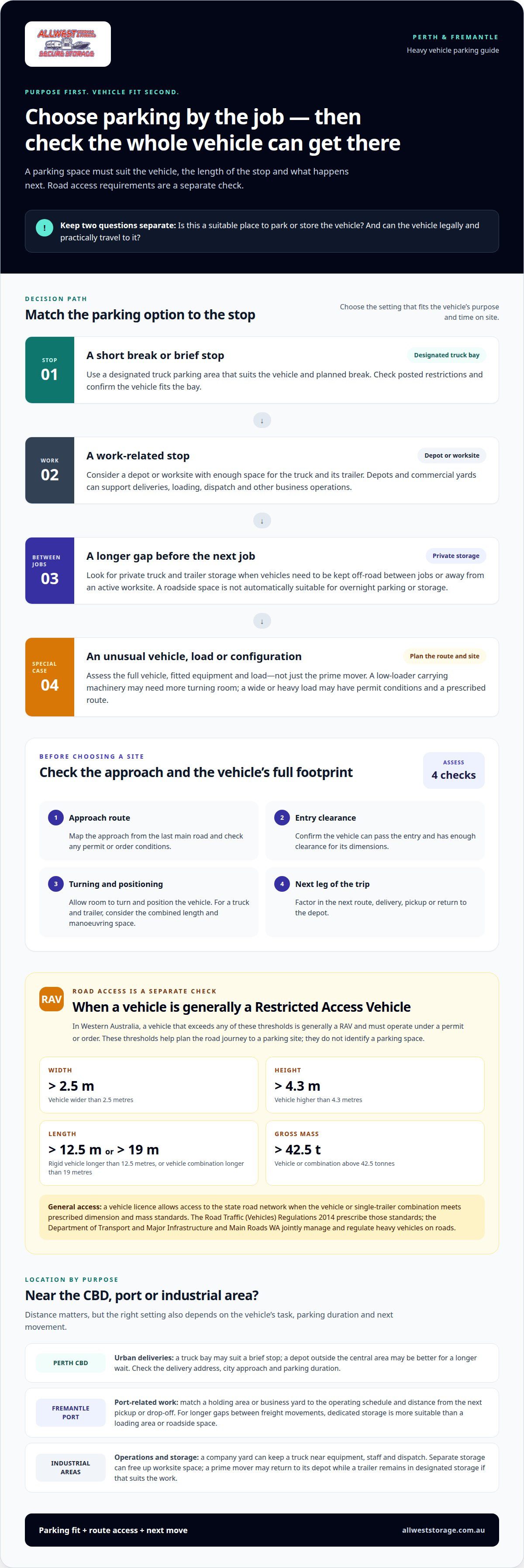
Road access rules affect where a heavy vehicle can travel, but they don’t identify a parking space. In Western Australia, a vehicle wider than 2.5 m or higher than 4.3 m is generally a Restricted Access Vehicle (RAV) and must operate under a permit or order. A rigid vehicle longer than 12.5 m, or a vehicle combination longer than 19 m, is also generally a RAV. These thresholds matter when planning the route to a parking site, not just the final turn into it.
The Road Traffic (Vehicles) Regulations 2014 prescribe standards for heavy vehicle dimensions and mass. A vehicle or combination with gross mass above 42.5 t is generally a RAV and must operate under a permit or order. The Department of Transport and Major Infrastructure and Main Roads WA jointly manage and regulate heavy vehicles on roads. A vehicle licence allows general access to the state road network when the vehicle or single-trailer combination meets prescribed dimension and mass standards.
Start by matching the parking option to the vehicle and the trip:
- For a short stop, use a designated truck parking area that suits the vehicle and planned break.
- For a work-related stop, consider a depot or worksite with space for the truck and its trailer.
- For longer periods between jobs, look for private truck and trailer storage rather than relying on a roadside space.
- For an unusual vehicle or load, plan the access route around its dimensions and any permit conditions.
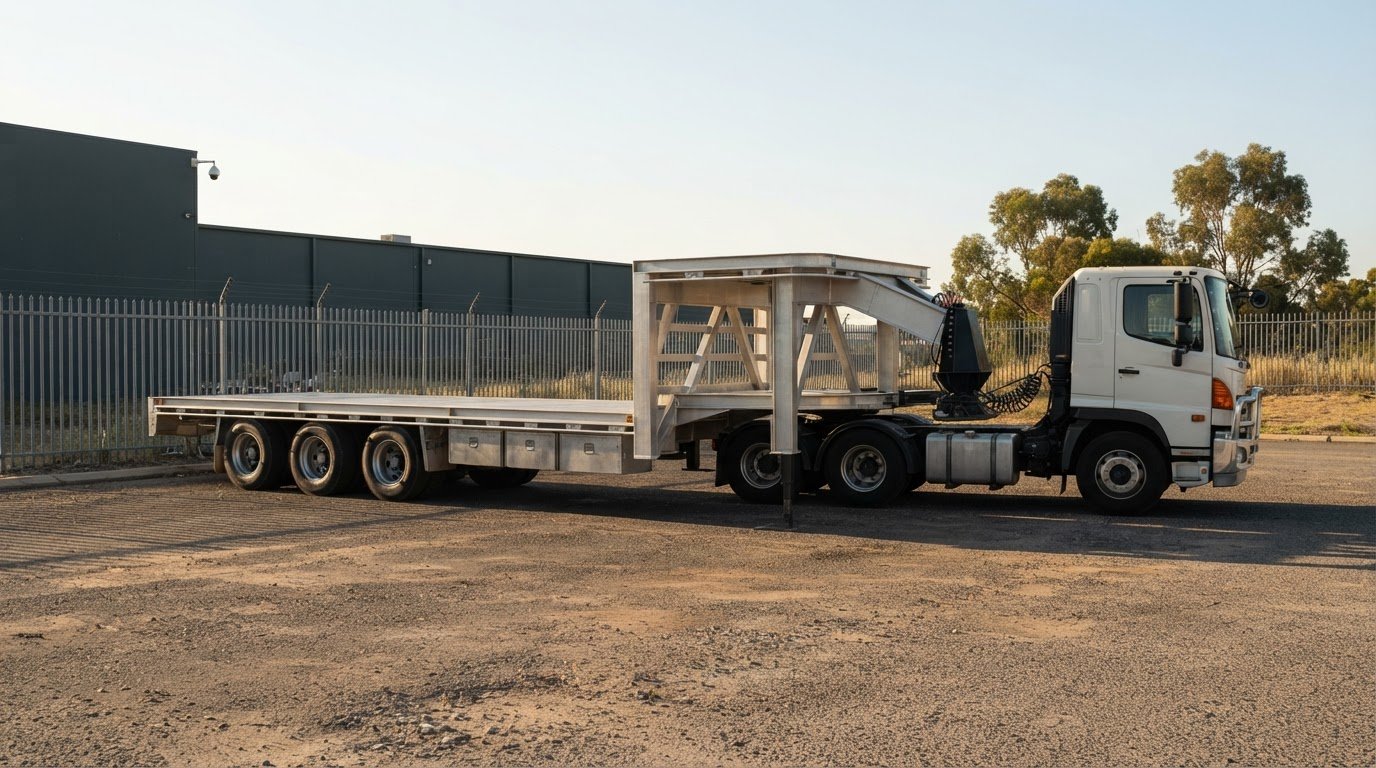
Special-purpose vehicles need the same practical assessment, with attention to fitted equipment and overall dimensions. A low-loader carrying machinery, for example, may need more turning room than a rigid truck. A vehicle carrying a wide or heavy load may also have permit conditions and a prescribed route. Choose parking based on the vehicle’s full configuration, not just the prime mover.
Before settling on a location, map the approach from the last main road and consider turning space, entry clearance and room to position the vehicle. For a truck and trailer, assess the combined length and whether the site allows the trailer to be manoeuvred safely. For an oversized vehicle, follow its permit or order conditions when planning the road journey. This separates the question of where to park from whether the vehicle can legally and practically reach that space.
What heavy vehicle parking facilities are available near Perth CBD, ports and industrial areas?
Parking near Perth CBD, Fremantle Port and industrial worksites serves different needs. Short-stay truck bays suit drivers stopping between deliveries. Depots and commercial yards can provide operational parking for vehicles assigned to a business. Private storage facilities suit trucks and trailers kept off-road between jobs. The right choice depends on whether the vehicle is waiting, working or being stored.
Near Perth CBD, proximity can save time on urban deliveries, but a large vehicle still needs a practical approach and enough room to manoeuvre. A marked truck bay may suit a brief stop, while a depot outside the central area may be better for a longer wait. When comparing heavy vehicle parking solutions in Perth, consider the delivery address, route into the city and parking duration.
Fremantle Port traffic has different timing needs. A truck awaiting a port-related task needs parking that fits its operating schedule and distance from the next pickup or drop-off. A holding area or business yard can work for a short operational pause. For longer gaps between freight movements, dedicated vehicle storage is more suitable than treating a loading area or roadside space as permanent parking.
Industrial areas create another set of choices. A company yard can keep a truck close to equipment, staff and dispatch operations. A separate parking or storage facility can free up worksite space when a truck or trailer is not in use. For example, a prime mover may return to its depot while a trailer remains in a designated storage area, if that arrangement suits the operator’s work.
Compare facilities by purpose and site layout, not distance alone:
- Truck bays: suited to brief stops, subject to posted restrictions and the vehicle’s fit.
- Business depots: practical for operational parking linked to deliveries, loading or dispatch.
- Port or freight holding areas: useful for managing a scheduled collection or drop-off.
- Private yards or storage facilities: suited to vehicles parked between jobs or kept away from active worksites.
For special-purpose vehicles, assess the full vehicle and load configuration. A truck carrying equipment may need more clearance than an unloaded prime mover. A truck and trailer also need room to turn and position both units. Heavy vehicle parking solutions in Perth work best when the facility suits the vehicle’s role, storage period and next leg of the journey.
If a vehicle cannot continue its journey, towing may become part of the parking decision. Towing providers in Perth metro areas typically aim for response times of around 45 minutes. That timing can be relevant when considering where a truck or trailer can wait safely while the operator arranges its next move.
For planned stops, check that the facility suits the whole vehicle combination and how long it will remain there. For an unexpected pause, consider whether the location works for the vehicle’s current condition and its next pickup, drop-off or return to a depot. Being clear about the parking purpose helps distinguish an operational stop from longer-term storage.
Which Perth truck parks offer secure, gated or 24-hour access?
In Perth, look for truck storage facilities that clearly distinguish site security from entry hours. A gated yard controls vehicle entry, while 24-hour access means drivers can enter or leave at any time. These features are separate. A site can have a gate but limited opening hours, or CCTV monitoring without round-the-clock access.
Security features also serve different purposes. A perimeter fence and controlled entry can restrict access to the parking area. CCTV monitoring records or observes activity, but it doesn’t mean drivers can access their vehicles at all hours. For example, a facility may provide hardstand or undercover parking with 24/7 CCTV monitoring, while operating access at set times.
Match the facility’s access arrangements to how the truck is used. A vehicle parked between scheduled jobs may suit a managed storage arrangement with set entry hours. A truck dispatched at varying times needs arrangements that support its operating pattern. A truck and trailer also need a layout that allows both units to be positioned and retrieved without obstructing other parked vehicles.
Use these distinctions to assess a Perth truck park:
- Gated access: indicates an entry point is controlled, but doesn’t by itself establish access hours.
- 24-hour access: means entry is available around the clock, subject to the facility’s operating arrangements.
- 24/7 CCTV monitoring: describes monitoring, not unrestricted driver entry or a guarantee against loss.
- Hardstand or undercover parking: describes the parking surface or cover, not the site’s gate controls.
For a special-purpose vehicle, include its working configuration in the decision. A truck with an attached trailer takes more room to manoeuvre than a solo vehicle. A parked trailer may also need a different arrangement from a prime mover that returns to work daily. Separating storage needs from dispatch needs helps determine whether a truck park’s access pattern suits the operation.
Don’t treat “secure” as a complete description. Compare the stated entry controls, monitoring and access hours as distinct features. For vehicles kept between jobs, explore truck and trailer storage suited to longer-term or shorter-term parking needs.
Parking and entry arrangements are separate from the rules that apply when a vehicle operates on roads. In Western Australia, a vehicle with more than 9 t on a single axle is generally a Restricted Access Vehicle (RAV) and must operate under a permit or order. A vehicle with more than 6 t on a single steer axle is generally a Restricted Access Vehicle (RAV) and must operate under a permit or order. A vehicle with more than 10 t on a twin steer axle group with non-load sharing suspension is generally a Restricted Access Vehicle (RAV) and must operate under a permit or order.
The same distinction applies to other axle groups. In Western Australia, a vehicle with more than 11 t on a twin steer axle group with load sharing suspension is generally a Restricted Access Vehicle (RAV) and must operate under a permit or order. A vehicle with more than 16.5 t on a tandem axle group is generally a Restricted Access Vehicle (RAV) and must operate under a permit or order. A vehicle with more than 20 t on a tri or quad axle group is generally a Restricted Access Vehicle (RAV) and must operate under a permit or order. Consider these requirements alongside the truck park’s entry arrangements when planning vehicle movements.
Allwest Storage & Parking
Allwest Storage & Parking provides truck and trailer storage for operators needing somewhere to keep vehicles between jobs or outside active work periods. Choose hardstand or undercover storage to suit your vehicle and preferred arrangement. Both short-term and long-term storage are available, with flexible rates and no lock-in contracts.
This is a practical option when a truck or trailer needs dedicated storage rather than a brief roadside stop or a space within a working depot. Allwest also offers storage for caravans and campervans, boats and cars. Request a quote from Allwest Storage & Parking to discuss your storage needs.
Plan your next parking move
Choose a parking arrangement based on how the vehicle will be used next, not only where it can sit today. A truck that returns to work regularly has different needs from one kept between contracts. Matching the storage period and parking type to your operating plans can make the next move easier to organise.
For heavy vehicle parking solutions in Perth, Allwest Storage & Parking offers truck and trailer storage, along with caravan and campervan, boat and car storage. Request a quote to find a storage arrangement suited to your vehicle.
Consider what needs storing and whether hardstand or undercover storage better suits your plans. Then take the next step and contact Allwest Storage & Parking to discuss your requirements. A clear plan gives you a practical starting point.
Leave A Comment