
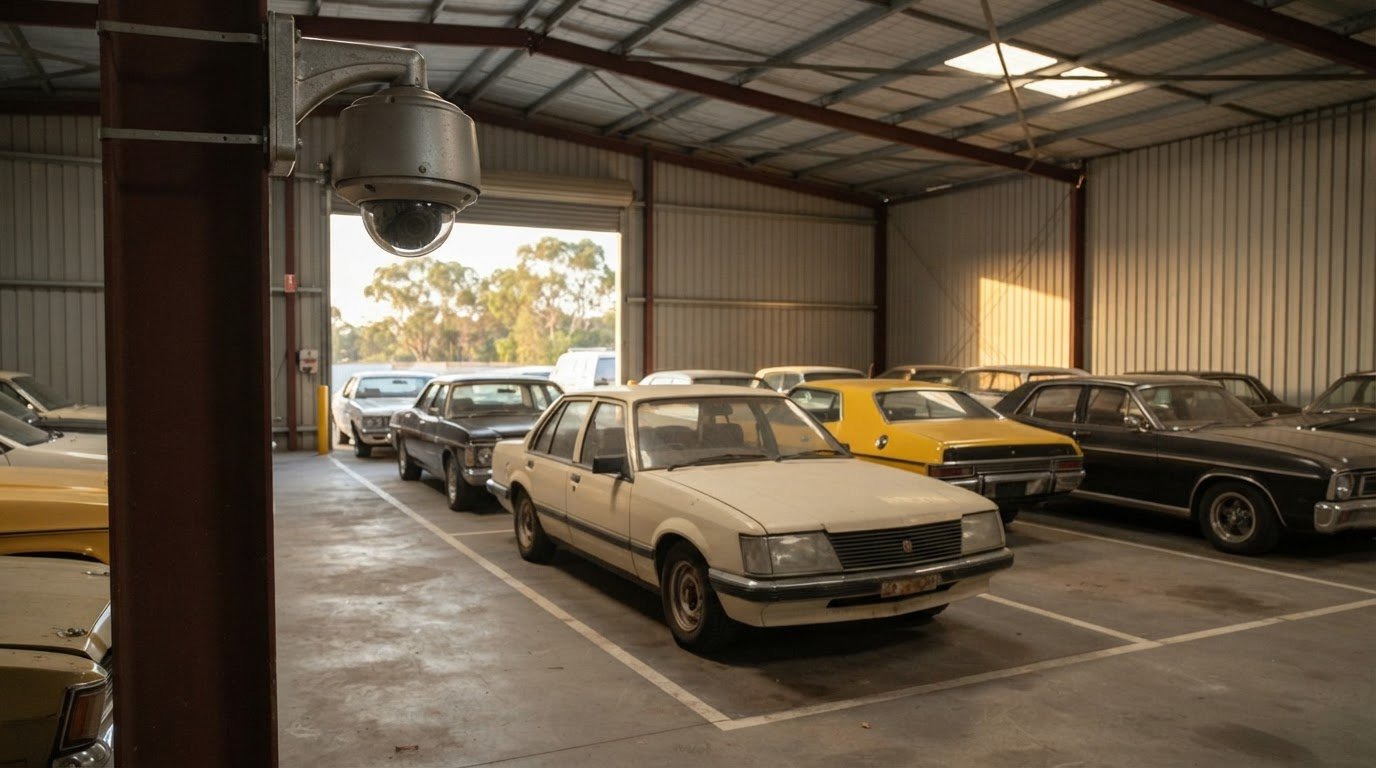
Visible CCTV can deter vehicle theft and vandalism. That’s why CCTV monitoring is important for car storage: recorded footage can help show what happened and identify people involved. Where alerts are used, they can also draw attention to activity that needs review.
Leaving a vehicle unattended can raise practical concerns, especially when valuable parts may also be targeted. CCTV’s usefulness depends on more than having cameras on site. Camera placement, low-light visibility, monitoring and access to recordings all affect what the system captures and how useful the footage is after an incident.
This article explains what a car video monitoring system does, which camera types storage facilities use, and how monitoring, alerts and recorded footage can support deterrence and investigations. It also covers how footage may assist police and why privacy-aware handling matters in Australia. The focus is practical: what CCTV can do and how it fits into secure car storage in Perth.
Key Takeaways
- Learn what makes recorded footage more useful when an incident needs to be investigated.
- Understand how different camera positions can cover vehicle access points and storage areas.
- See how monitoring alerts can help staff review unusual activity and respond appropriately.
- Explore how Allwest Storage & Parking’s car storage with 24/7 CCTV monitoring can suit short- or long-term vehicle storage.
Footage for identifying suspects and recovering vehicles or parts
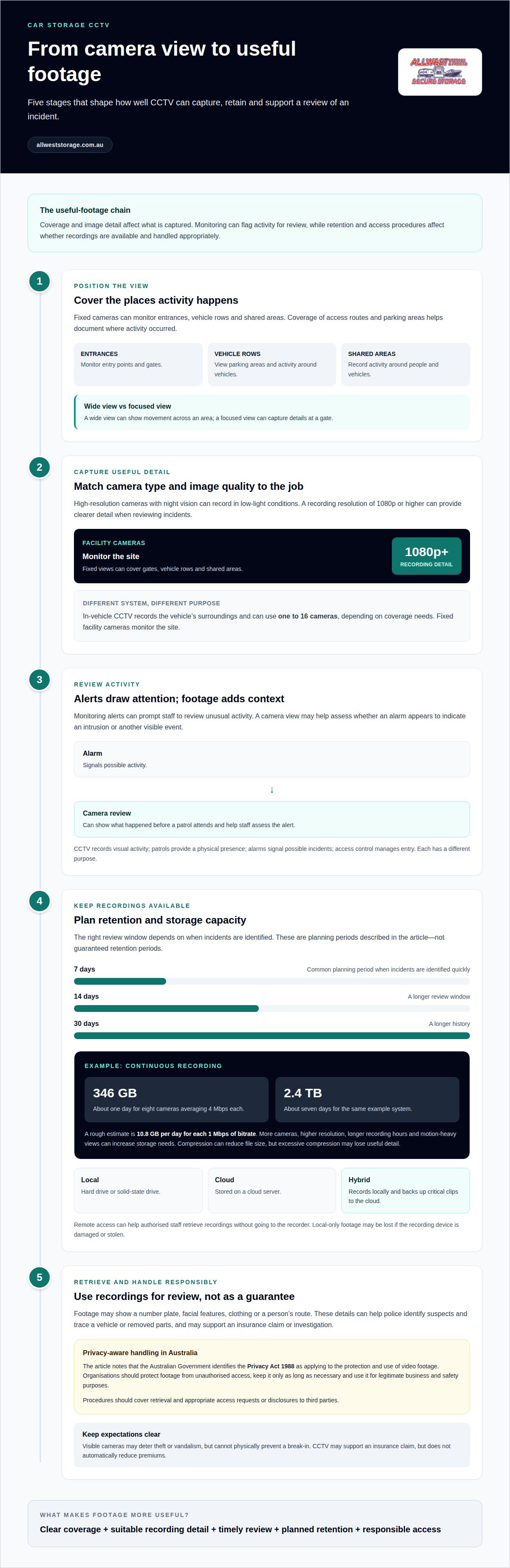
Understanding why CCTV monitoring is important for car storage starts with what a recording can show. Footage can help investigators reconstruct theft or damage. A clear view may capture a number plate, facial features, clothing or the route someone took. These details may help police identify suspects and trace a vehicle or removed parts. Recordings can also support an insurance claim or investigation.
CCTV records visual activity, patrols provide a physical presence, alarms signal possible incidents, and access control manages entry. Each serves a different purpose. For example, an alarm may flag activity, while footage helps show what happened before a patrol attends.
Retention planning affects whether footage remains available when an incident is reported. Seven days is a common planning period when incidents are identified quickly. Fourteen days gives a longer review window, while 30 days keeps a longer history. Continuous recording also needs storage capacity: a rough estimate is 10.8 GB per day for each 1 Mbps of bitrate.
Footage may be stored on a hard drive, solid-state drive or cloud server. A hybrid setup records locally and backs up critical clips to the cloud. Remote access can help authorised staff retrieve recordings without going to the recorder. Local-only footage may be lost if someone damages or steals the recording device.
Retention and access procedures help protect recorded information. In Australia, the Australian Government identifies the Privacy Act 1988 as applying to video footage’s protection and use. Organisations should protect footage from unauthorised access, keep it only as long as necessary, and use it for legitimate business and safety purposes. Procedures should cover retrieval and appropriate access requests or disclosures to third parties.
Does CCTV monitoring reduce car storage insurance premiums in Australia? Footage may support a claim, but it doesn’t automatically reduce premiums. Insurers assess premiums according to the policy and their assessment of risk. This is another reason why CCTV monitoring is important for car storage: usable recordings can support an incident review.
Camera types and their uses at storage facilities
Storage facilities use fixed cameras to monitor entry points, vehicle rows and shared areas. High-resolution cameras with night vision can record activity in low-light conditions. A 1080p recording resolution or higher can provide clearer detail when reviewing incidents. Camera placement matters too: a wide view can show movement across an area, while a focused view can capture details at a gate.
In-vehicle systems have different capabilities. Some use GPS and automatically save footage after events such as a sudden stop. Vehicle CCTV systems can use one to 16 cameras, depending on coverage needs. Those systems record the vehicle’s surroundings, while fixed facility cameras monitor the site. They serve different purposes.
Camera numbers and recording settings affect storage capacity. As an example, eight cameras averaging 4 Mbps each use about 346 GB for one day of continuous recording. That system needs about 2.4 TB for seven days. Higher resolution, longer recording hours and motion-heavy views can increase storage needs. Compression can reduce file size, though excessive compression may lose useful detail.
IP cameras can use Power over Ethernet (PoE), which carries data and power over one cable. Keep the complete Ethernet channel within 100 m. Cat6 solid-copper U/UTP cable, normally 23 or 24 AWG, is recommended for camera data and PoE. Cable quality and distance affect reliable camera connections.
How much does CCTV monitoring cost for car storage facilities in Australia? Costs depend on the system’s camera count, resolution, storage capacity, cabling and monitoring arrangement. A price depends on the case and is given after a quote request.
Customers assessing a facility’s CCTV security can consider whether cameras cover entrances, vehicle areas and low-light zones, and whether recordings can be reviewed. For a broader view of vehicle storage options, consider how camera coverage fits with site access arrangements.
Theft, vandalism and break-in protection
Visible cameras can deter potential thieves, while recorded views may help clarify an incident. Their value depends on whether they cover access routes and vehicle parking areas.
Protecting assets and personnel
CCTV supports the protection of vehicles and people by recording activity around vehicles and shared areas. Staff can review that record after an incident, such as attempted entry or damage to a parked car. Catalytic converters, wheels and airbags are among the valuable parts targeted by thieves. Camera coverage can document activity involving these assets, while clear procedures help staff use footage appropriately.
Other risks CCTV can detect
CCTV can help document vandalism, unauthorised access and activity that triggers an alarm. Reviewing footage can show whether an alarm reflects a possible intrusion or another visible event. This context helps staff distinguish incidents that need attention from alerts that show no apparent break-in. Views of vehicle rows and entrances can also help establish where activity occurred.
Visible surveillance may discourage attempts to steal vehicles or parts, but it cannot physically prevent a break-in. Catalytic converters attract interest for their platinum, palladium and rhodium content and resale value. Wheels and airbags are also potential targets. After a reported incident, footage can record the approach, actions and departure, giving investigators useful details to review.
Monitoring can also make an alarm more informative. Staff can review the camera view to assess whether activity appears to be an intrusion. If the system automatically flags or saves footage, it can provide a focused record for later review. The camera still needs a clear view of the relevant area.
Surveillance involves personal information as well as property. Organisations should conduct a data protection impact assessment that considers the rights and freedoms of people captured. Clear signage can explain when recording may occur and whom to contact. A suitable policy should cover access, retention and appropriate disclosure. Audio recording should generally be switched off by default.
Millions of vehicles are stolen globally every year. Surveillance footage can be checked to determine whether a camera alarm is a genuine intrusion, helping staff assess the alert.
Real-time monitoring and alerts
Real-time surveillance gives staff a view of activity as it happens, while alerts can draw attention to movement in selected areas. An alert prompts a review, and CCTV footage can help show what triggered it. This helps distinguish a visible event, such as a vehicle moving near an entry, from activity that needs further attention.
Alert systems depend on their settings and camera coverage. Motion detection may flag activity inside a defined zone, but a poorly positioned camera can miss relevant details. Staff reviewing an alert can compare the live view with the recording and follow the facility’s incident process. Remote viewing can support the review without requiring someone to stand beside the recorder.
Continuous recording and alerts serve different roles. Continuous recording creates a record for later review; alerts can draw attention to selected activity sooner. Neither function physically stops someone from entering or damaging a vehicle. Cameras also don’t replace suitable access controls or an on-site response. If power, connectivity or recording equipment fails, surveillance may be interrupted, so system checks matter.
What are the limitations of CCTV monitoring for stored cars? Cameras can’t prevent every theft, vandalism incident or break-in, and footage may not show an event clearly if the view is blocked or lighting is poor. An alert is a notification, not proof of a crime or a substitute for an appropriate response.
Useful monitoring relies on clear procedures: define which camera views generate alerts, direct alerts to the responsible person, and document how incidents are reviewed. Consistent zone names help staff find the right camera quickly. For example, an alert labelled “north gate” should match the camera view and incident procedure using that name.
For vehicle storage with 24/7 CCTV monitoring, explore the available car storage options and choose an arrangement that suits your vehicle.
Allwest Storage & Parking
Allwest Storage & Parking provides storage for vehicles, including cars, boats, caravans, trucks and trailers. For owners weighing how CCTV fits into their storage decision, the facility combines 24/7 CCTV monitoring with a choice of hardstand or undercover storage.
Allwest Storage & Parking offers short-term and long-term storage, with flexible rates and no lock-in contracts. CCTV is one part of the overall storage arrangement: it can record activity and support later review, but it cannot guarantee that theft or damage will never occur. The right option depends on the vehicle and how long you need to store it.
If you’re considering storage for a vehicle, contact Allwest Storage & Parking to discuss your requirements.
Make your next storage decision with confidence
Knowing why CCTV monitoring is important for car storage can help you weigh security alongside the practical needs of keeping a vehicle off the road. Consider the type of vehicle, how long you expect to store it, and whether hardstand or undercover storage suits your plans. CCTV is one part of the decision, not the only factor. Choosing an option that fits the vehicle and intended use makes the next step clearer.
Allwest Storage & Parking offers Car Storage, Boat Storage and Caravan & Campervan Storage. These options give vehicle owners a place to start when planning storage, whether they’re arranging a break from driving or making room at home. Think about the vehicle you need to store and the period that suits your circumstances, then discuss the arrangement with the team.
Contact Allwest Storage & Parking today to talk through your storage needs and take the next step.
Frequently Asked Questions
What Is a Car Video Monitoring System?
A car video monitoring system uses cameras and recording equipment to capture activity around a vehicle or within a storage site. At a facility, cameras may be fixed to view entrances and parking areas; an in-vehicle system is mounted on the vehicle itself. The key difference is what each camera observes, which affects the context available when reviewing an event.
How does CCTV monitoring protect cars in storage from theft and vandalism?
CCTV can make unauthorised activity more visible and create a record that helps explain what happened. For example, if a vehicle owner reports damage, staff can use the reported time and parking location to narrow down relevant recordings. Footage may help investigators assess the incident, but cameras don’t physically prevent access or replace other security measures.
What CCTV features are important for vehicle storage security, such as night vision and camera coverage?
Useful features include night vision for dim areas and camera views that capture entrances and parked vehicles. Consider whether the camera angle shows the detail needed to review an incident, rather than only a broad view of the site. A clear view of an entry route, for example, can help establish how someone approached, while a view of the vehicle area can show activity near a car.
Leave A Comment