

Boat size can affect the storage bill before you consider the storage type. To understand what affects boat storage prices in Perth, start with the storage option, the boat’s dimensions and the space allocated. A larger vessel, or one stored on a trailer, may need more room. Undercover and outdoor hardstand storage also use space differently.
Two boats of similar length can still receive different quotes if their beam, trailer footprint or storage arrangement differs. The storage type matters, but so does how a facility measures and allocates space. This guide explains how storage type, boat size and space calculations shape a quote in Perth. You’ll learn why length alone may not tell the whole story, which details affect the space needed, and how outdoor hardstand and undercover options compare. With these factors in mind, you can assess a quote more clearly than by relying on a single size label.
Key Takeaways
- Factor in the storage location, as local demand and the cost of space can influence the quote.
- Weigh the practical differences between undercover and outdoor hardstand storage when choosing an option.
- Use the boat’s full dimensions, including its beam and trailer footprint, to understand how a facility may allocate space.
- Consider how a larger vessel’s storage needs can affect its cost, even when two boats have similar lengths.
How much does it cost to store a boat?
There’s no single storage price for every boat. Understanding what affects boat storage prices starts with location, storage type, boat dimensions and allocated space. Extra services and contract length can also change the total, so a useful quote reflects the full storage arrangement rather than the boat’s length alone.
Location and local economic factors
Location can influence storage prices through local demand, land costs and the space available at a facility. Perth’s operating conditions may differ from those in quieter coastal towns or inland areas.
Coastal storage can be convenient for launching, while inland storage may mean a longer trip to the water. Local economies also influence land and operating costs. Consider travel alongside the storage fee, including how often you’ll retrieve the trailer or use the boat. A clear view of what affects boat storage prices helps you weigh location against convenience.
Seasonal demand and pricing
Seasonal demand can affect the availability of storage spaces as boating activity changes. In Perth, when you plan to store or retrieve your boat can help determine which arrangement suits your needs.
Agreements of six months or a year can sometimes secure a lower average monthly rate. Month-to-month contracts may suit shorter storage periods. Match the contract to your boating calendar and when you need the boat ready for use.
Additional storage fees
When comparing quotes, look at what the storage fee includes. An itemised breakdown can clarify whether services such as launching or retrieval, power, insurance arrangements and cleaning are included or charged separately.
Some packages bundle services such as winterisation, while other facilities charge for services individually. Compare the security features included, such as CCTV monitoring, gated access or locked storage units. If insurance requirements matter to you, review your policy to understand how your storage arrangement may affect cover.
Contract length and payment frequency
Contract length sets how long the space is reserved. Agreements of six months or a year can sometimes secure a lower average monthly rate, while month-to-month contracts allow a shorter commitment.
Annual agreements can include service discounts. Compare the whole arrangement, including payment timing, storage duration and services, to understand the total cost for your boat.
Indoor versus outdoor storage
In Australia, storage type affects the balance between cost, weather protection and convenience. Outdoor storage is generally more affordable than indoor storage, while wet storage tends to cost more than dry storage. A marina berth can also cost more than indoor dry storage at a boatyard in a smaller town, showing that the setting matters alongside the storage method.
Indoor storage shields a boat from sun, rain and wind, helping reduce UV damage and fading. That extra shelter can make indoor storage more expensive than outdoor space. Indoor dry storage may be paid year-round, which can avoid separate summer wet-slip costs. For a boat used seasonally, consider whether keeping it stored on land suits your access needs better than a marina berth.
Outdoor storage leaves a boat exposed to weather, so protection depends partly on the cover and tie-downs used. It can be a practical option for a trailer boat that needs straightforward access, but outdoor storage is often less secure than indoor storage. Compare the benefit of a lower-cost space with the level of exposure and security that suits your boat.
Dry-stack storage keeps boats in an elevated racking system and includes professional launch and retrieval. This can simplify getting a boat onto the water, but handling and access arrangements differ from parking a boat on its trailer. Dry-land storage is described as the most cost-effective option, while a wet slip keeps the boat in the water. Each choice involves a different balance of access, protection and cost.
When comparing quotes in Australia, compare the storage method, location, security, access and included services. Check whether the quote covers launch and retrieval, and whether the space is indoors, covered outdoors or uncovered. A marina berth and an indoor dry space are not like-for-like options, even if both suit the same boat. Include the weather exposure and how often you use the boat in your decision.
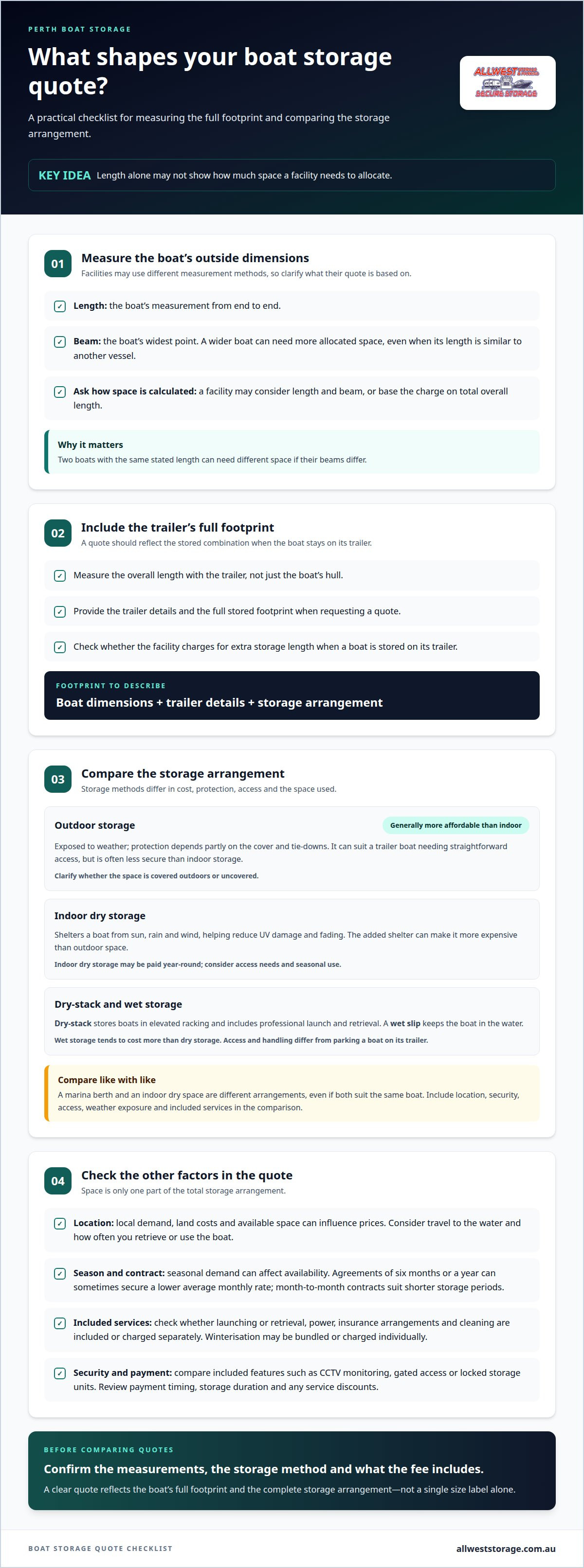
Boat size and how facilities calculate storage space
Facilities may use a boat’s length and beam to calculate storage space, while others base the charge on total overall length. The measurement method matters because it determines the space allocated. Two vessels with the same stated length can need different space if their beams differ.
Length and beam describe different dimensions. Length measures the boat from end to end, while beam is its widest point. A facility that considers both can account for a wide vessel that takes up more space. A quote based only on overall length uses a different calculation. Ask which dimensions are used so you can understand the space estimate.
A trailer can increase the space required beyond the boat alone. Facilities may charge for extra storage length when a boat is stored on its trailer. For example, the trailer’s full stored footprint may extend beyond the vessel’s hull length. Include the trailer in the measurements provided for a quote. That helps the facility assess the space needed for the complete combination, rather than the boat alone.
When arranging seasonal storage, provide the boat’s length, beam and overall length, along with trailer details. These measurements help assess suitable storage options. A boat stored on its trailer has a different footprint from one measured by vessel dimensions alone. Consider how you plan to access the water, as well as how much space the boat needs.
Interior features such as upholstery don’t alter a boat’s external length or beam. For a space estimate, the key details are its external dimensions and storage arrangement. Clear measurements give the facility a practical basis for assessing the space needed and preparing a quote. They also help you compare options consistently, whether you need short-term or seasonal storage.
How boat size affects storage prices
Larger boats generally need more facility space to store. What affects boat storage prices includes more than a broad label such as “small” or “large”. A facility may use a size category or calculate the space required for a particular vessel. Those methods can produce different quotes for boats of similar length.
Some storage options set flat rates for size categories. A boat near the boundary between categories may be priced differently from a slightly smaller vessel, even if their storage needs seem similar. Other facilities calculate charges using the space allocated to the boat. In that case, dimensions and the storage arrangement help determine the footprint.
A boat stored on its trailer can need more space than the vessel alone. The trailer’s stored footprint can affect the quote, not just the hull measurement. Provide both vessel and trailer details when requesting an estimate so the space assessment reflects the complete setup.
For owners comparing quotes, what affects boat storage prices is the relationship between boat size, storage type and how the facility measures its space. A wider vessel may need a different allocation than a narrower boat of similar length. Indoor space, outdoor hardstand and undercover storage can also suit different footprints. Size alone doesn’t show whether a storage option matches the boat’s full dimensions.
Compare quotes using the same vessel and trailer measurements, storage period and storage type. Check whether each quote uses a size category or allocated space. This gives you a clearer basis for judging whether an option is suitable and affordable for your boat. Explore boat storage options.
Allwest Storage & Parking: Boat Storage
Allwest Storage & Parking provides boat storage in Perth, with hardstand and undercover options. These suit boat owners who need a place to store a vessel between outings or for a longer period.
Choose the storage type that fits your boat and how you plan to use it. Hardstand provides an outdoor storage option, while undercover storage offers shelter from the weather. Both options have 24/7 CCTV monitoring. Short-term and long-term storage are available, with flexible rates and no lock-in contracts.
For a quote, the relevant details include your boat’s dimensions, whether it is on a trailer, your preferred storage type and how long you need the space. These factors help establish the suitable storage arrangement. Contact Allwest Storage & Parking to discuss boat storage for your needs.
Choose storage that fits your next boating season
To choose a suitable arrangement, consider when you’ll take the boat out, how often you need access and whether its measurements include a trailer. Sharing these details helps make a storage quote relevant to your plans, rather than relying on a broad estimate based on boat length alone.
Understanding what affects boat storage prices gives you a clearer basis for discussing the space and storage type your vessel needs. Allwest Storage & Parking offers boat storage in Perth, alongside Caravan & Campervan Storage and Car Storage. Request a quote to discuss the option that suits your boat and intended storage period, with flexible short-term and long-term arrangements.
Discuss your boat storage needs with Allwest Storage & Parking and take the next step towards organising suitable space for your vessel.
Frequently Asked Questions
What is the average cost of boat storage in Australia?
Boat storage costs vary across Australia, so an average won’t describe every boat or location. The amount depends on the storage method, the boat’s dimensions, the facility’s location and the space it allocates. For a useful estimate, provide your boat’s measurements and storage requirements, then compare quotes covering the same period and services.
How do boat length, height and weight affect storage prices?
Length and beam commonly shape a space calculation, while some facilities use total overall length. A trailer can add to the space needed beyond the boat itself. Height and weight may affect which spaces are suitable, but they aren’t universal pricing measures. Provide complete vessel and trailer details so the facility can assess the required space and applicable size category.
How do indoor, covered and outdoor boat storage costs compare in Australia?
Outdoor storage is generally more affordable than indoor storage, and covered outdoor space typically costs more than uncovered space. Indoor storage offers shelter from sun, rain and wind, while outdoor options leave the boat more exposed. Compare the protection and space included, not just the storage label. For example, a covered outdoor space and an indoor bay aren’t equivalent options.
How much does marina or in-water boat storage cost compared with dry storage?
Wet storage tends to cost more than dry storage, but the difference depends on location and the arrangement. A marina berth in a popular tourist area may cost more than indoor dry storage at a boatyard in a smaller town. Compare the total arrangement, including any additional services, rather than assuming an in-water berth costs less than land storage.
How does location affect boat storage prices across Australian cities and regional areas?
Storage prices can differ between major Australian cities and quieter coastal towns. Local demand, land costs and operating conditions all influence facility pricing, so quotes may vary even for similar boats. Perth has its own local market. Compare location with access needs and storage type to understand what shapes a particular quote.
Leave A Comment