
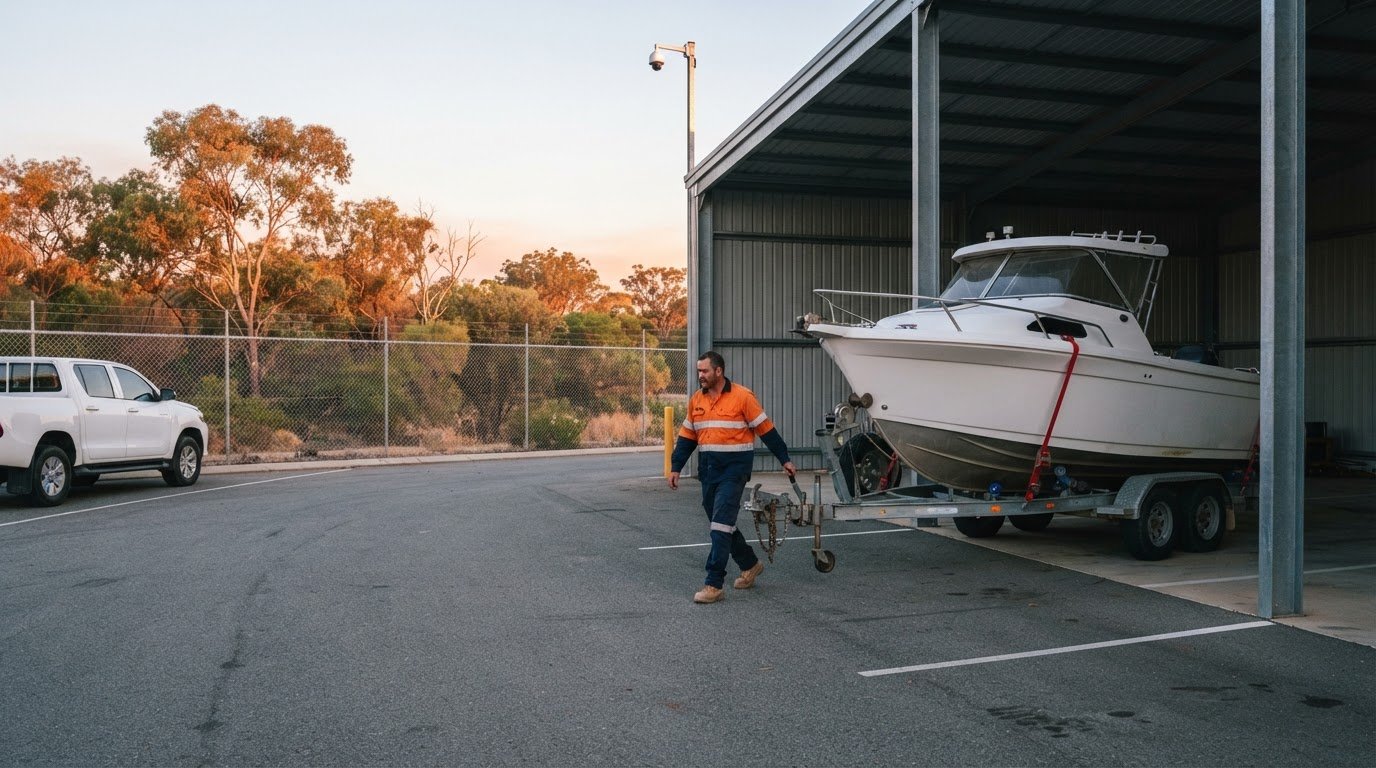
Some boat storage facilities offer 24-hour access, making early fishing trips possible. For boat storage for FIFO workers, the practical answer is to choose a facility whose access arrangements fit your roster and launch plans. Your boat’s size and the room needed to move it also affect which storage option suits.
If you work FIFO, it makes sense to prioritise convenient access to your boat when you’re home between shifts. But convenience is only part of the decision: a longer drive to the water adds towing time and effort, while storage terms that don’t suit changing work plans can be difficult to manage.
This guide explains how to assess the space your boat needs, compare flexible storage terms and weigh a facility’s location against transport effort. It also covers when ongoing storage can make sense during long-term FIFO work, so you can choose an arrangement that fits your roster and time on the water.
Key Takeaways
- Choose storage based on your boat and trailer dimensions, with enough space to move and position them safely.
- Flexible, short-term arrangements can better suit changing rosters than a long commitment.
- Balance convenient access to the water against the extra towing involved when storage is farther away.
- Review whether storage still fits your plans as FIFO work continues, and compare hardstand and undercover options for your boat.
Choosing unit sizes for different belongings
For FIFO workers, boat storage choices include indoor, outdoor, covered and dry-stack arrangements. Match the option and space to your vessel, trailer, access needs and roster.
Matching unit size to belongings
The space you need depends on the floor area and clearance required for your boat, trailer and any gear stored with it. A tight fit can make manoeuvring and access difficult. Indoor storage places a boat inside a building, outdoor storage keeps it in an open area, and covered storage provides shelter overhead. Dry-stack storage keeps a boat ashore on a rack. Each option differs in shelter, layout and handling.
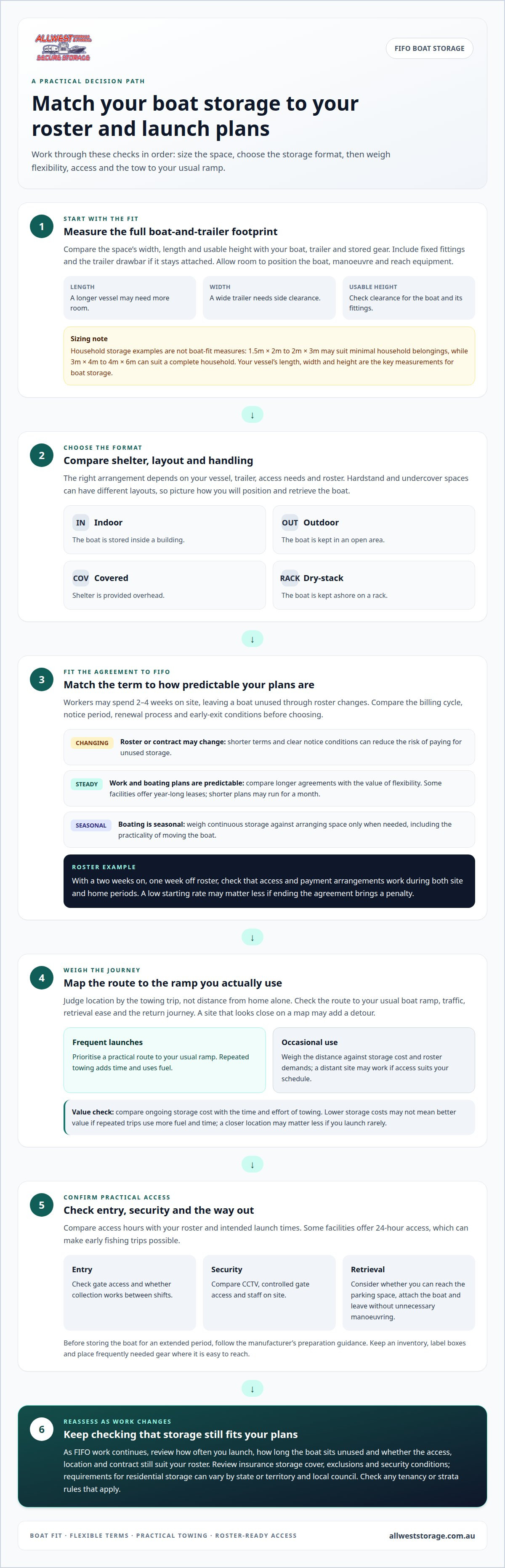
Start with the boat and trailer dimensions, then allow room to position them and reach equipment. A 1.5m x 2m to 2m x 3m unit may suit minimal household belongings, while 3m x 4m to 4m x 6m can suit a complete household. Those household examples don’t determine boat fit: the vessel’s length, width and height remain the key measurements.
Understanding storage unit dimensions
A storage space’s dimensions describe its width, length and usable height. Compare them with the full boat-and-trailer footprint rather than relying on a general size label. Measure the boat with fixed fittings, include the trailer drawbar if it will stay attached, and allow for the room needed to manoeuvre into position.
A long vessel may need more length, while a wide trailer needs extra clearance at the sides. Hardstand and undercover options have different layouts, so consider how the boat will be positioned and retrieved.
Compare facility access hours with your roster and intended launch times. Review the contract period and applicable charges, then weigh those terms against the towing distance to the water. A flexible arrangement can suit changing FIFO shifts better than a commitment that outlasts your plans.
Review your boat insurance policy’s storage cover, exclusions and security conditions. For residential storage, requirements can vary by state or territory and local council. Also consider any tenancy or strata rules that apply to the property.
Before storing your boat for an extended period, follow the manufacturer’s preparation guidance. Keep an inventory of the gear, label boxes and place frequently needed items where they’re easy to reach. This can make access during your time at home simpler.
Month-to-month contracts and roster flexibility
A storage lease should match the length and pattern of your FIFO work. Workers may spend 2-4 weeks on site, so a boat can remain unused through several roster changes. Month-to-month terms can suit uncertain plans; longer arrangements may suit a stable role and predictable boating routine.
Before choosing storage, compare the billing cycle, notice period, renewal process and early-exit conditions. For example, with a two weeks on, one week off roster, access and payment arrangements need to work during both site and home periods. A low starting rate matters less if ending the agreement brings a penalty.
Storage terms vary. Some recreational boat facilities offer year-long leases, while shorter plans may run for a month. If your FIFO contract or roster could change, a shorter term can reduce the risk of paying for unused storage. A longer lease may suit you when your work and boating plans are steady.
Seasonal storage may suit a boat used mainly at particular times of year. Consider whether you’ll keep the same space during quieter months or end the arrangement and organise storage again later. The right choice depends on how often you launch, how long you expect to be away and whether moving the boat between arrangements is practical.
- Changing roster or contract: favour shorter terms and clear notice conditions.
- Predictable long-term work: compare longer agreements with the value of flexibility.
- Seasonal boating: weigh continuous storage against arranging space only when needed.
Allwest Storage & Parking offers short- and long-term storage with flexible rates and no lock-in contracts. If those terms suit your plans, explore flexible boat storage arrangements as part of your roster planning.
Storage facility location and transport costs
Look for CCTV, controlled gate access and staff on site. For FIFO workers, practical entry arrangements matter when collecting a boat between shifts or before a planned launch.
Distance from storage to the water affects more than travel time. Towing uses fuel and time, and a longer route can make spontaneous outings harder to fit around your roster. A facility closer to your usual launch area may suit frequent boating; a more distant site may work if you launch occasionally and its access arrangements suit your schedule.
Map the route from storage to the boat ramp you actually use, rather than judging distance from home alone. Consider whether the route suits towing, how traffic may affect the trip and how easily you can retrieve the boat. Include the return journey in your plans. A site that looks convenient on a map may add a lengthy detour to your regular ramp.
Compare the ongoing storage cost with the time and effort involved in your usual boating routine. Think about how often you tow, whether someone else can collect the boat and how long it sits unused during a FIFO swing. Lower storage costs may not mean better value if repeated trips use more fuel and time. On the other hand, a more convenient location may matter less if you launch rarely.
Security and access also affect location suitability. CCTV, gate access and staff on site are useful features to compare. Consider the route from the entrance to your parking space, too. A layout that allows you to retrieve the boat and attach it to the tow vehicle without unnecessary manoeuvring can make an early departure simpler.
- Frequent launches: prioritise a practical route to your usual ramp.
- Occasional use: weigh distance against storage cost and roster demands.
- FIFO collection: compare access arrangements and site security features.
When to reconsider storage for long-term FIFO work
Long-term FIFO work can change how often you use your boat and where you keep a base. If you don’t maintain a fixed address while away for extended work periods, consider whether your boat storage still fits your home arrangements, roster and plans for time off.
Start with how you actually use the boat. Compare recent launches with the time it has spent in storage, then consider whether that pattern is likely to continue. If roster changes leave little time for trips, ongoing storage may still be practical, but the space and access arrangements should suit less frequent use. If your work base or home location changes, towing distance may become more important.
Weigh ongoing storage against the alternatives available to you. Keeping a fixed home for a boat you rarely use can bring responsibilities beyond storage, while ending storage means arranging another suitable place for the vessel. Consider where the boat will be kept, how you’ll retrieve it and whether someone you trust can help while you’re away.
- Keep storing: your boat remains useful, and access fits your roster.
- Change the arrangement: your address, work base or launch routine has shifted.
- Reconsider ownership: you rarely use the boat and no longer want its ongoing costs and responsibilities.
Review your storage arrangement when your contract, roster or living arrangements change. Keeping a simple record of launch dates, storage periods and travel effort can show whether it still works. Repeatedly missing trips because of access or towing logistics may be a sign to reconsider the arrangement.
If storage remains the practical choice, explore storage options that can accommodate your changing FIFO plans.
Allwest Storage & Parking: Caravan & Campervan Storage
Allwest Storage & Parking provides boat storage for FIFO workers who need a place for their vessel between roster breaks or longer periods away. Boat owners can choose between hardstand and undercover options, with 24/7 CCTV monitoring.
Consider how often you launch, how much space your boat and trailer need, and how storage fits your roster. At Allwest Storage & Parking in Perth, hardstand storage offers an outdoor option, while undercover storage shelters your boat from the elements. Allwest also provides Caravan & Campervan Storage, Car Storage, and Truck & Trailer Storage.
If your plans change, Allwest offers short-term and long-term storage with no lock-in contracts. Consider which option suits your boat and expected storage period, then request a quote from Allwest Storage & Parking.
Make storage part of your FIFO plan
Choosing boat storage for FIFO workers means treating storage as part of your wider work-and-home plans. Reassess your needs when your role, living arrangements or plans for time off change. This helps ensure storage continues to suit how you use your boat, rather than becoming an arrangement you keep by default.
A short note of your priorities can make decisions easier. Record what matters most, such as keeping the boat ready for planned outings, reducing ongoing commitments or simplifying life between work swings. Use that list as a guide when circumstances shift, rather than making a rushed choice during a roster change.
Allwest Storage & Parking can help you consider a storage arrangement for your boat. Contact Allwest Storage & Parking to discuss your needs and take the next step with confidence.
Frequently Asked Questions
Can I access my boat any time, including early morning for fishing trips?
Access depends on the facility’s entry arrangements, so don’t assume you can reach your boat at any hour. Compare the access arrangements with your planned departure and allow time to retrieve and hitch the boat. Before an early fishing trip, make sure your arrival and exit fit the facility’s rules as well as the drive to your chosen ramp.
How much does it cost to store a boat in Perth?
Boat storage costs in Perth depend on the vessel’s size, storage type and rental period. Hardstand and undercover spaces may have different rates, and the length of stay can also affect your quote. Request pricing for your boat and intended storage period, then factor in the journey to your usual launch point when comparing the overall cost.
How much does boat storage cost per week or month in Australia?
There isn’t one Australia-wide weekly or monthly rate for boat storage. The total depends on the boat’s dimensions, storage type, location and length of stay. To compare quotes, use the same rental period and describe your boat and trailer accurately. Include transport costs in your budget, as a site farther from your usual launch point can add towing time and effort.
Which boat storage facilities are near major FIFO airports and mining hubs?
In Perth, compare facilities by their road connections to Perth Airport, your home base and your usual boat ramp. A site near major roads may simplify travel between work and storage, but the actual journey depends on your starting point and destination. Consider the route at the times you expect to collect or tow the boat.
Can FIFO workers arrange long-term or unattended boat storage?
Yes. FIFO workers can arrange storage while they’re away, including for longer stays. Allwest Storage & Parking offers short-term and long-term vehicle storage in Perth, with 24/7 CCTV monitoring. For unattended storage, plan who holds the keys and can act on your behalf if access or collection needs change while you’re working away.
How can FIFO workers arrange boat access, launching and retrieval around their roster?
Match collection and return plans to your roster before each trip. Check the facility’s access arrangements, allow time to hitch the boat and plan the drive to your chosen ramp. If you’ll be away when the boat needs moving, arrange for someone you trust to handle access and retrieval. Keep keys and essential details organised to make handovers straightforward.
Leave A Comment