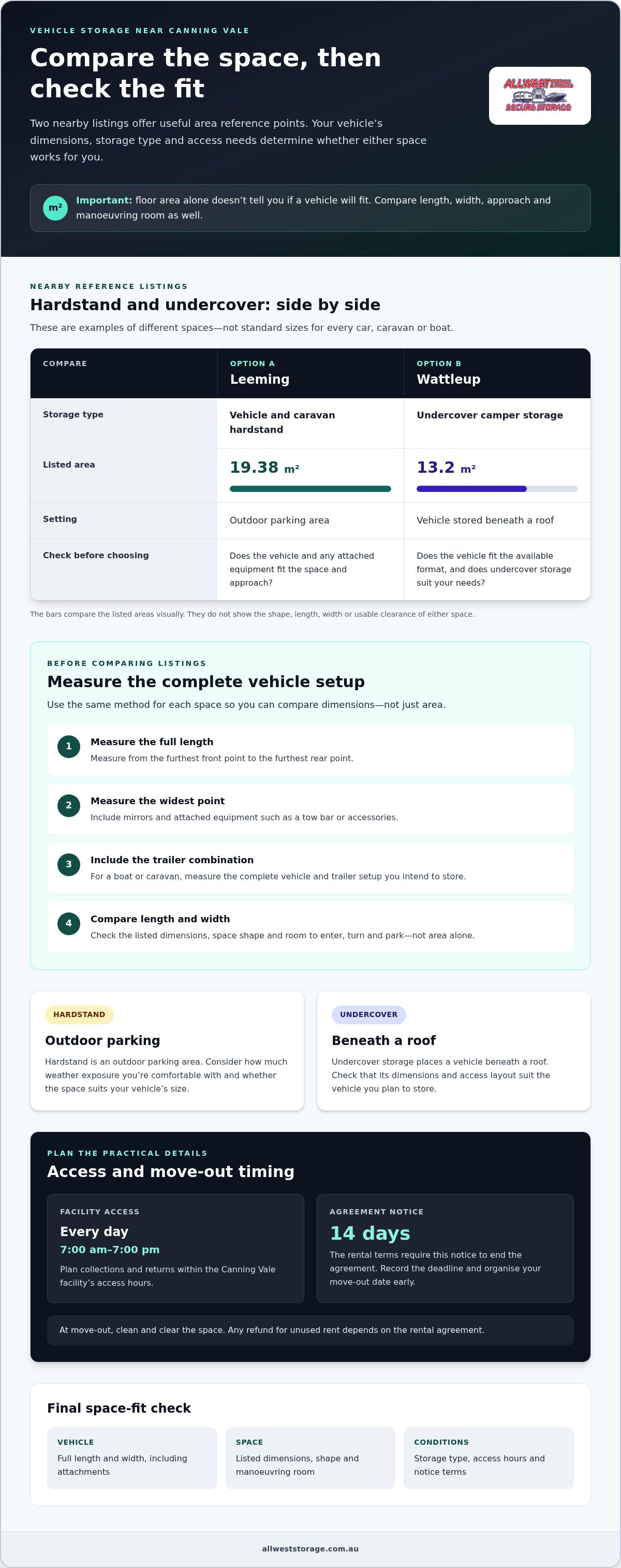
Allow 14 days’ notice to end a storage agreement: the rental terms require this notice. For vehicle storage in Canning Vale, build that time into your move-out plan so you can organise your departure date and avoid leaving the arrangements until the last minute.
Choosing a space also means matching its dimensions and storage type to your vehicle. A vehicle and caravan hardstand in nearby Leeming measures 19.38 m², giving you a concrete point of comparison when considering the room your vehicle needs.
This guide explains how to assess vehicle-space dimensions, booking and contract conditions, security, and storage options near Canning Vale. You’ll also learn what to consider when comparing hardstand and undercover storage, and how notice periods affect your move-out plans. Use these practical points to choose an arrangement that suits your vehicle and how you plan to use it.
Key Takeaways
- Measure the vehicle and account for its full footprint, including any attached trailer, before comparing spaces.
- Plan your move-out around the agreement’s notice terms, and leave the space clean and clear when handing it back.
- Choose between hardstand and undercover storage based on the protection and access your vehicle needs.
- 24/7 CCTV monitoring is one security feature to consider when assessing where to store a vehicle.
- Compare nearby options by vehicle fit, storage type and contract conditions, not location alone.
Need storage in Canning Vale?
Vehicle storage in Canning Vale can help if you need to keep a car, caravan, boat or trailer off the street or out of your driveway. Start by identifying the vehicle, how long you expect to store it and how often you’ll need access. These details help you compare storage types and choose a space that fits your plans.
Canning Vale is in Western Australia, postcode 6155. Before choosing a space, record the vehicle’s full dimensions and note anything that changes its footprint, such as a tow bar, boat trailer or caravan accessories. A car stored on its own has different space needs from a caravan connected to a tow vehicle. Measure the complete setup you intend to store, not just the main vehicle.
Car storage can be a practical option when your vehicle won’t be used regularly. Storing it off-site can free up your driveway during a renovation, an extended trip or when parking at home is limited. Plan the collection routine too: consider how you’ll get to the facility, retrieve the car and keep its keys accessible.
For caravan and campervan storage, consider the full vehicle and the room needed to manoeuvre it into position. If you store the caravan separately from its tow vehicle, plan where each will be parked. Boat storage requires room for the boat and its trailer. Measure the overall length and width of the complete vehicle or combination before comparing spaces.
Storage type affects the conditions your vehicle will face. Hardstand provides an outdoor parking area; undercover storage places a vehicle beneath a roof. Consider how much weather exposure you’re comfortable with and whether your vehicle’s size suits the available format. Standard weatherproof sheds can provide basic protection from rain and heat, but climate control isn’t offered at every facility.
Access hours matter if you expect to collect or return a vehicle around work or travel. The Canning Vale storage facility access hours are every day, 7:00 am to 7:00 pm. Match those hours to your expected routine before making a booking. Also allow 14 days’ notice to end a storage agreement, as required by the rental terms. Planning your move-out date early makes it easier to organise transport and clear the space on time.
- Car: Record its dimensions and consider how often you’ll need to retrieve it.
- Caravan or camper trailer: Measure the full unit and plan its manoeuvring route.
- Boat: Include the trailer when measuring the complete setup.
Available vehicle-space dimensions
Two nearby listings give useful reference points for comparing vehicle spaces. A vehicle and caravan hardstand in Leeming measures 19.38 m². An undercover camper storage space in Wattleup measures 13.2 m². These figures describe different spaces, not a standard size for every car, caravan or boat. Use them as starting points, then compare each option with your vehicle’s actual footprint.
Area alone doesn’t show whether a vehicle will fit comfortably. A long, narrow space and a wider, shorter space can have the same area but suit different vehicles. Before contacting a facility, measure the vehicle’s length and width, then include fixed attachments such as a tow bar, mirrors or boat trailer. For a caravan, measure the body and any fittings that extend beyond it.
Use this simple measuring sequence:
- Measure the vehicle from its furthest front point to its furthest rear point.
- Measure its widest point, including mirrors or attached equipment.
- For a boat or caravan, measure the complete trailer combination.
- Compare those measurements with the listed length and width, not just the total area.
Allow room to enter and leave the space. A caravan may need a wider turning approach than a car, and a boat on a trailer may need extra room for alignment. Consider the route from the entrance to the parking position. A space can match the vehicle’s footprint and still be difficult to use if the approach is tight.
Plan for access around the vehicle as well. If you need to open a door or boot, or remove packing, consider how much clearance these tasks require. Don’t assume loose items can be stored beside the vehicle. Keep your measurements and a simple sketch together to compare spaces accurately.
Dimensions can also help you judge whether a storage type suits your vehicle. Compare the 19.38 m² Leeming hardstand with the 13.2 m² Wattleup undercover space, then consider the shape and access layout as well as area. For example, a compact car may fit a smaller footprint, while a long caravan needs sufficient length and room to manoeuvre.
Before booking, match your measurements to the space dimensions and consider how you’ll make payments under the agreement. For a practical comparison, explore vehicle storage options alongside the measurements you’ve recorded.
Booking and contract conditions
Before booking, read the agreement and note its notice period, access arrangements and vehicle requirements. Planning how you’ll move in and out helps keep the process organised and avoids preventable hassles.
Insurance is optional and may provide an added safeguard for valuable vehicles or long-term storage. For registration and vehicle-condition requirements in Western Australia, follow the conditions set out in the storage agreement.
The rental terms require 14 days’ notice to end the agreement. Record the notice deadline when you sign, then arrange transport and a move-out date early. If you leave before the paid period ends, a refund for unused rent depends on the rental agreement. At move-out, clean the space and remove all belongings to avoid extra fees.
Access and vehicle retrieval
The Canning Vale storage facility is accessible every day from 7:00 am to 7:00 pm. Plan collections and returns within those hours, allowing time to retrieve the vehicle and exit before closing. If another person will collect it, authorise them under the facility’s process. You’re responsible for anyone you authorise to access your space.
Plan how you’ll retrieve the vehicle before booking. Collecting a caravan may require a tow vehicle and driver, while collecting a car may only require its keys. Keep access details and any required arrangements with your agreement so the person collecting the vehicle knows what to do.
Storage risks and restrictions
Consider weather exposure, vehicle condition and who can access the space. Outdoor hardstand storage leaves a vehicle more exposed than undercover storage, while weatherproof sheds provide basic protection from rain and heat. Not every facility offers climate control, so match the storage type to the vehicle and its contents.
Read the agreement for terms about stored belongings, vehicle condition and authorised access. Secure valuable items inside the vehicle or remove them before storage. For a boat or caravan, consider any equipment in external compartments. These steps can help protect your belongings during storage.
Use this booking sequence to reduce last-minute issues:
- Read the agreement and mark the 14-day notice deadline.
- Record the access hours and arrange who may retrieve the vehicle.
- Prepare the vehicle and remove belongings that shouldn’t remain inside.
- At move-out, clear and clean the space before handing it back.
Keep a copy of the agreement and note any instructions about access, registration or vehicle condition. Having these details to hand makes it easier to organise your booking and departure.
CCTV and on-site security
Security features help protect stored vehicles and support a clear access process. The storage options include 24/7 CCTV monitoring. CCTV can record activity in monitored areas, while physical site features and controlled access address different parts of vehicle security. Consider how these measures work together rather than treating a camera as the only safeguard.
Monitoring around the clock means CCTV operates day and night. It doesn’t mean every part of a facility is necessarily visible from every camera. Coverage depends on camera placement, viewing angles and the areas being monitored. For example, cameras may capture vehicle movement through an entrance, while a parked vehicle’s position depends on whether that bay falls within view.
On-site security is broader than CCTV. Site layout, perimeter barriers, lighting and access arrangements can all affect how a vehicle is protected. These features serve different purposes: lighting can improve visibility, while barriers can restrict vehicle entry. Don’t assume that CCTV provides an on-site guard or that every security measure is included. Treat each feature according to what it does.
Match your preparation to the vehicle you’re storing. A car may contain removable valuables, while a caravan or boat can have equipment in several compartments. Remove items you don’t need to leave inside and secure anything that remains. Keep your keys under your control and share access details only with people you authorise.
- CCTV: 24/7 monitoring records activity in camera-covered areas.
- Lighting: Well-lit access routes can make movement around a vehicle easier to see.
- Perimeter: Barriers and gates can help limit vehicle entry to the site.
- Personal precautions: Remove loose valuables and secure vehicle compartments before leaving.
Security and storage type are separate decisions. Undercover storage can shield a vehicle from the elements, while CCTV monitoring helps monitor activity. Neither replaces sensible preparation, such as locking the vehicle and removing items you’d rather keep with you. Consider your vehicle’s value and contents, then compare those needs with the storage options.
When comparing costs, consider the storage format and the features that matter to you, not just the headline rate. Hardstand may suit a vehicle that needs outdoor parking, while undercover storage provides shelter from the elements. Allwest Storage & Parking offers affordable rates, with discounted rates for extended stays. Keep belongings secure and follow the facility’s access arrangements.
Before storing a vehicle, make a short security checklist: lock doors and compartments, take valuables with you, retain your keys, and note who is authorised to access the space. For a caravan or boat, secure external storage compartments as well. These simple steps complement 24/7 CCTV monitoring without assuming cameras prevent every incident.
Storage options near Canning Vale
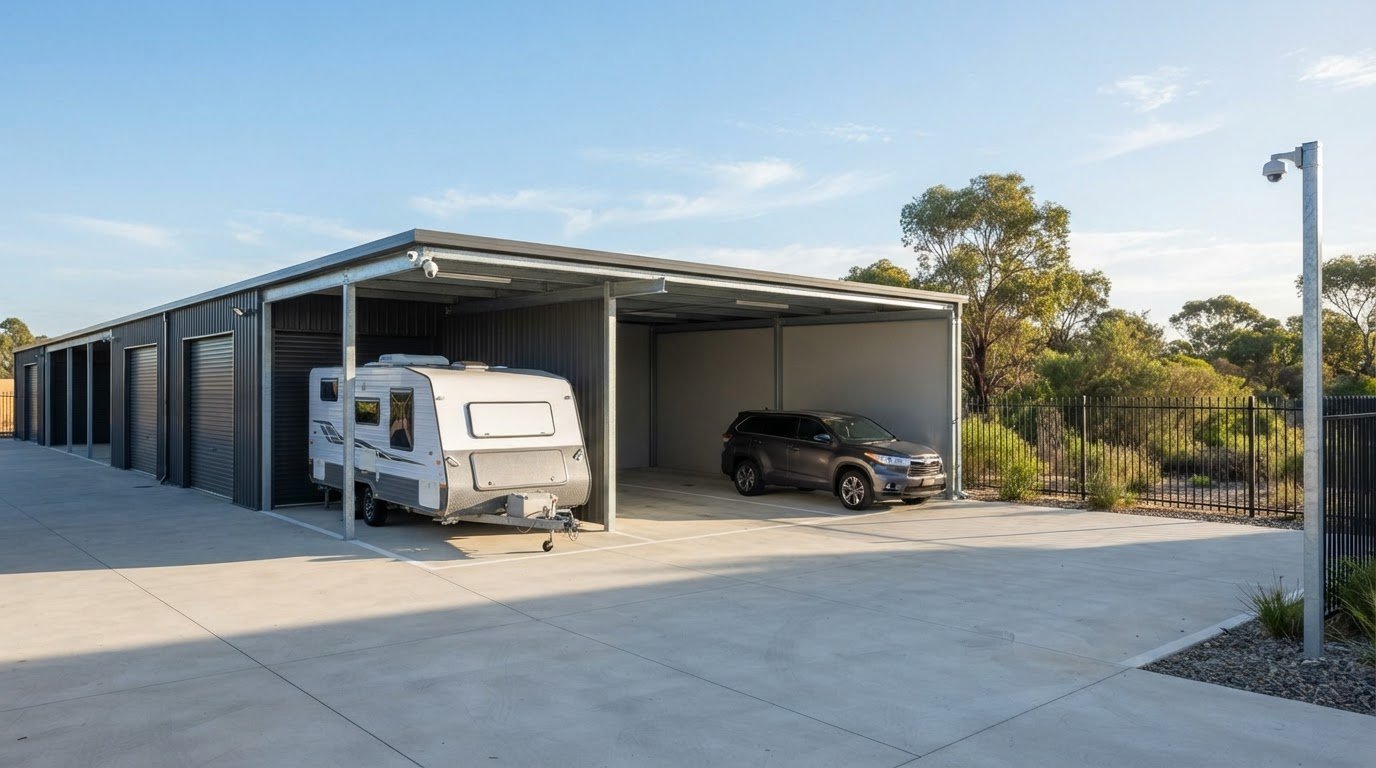
Near Canning Vale, vehicle storage choices include covered and outdoor hardstand spaces. Enclosed storage units are a separate format, so compare the actual structure and protection offered before deciding.
Covered storage
Undercover storage places a vehicle beneath a roof, helping shield it from direct rain and sun. It doesn’t mean the space is enclosed or climate-controlled. Standard weatherproof sheds provide basic protection from rain and heat, but climate control isn’t available at every facility. Check the space dimensions and access layout against your vehicle before choosing this format.
Outdoor storage
Hardstand storage provides an outdoor parking space rather than a roofed or enclosed unit. It can suit a car, caravan, boat or trailer if the vehicle fits the allocated area. Consider its exposure to the weather and prepare it accordingly, for example by securing external compartments and removing loose belongings.
When comparing vehicle storage near Canning Vale, consider both the location and the format. Allwest Storage & Parking is conveniently located near major roads in Perth, with hardstand and undercover options. Choose a format that suits your vehicle and how much shelter you prefer.
Use these points to compare storage units and parking spaces:
- Structure: Identify whether the space is outdoor, undercover or enclosed.
- Vehicle fit: Match the space’s shape and dimensions to the vehicle and its attachments.
- Exposure: Consider whether a roof is important for your vehicle and storage period.
- Access: Think about how easily you can drive or tow the vehicle into position.
Don’t treat “covered” and “enclosed” as interchangeable. A roof can provide shelter overhead while leaving the sides open. An enclosed unit has walls and a closable entrance, which changes access and the space available for manoeuvring. Ask yourself what protection you need, then compare the physical setup rather than relying on the label alone.
For a caravan or boat, include its trailer and the room needed to position it. A car may fit a more compact bay, while a longer vehicle needs enough room to enter and leave. Use your measurements to compare spaces that suit both the vehicle and your usual access routine.
Choose the format that matches your priorities: undercover storage for overhead shelter, or hardstand storage for an outdoor parking space. Explore covered and hardstand storage options to compare the formats available for your vehicle.
Allwest Storage & Parking: Caravan & Campervan Storage
Allwest Storage & Parking offers Caravan & Campervan Storage for owners needing space between trips or during longer periods off the road. Choose between hardstand and undercover storage, with 24/7 CCTV monitoring. Short-term and long-term storage are available, with no lock-in contracts.
Storage needs vary. A caravan used infrequently may suit a longer arrangement, while a campervan kept between trips may need more frequent access. Allwest Storage & Parking offers Caravan & Campervan Storage, Boat Storage, Car Storage, and Truck & Trailer Storage. Consider your vehicle’s dimensions, preferred storage type and expected storage period.
To discuss storage for your vehicle, contact Allwest Storage & Parking.
Make your next storage decision
Choosing vehicle storage near Canning Vale is easier when you start with how you plan to use the vehicle. You may be storing it between trips, keeping it off the road for an extended period or freeing up space at home. That purpose can guide your choice of vehicle type, storage format and access routine.
Allwest Storage & Parking offers Caravan & Campervan Storage, Boat Storage and Car Storage in Perth. Identify the vehicle you need to store, then prepare its dimensions and preferred storage format before requesting a quote. A clear description of your plans helps focus the discussion on practical needs.
For a storage option that suits your vehicle, contact Allwest Storage & Parking. Start with the vehicle you need to store and the arrangement that works for you, then move ahead with a clearer plan.
Frequently Asked Questions
How much notice is needed to move out of a storage unit?
Allow 14 days’ notice to end the agreement. Put the deadline in your calendar when you arrange storage, then work backwards from your intended move-out date. This gives you time to organise transport and remove the vehicle and belongings. If your plans change, read the agreement’s terms for how notice is submitted and how unused rent is handled.
What vehicle storage facilities are available in Canning Vale, Western Australia?
Vehicle storage options include outdoor hardstand and undercover parking. At the Canning Vale facility, access is available every day from 7:00 am to 7:00 pm. Consider whether you need a roofed space or an open-air parking area, then match that format to your vehicle and storage plans. CCTV monitoring is another feature to weigh when comparing arrangements.
What types of vehicles can be stored at Canning Vale storage facilities?
Allwest Storage & Parking provides storage for cars, boats, caravans, campervans, trucks and trailers, with hardstand and undercover options in Perth. Start by identifying whether you’re storing one vehicle or a combination, such as a truck and trailer. This helps you describe your needs when requesting a quote.
What vehicle storage unit sizes and parking spaces are available in Canning Vale?
Nearby examples include a 19.38 m² vehicle and caravan hardstand in Leeming and a 13.2 m² undercover camper space in Wattleup. These are specific listings, not standard dimensions for every space. Compare each space’s length and width with your vehicle measurements. For a towing combination, account for the full setup rather than the vehicle alone.
What security features do Canning Vale vehicle storage facilities offer?
Allwest Storage & Parking provides 24/7 CCTV monitoring. This refers to security monitoring, not round-the-clock physical access. Consider what areas the cameras cover and how access to the storage area is managed. You can also improve your own vehicle security by locking doors and compartments, keeping keys secure and removing valuables before storing the vehicle.
How do Canning Vale vehicle storage facilities compare with nearby options in Perth?
Compare nearby options by storage format, vehicle fit and travel convenience. For example, Leeming has a hardstand listing, while Wattleup has an undercover camper space. Think about the route you’ll take to collect the vehicle, especially if you’re towing a caravan or boat. The best practical comparison is the one that fits your vehicle and your regular access routine.
How can I book vehicle storage in Canning Vale, and what documents or steps are required?
Start with a quote request and prepare the details needed to describe your storage needs. Note your vehicle type, dimensions, preferred format and expected storage period. Then review the agreement’s terms, including access arrangements and the move-out notice period, before accepting. This preparation helps keep the booking discussion focused without assuming a particular document list applies to every vehicle.
Leave A Comment