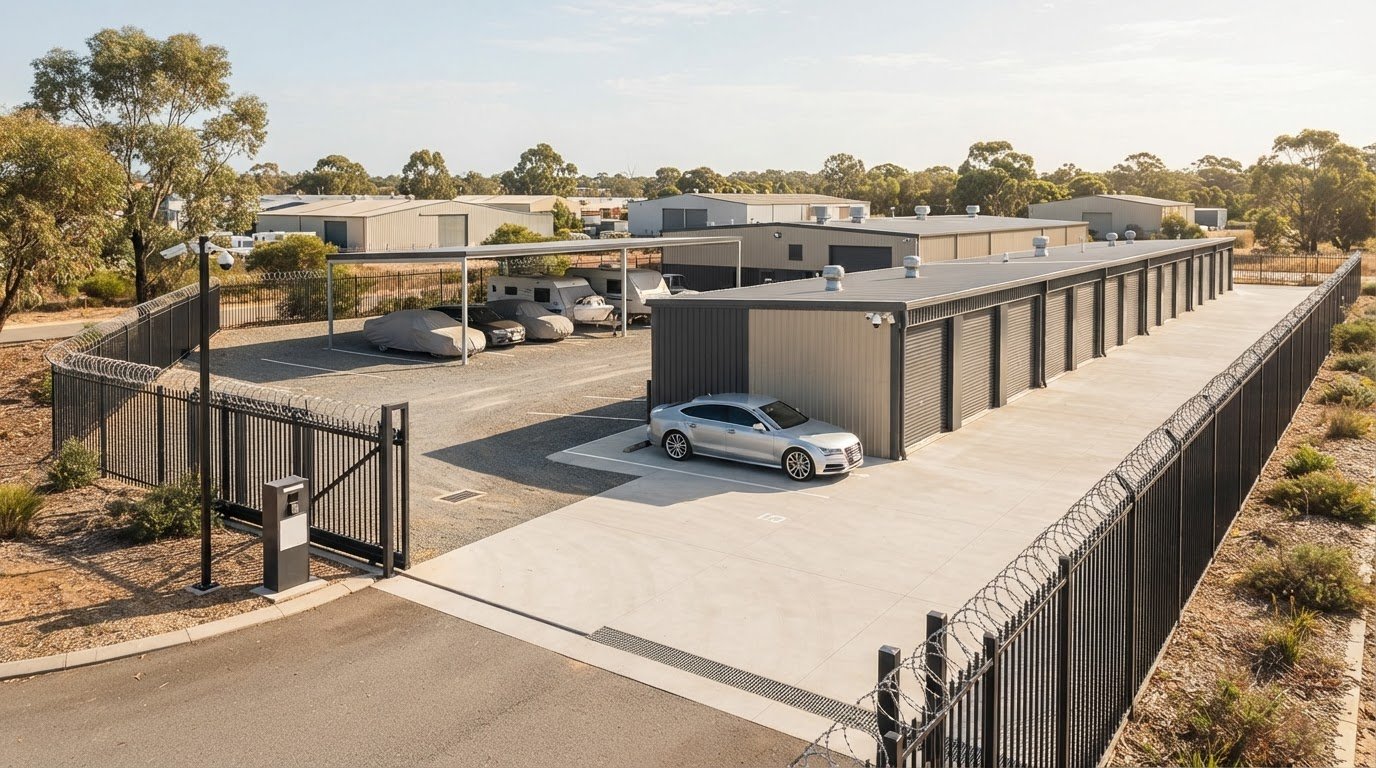
The nearest parking space isn’t automatically the right place for your vehicle. For car storage in Maddington, first decide whether a hardstand or undercover space suits your car, then compare security, access and cost. The right fit depends on how you plan to use the vehicle while it’s stored.
Compare more than the advertised price. Location, space type and security all affect whether a facility meets your needs, especially if you’re storing a valuable car or won’t use it for a while.
This guide covers advertised monthly rates and nearby facility prices, explains which security features to look for, and outlines the differences between hardstand and undercover storage. You’ll also learn what to consider for short- or long-term storage in Maddington South, so you can narrow down the options and choose a practical arrangement for your vehicle.
Key Takeaways
- Compare nearby parking and storage listings by space type and location to find options that suit your vehicle.
- Learn how CCTV, individually alarmed units and pin-code access can shape your security comparison.
- Distinguish advertised vehicle parking rates from self-lock storage unit rates before weighing costs.
- Consider how short- or long-term storage and contract flexibility fit your plans for the car.
- Compare hardstand and undercover storage, then choose the setup that best matches your vehicle and storage needs.
Need storage in Maddington South?
Maddington is in postcode 6109, with vehicle parking and storage options across nearby suburbs. Compare the space type, dimensions and move-in arrangements before choosing a site.
Indoor and Outdoor Vehicle Parking
Nearby listings include both covered and open parking. An Osborne Park bay measures 12.96 m² and is listed for covered and open parking, while undercover camper storage in Wattleup measures 13.2 m². These examples show why the advertised space type and vehicle footprint matter.
Before choosing a parking space, compare its stated dimensions with your car, including fitted accessories. Then consider whether hardstand or undercover parking better suits how you’ll access and store the vehicle.
Unregistered and Non-running Cars
For an unregistered or non-running car, clarify the storage agreement and how the vehicle will be moved into position. Describe its condition and whether it can be driven or needs to arrive by trailer or tow vehicle.
Ask how the site handles vehicle arrival and positioning, then plan transport around the car’s condition. This helps match the space and move-in process to a car that cannot be driven.
Vehicle Types and Sizes
Nearby listings cover cars, campervans and other vehicle parking needs, but each space has its own dimensions. A Leeming hardstand measures 19.38 m². Compare that footprint with your vehicle’s length and width, and account for anything extending beyond its body.
For car storage in Maddington, choose a space based on the actual vehicle, not just its category. Confirm that the space type and dimensions suit your car before planning the move-in.
Insurance requirements and cover depend on the storage agreement and your motor policy. Review both sets of terms to understand what cover applies while the car is stored.
A free loan trailer is available for storage and removals. As a loan trailer isn’t the same as vehicle hire, plan your journey around the transport option you’ll use.
To arrange storage, prepare your vehicle’s dimensions, condition and preferred space type. Have your identification and vehicle details ready, then review the agreement’s access, payment and insurance terms before signing.
CCTV, individually alarmed units and pin-code access
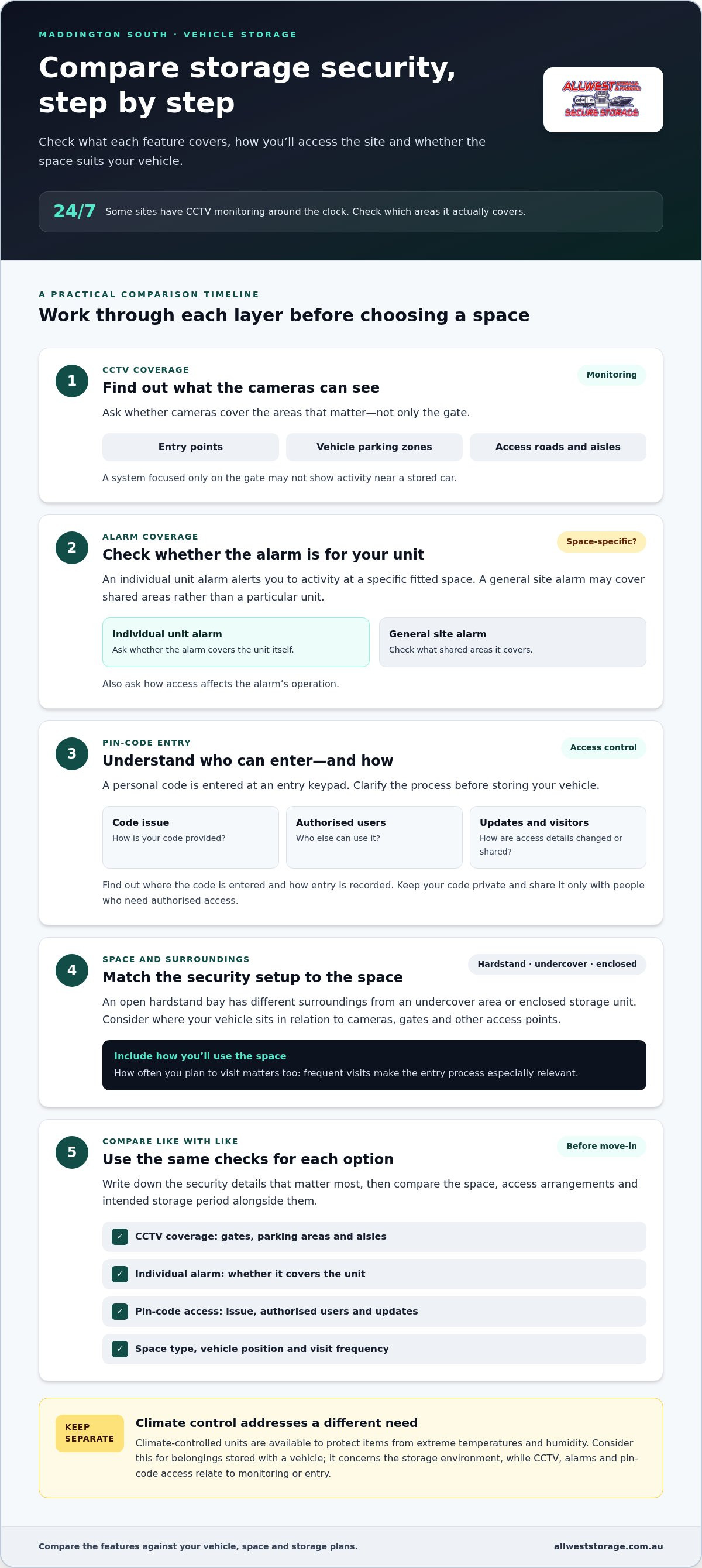
Security features serve different purposes. CCTV monitors activity around covered areas, an individual unit alarm alerts you to activity at a specific space, and pin-code access controls entry through a keypad. Compare what each feature covers when choosing vehicle storage.
A 24/7 CCTV-monitored site keeps surveillance operating around the clock. Ask which areas the cameras cover, such as entry points, vehicle parking zones and access roads. Camera coverage matters because a system focused only on the gate may not show activity near a stored car.
An individual unit alarm provides a separate alert for each fitted space, unlike a general site alarm that may cover shared areas rather than a particular unit. When comparing storage units, check whether the alarm covers the unit itself and how access affects its operation.
Pin-code access uses a personal code at an entry keypad. Before storing a vehicle, find out how the code is issued, who can use it and how access details are updated. Keep your code private and share it only with people who need authorised access.
Use these practical checks to compare security arrangements:
- Identify which gates, parking areas and aisles CCTV covers.
- Find out whether an alarm is assigned to an individual unit.
- Understand where a pin code is entered and how entry is recorded.
- Check how visitors or additional authorised users access the site.
Security also depends on the type of space. An open hardstand bay has different surroundings from an undercover area or enclosed storage unit. Consider how your vehicle’s position relates to cameras, gates and other access points, and how often you plan to visit.
Affordable storage still needs to meet your practical security needs. Compare the protection features alongside the space, access arrangements and intended storage period. A low-cost option may suit a vehicle that rarely moves, while frequent visits make the entry process especially relevant.
Before move-in, write down the security details that matter most: CCTV coverage, individual alarms and pin-code access. Use the same list for each option, so you can compare like with like. For a site with 24/7 CCTV monitoring, review the vehicle storage security features alongside the space arrangement.
Climate-controlled storage units are available to protect items from extreme temperatures and humidity. If you’re considering storing belongings with a vehicle, decide whether protecting those items from temperature and humidity changes is part of your storage needs. Compare this consideration separately from CCTV, alarms and entry arrangements: climate control addresses the storage environment, while the listed security features address monitoring or access.
Before choosing a space, consider what you plan to store, how long you expect to store it and whether climate-controlled storage is relevant to those items. Ask which type of space is available and whether it suits your intended arrangement. Keep the decision tied to your own requirements rather than assuming that every vehicle or storage situation needs the same conditions. Then compare the environment alongside the security features and access process, so the arrangement you choose reflects both the items being stored and the way you plan to use the space.
Nearby facility price comparisons
To compare Maddington, Kenwick and Cannington, match equivalent options. A vehicle bay, an enclosed storage unit and an undercover space meet different needs, so their prices aren’t directly comparable unless the space type and features match.
Vehicle storage pricing is provided after a quote request. Factors include vehicle size, space type, security requirements, access needs and storage period. Compare these details before deciding which option offers the best fit.
For car storage in Maddington, start with your vehicle’s dimensions and the space offered. Then compare equivalent hardstand or undercover options in Kenwick and Cannington. A larger space or different level of cover changes the comparison, even when listings use similar descriptions.
Location also affects a facility’s practical value. Maddington may suit your regular commute, while Kenwick or Cannington may be more convenient for another route. Consider how often you’ll visit, the distance from home or work and the time needed to collect your car.
Use this checklist to compare nearby options consistently:
- Record whether each listing is for open, undercover or enclosed parking.
- Match the advertised space dimensions to your vehicle.
- Compare CCTV, alarms and entry arrangements as separate features.
- Check how the agreement handles access and the intended storage period.
- Include the drive to Maddington, Kenwick or Cannington in your decision.
Space dimensions are useful, but they don’t establish equivalent pricing. For example, a vehicle bay in Osborne Park may differ from a Maddington space in location, cover and layout. Compare those details before treating the listings as alternatives.
For a clear comparison, make a table with a row for each suburb. Record the space type, dimensions, security features, access terms and quoted amount. This makes differences easy to see and helps distinguish a lower price from a better fit.
Kenwick and Cannington offer alternatives to Maddington, but a useful comparison depends on matching space types, dimensions and features. Compare equivalent arrangements rather than assuming one suburb is cheaper.
Short- and long-term storage with no lock-in contracts
Short- and long-term storage suit different plans. Before arranging either option, compare your expected stay, access needs and the agreement terms.
Long-term Storage
Long-term storage suits a vehicle that will remain unused for an extended period. Estimate how long you expect to store it, then choose a space type that fits your vehicle and plans. Flexible terms can accommodate changes to your storage period.
Before move-in, record your vehicle’s condition and organise its keys and relevant documents. Consider how often you might need access, even if you don’t plan regular visits. A car stored during travel, a move or a change in household arrangements may have different access needs from one kept between occasional uses.
For a longer stay, consider the full arrangement, not just the initial space choice. Decide whether your car needs undercover or hardstand storage, how you’ll access it and what the agreement says about ending or changing the arrangement. This makes it easier to plan if your return date or vehicle plans shift.
No Lock-in Contracts
No lock-in contracts mean you aren’t tied to a fixed long-term commitment. This can suit a temporary move, travel plans or a car awaiting its next use. Short-term storage is also available when you need a space for a limited or uncertain period.
Read the agreement before moving in. Note the billing period, payment arrangements, notice requirements and any steps for ending storage. No lock-in doesn’t remove the need to understand these terms; it helps avoid assuming that a flexible arrangement has no conditions.
Use a simple planning sequence:
- Estimate the likely storage period and identify what could change it.
- Choose a space type that fits the vehicle and intended stay.
- Read the agreement for payment, access and cancellation terms.
- Keep a copy of the agreement and your move-in records.
Work, travel and household plans can change, so flexible storage can help accommodate a shift in circumstances without a lock-in term. For example, if you’re storing a car during a temporary relocation, consider your expected stay and review the agreement if your return date changes.
Before committing, compare your expected storage period with the agreement’s practical terms. Make sure the access arrangements suit your plans and that you understand how to end or adjust the arrangement. This helps keep short- or long-term storage manageable as circumstances change.
Advertised monthly unit rates
Monthly listings need careful comparison because a vehicle parking space and a storage unit are different products. In Western Australia, check what an advertised rate covers before using it to estimate your car’s storage cost.
This is a rate for self-lock storage units, not a quoted price for vehicle parking. The distinction matters because a unit’s size and intended use differ from those of a hardstand or undercover vehicle space.
Vehicle storage pricing is provided after a quote request. Relevant factors include your car’s dimensions, whether you choose hardstand or undercover storage, security requirements, access needs and storage period. Compare these details with any advertised rate.
Use a simple comparison process before treating two monthly figures as equivalent:
- Identify whether the listing describes a vehicle space or a self-lock storage unit.
- Record the space type, such as hardstand or undercover.
- Compare dimensions with the car, including fitted accessories.
- Note whether the rate is monthly and what the listing says it covers.
- Account for security, access and the planned storage period.
For example, a self-lock unit advertised in Maddington may not suit a car, even if its monthly rate seems affordable. Compare a vehicle space with another vehicle space, not with a general storage unit, to keep the comparison relevant to your car’s needs.
Location can also affect value. A Maddington facility may be convenient for regular visits, while another suburb may better suit your usual route. Consider travel time and access alongside the monthly amount, especially if you expect to collect or return the car often.
Before deciding, record each option’s monthly basis, space type, dimensions and included features. Compare the complete arrangement with your needs, rather than choosing by the headline rate alone. For car storage in Maddington, request a quote based on your vehicle and preferred space.
When comparing quoted arrangements, distinguish the space features from its access arrangements. Customers can use their own padlock on a self-lock storage unit and keep the keys. This may suit someone who wants to manage the key themselves, but it doesn’t show that the unit is suitable for a vehicle. Check the intended use and dimensions, then consider the lock alongside your other requirements.
When reviewing options, note whether the arrangement is for a self-lock unit or a vehicle space, and keep those categories distinct. If the padlock detail is relevant, include it in your comparison notes rather than allowing it to outweigh space type, fit, access or storage period. Ask for clarification where a listing leaves the arrangement unclear, and compare like with like before deciding. A clear record of the space and its features makes the monthly amount easier to assess against your own priorities.
Allwest Storage & Parking: Caravan & Campervan Storage
Allwest Storage & Parking provides car storage with hardstand and undercover options, supported by 24/7 CCTV monitoring. Choose the space type that suits your vehicle and planned storage period. Short- and long-term storage is available, with flexible rates and no lock-in contracts.
Allwest Storage & Parking also offers storage for caravans and campervans, boats, trucks and trailers. Compare vehicle dimensions and access needs when choosing between hardstand and undercover storage. This helps match the space to your vehicle, whether it’s a car kept between trips or a larger vehicle stored for longer.
To discuss storage for your vehicle, visit Allwest Storage & Parking.
Make your next storage decision with confidence
Before choosing car storage in Maddington, turn your comparison into a practical plan. Note your vehicle’s dimensions, how often you expect to access it and whether your storage dates might change. These details help identify a suitable space and arrangement. Prioritise what matters most for your circumstances, whether that’s protection, access or flexibility.
Allwest Storage & Parking offers Car Storage, Caravan & Campervan Storage and Boat Storage. If you’re ready to discuss storing your vehicle, contact Allwest Storage & Parking with your requirements. You can outline the type of vehicle, preferred storage arrangement and expected term, then take the next step with a clearer idea of what you need. A well-prepared enquiry makes it easier to find an arrangement that fits your plans.
Frequently Asked Questions
What car storage facilities are available in Maddington, WA?
Options around Maddington include open vehicle parking, hardstand spaces, undercover bays and storage units. Examples nearby include a hardstand space in Leeming, undercover camper storage in Wattleup, and covered or open car bays in Osborne Park. Your vehicle’s dimensions and whether it can be driven help determine which format is practical. Compare location and space type before arranging transport or a move-in.
What are the monthly prices for car storage in Maddington?
These are different categories: a storage unit’s starting rate isn’t a vehicle parking quote. For a useful comparison, distinguish car spaces from general storage units and compare equivalent space types. Vehicle storage pricing depends on the space and arrangement you choose.
Which Maddington car storage facilities offer indoor or undercover parking?
Allwest Storage & Parking offers undercover storage for vehicles in the Perth area. Nearby listings also include an undercover camper storage space in Wattleup, measuring 13.2 m². These examples help identify covered options, but the vehicle’s dimensions still matter. Check that the space type and footprint suit your car, and consider how the facility’s location fits your collection and drop-off plans.
What security features do car storage facilities in Maddington provide?
Security features vary by facility and may include CCTV monitoring, individually alarmed units or pin-code entry. Allwest Storage & Parking provides 24/7 CCTV monitoring. Check what each feature covers: CCTV monitors designated areas, while an individual alarm relates to a particular unit. Pin-code access controls entry. Also distinguish security monitoring from site access hours, as CCTV operating around the clock doesn’t mean vehicle access is available around the clock.
Leave A Comment