
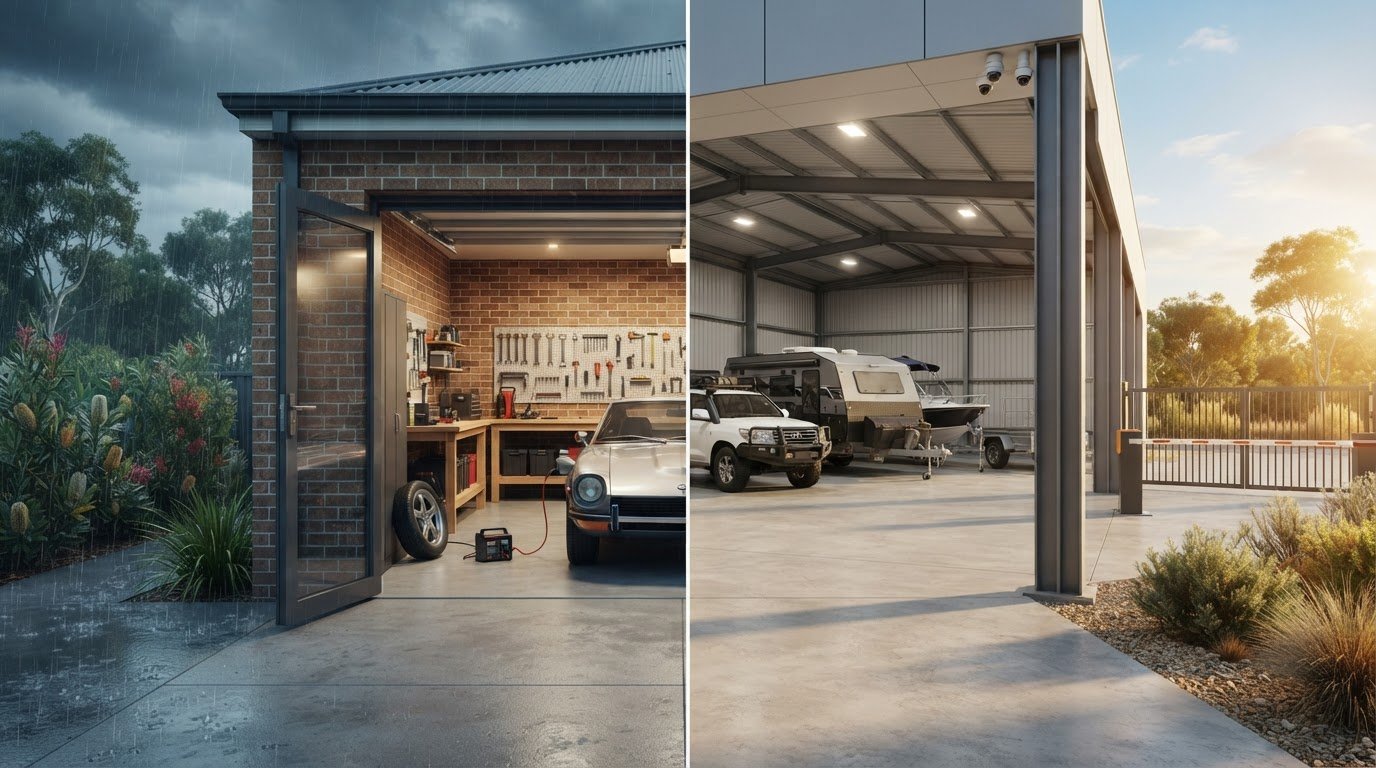
A home garage avoids storage fees, but the DIY car storage vs professional facility choice also depends on the protection and upkeep your vehicle needs. At home, you’re responsible for security, battery care, tyre pressure and checks for leaks. A professional facility can offer controlled access and CCTV, while undercover storage helps shield a vehicle from direct sun and rain.
Keeping a car at home can feel simpler, especially if you use it regularly. But a caravan, boat or trailer can take up valuable space, and any vehicle left unused needs preparation and attention wherever it’s stored.
This guide compares home and professional storage for security, weather exposure, insurance considerations and maintenance. You’ll also see how storage needs differ for cars, caravans, trailers and boats, with a practical decision guide to help match an option to your vehicle, storage period and available space.
Key Takeaways
- Home storage avoids a facility fee, but you’re responsible for vehicle security and routine upkeep while it’s parked.
- Compare facility security, access and space dimensions so your vehicle can be stored and retrieved with room to manoeuvre.
- Choose protection with your storage conditions in mind: undercover space limits direct exposure to sun and rain, while ventilation helps reduce trapped moisture.
- Review your insurance policy and registration arrangements before storage, especially if the vehicle won’t be driven.
- Match the storage option to the vehicle: cars, caravans, trailers and boats can have different space and access requirements.
Garage vs Professional Car Storage: What’s The Difference?
The DIY car storage vs professional facility choice comes down to the security controls, weather protection and access each option provides. A home garage keeps the vehicle close, while a professional site may add security measures across its shared entry areas.
Professional Facility Security
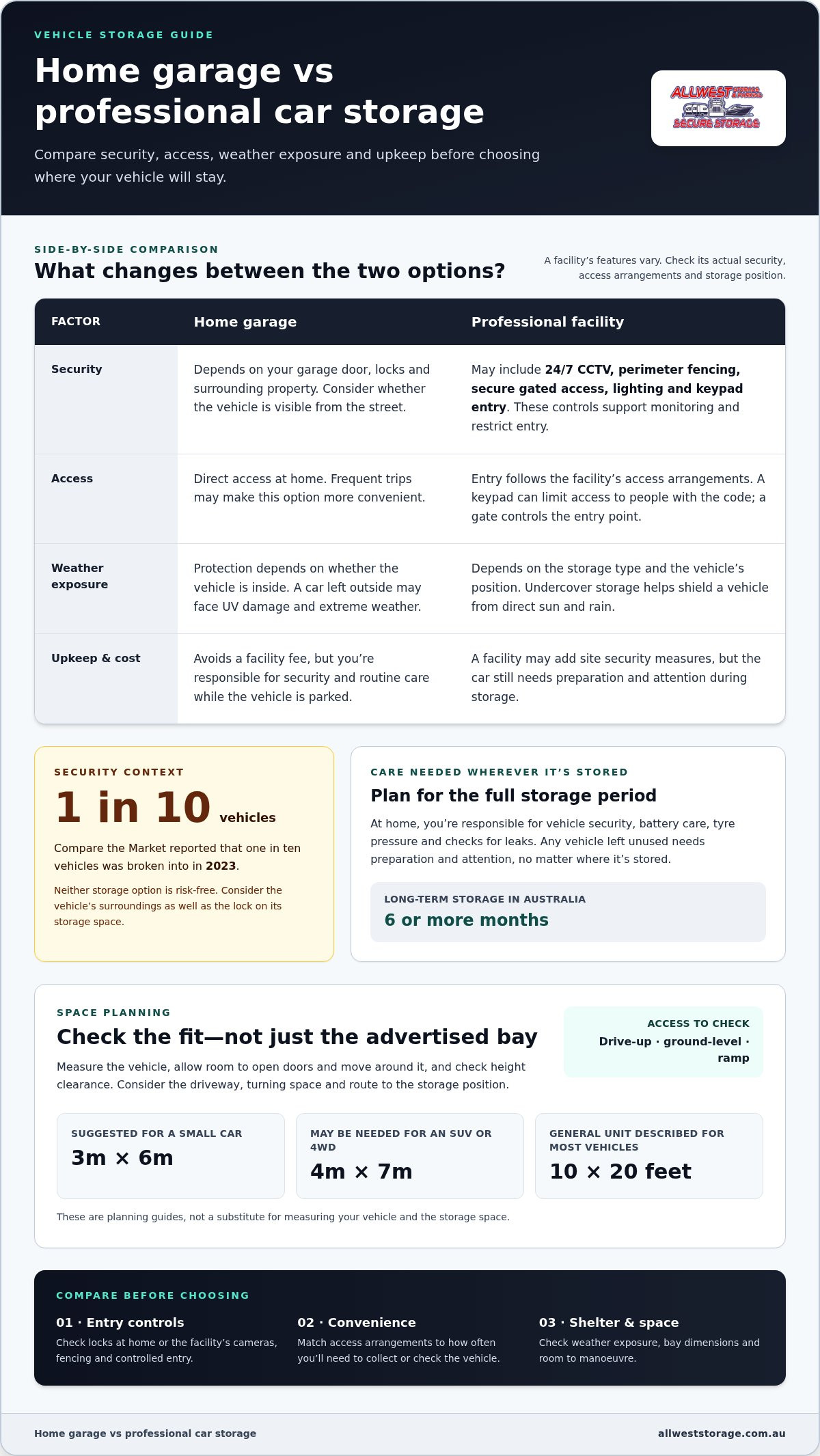
A professional facility can combine 24/7 CCTV monitoring with perimeter fencing, secure gated access, lighting and keypad entry. Each feature supports a different part of security: cameras monitor activity, fencing marks the boundary, and controlled entry limits who can come and go. A home garage depends on its own door, locks and surrounding property instead.
Access is part of the comparison. A keypad can restrict entry to people with the code, while a gate creates a physical entry point to control. CCTV may record activity at those points, and lighting can reduce dark areas around a vehicle. These measures can reduce theft risks, but neither storage option is risk-free.
Vehicle Protection and Security
A garage gives you direct control over who enters and when the vehicle is accessed. Its security depends on practical details, such as a working garage door and whether the vehicle is visible from the street. At a facility, security measures cover shared access areas, so protection also depends on the site controls and the vehicle’s position.
Consider the full storage duration, not only drop-off day. A car left at home may face theft, UV damage and extreme weather if it sits outside the garage. Compare the Market reported that one in ten vehicles was broken into in 2023. That figure makes the vehicle’s surroundings worth considering alongside the lock on its storage space.
Before choosing, list the security features your home garage has and compare them with the facility’s layout. Note whether the garage door locks securely and whether the car is visible from outside. For a facility, ask whether cameras, fencing and controlled entry are part of its security. Then consider how often you need access. Frequent trips may favour home storage, while a facility may suit a vehicle kept for longer.
| Storage option | Security controls | Vehicle access | Weather exposure |
|---|---|---|---|
| Home garage | Owner-managed door and locks | Direct access at home | Protection depends on whether the vehicle is inside |
| Professional facility | May include CCTV, fencing, lighting and gated or keypad access | Entry follows the facility’s access arrangements | Depends on storage type and vehicle position |
Use the DIY car storage vs professional facility comparison to assess visibility, entry controls, lighting and how often you’ll need access. Choose a garage if its security and convenience meet your needs; consider a professional facility if site security measures better suit the vehicle and storage period.
Is it safe to store a car long-term in a storage facility?
A storage facility can suit long-term car storage when its security, access and space match the vehicle. In Australia, long-term storage means 6 or more months. Safety also depends on preparing the car and choosing a site where you can store it without awkward manoeuvres or tight clearances.
Start with location. A facility close to your usual Perth routes can make collection and drop-off easier, while a site farther away may suit a car you rarely need. Consider the route from the entrance to the parking space, including turns, slopes and driveway width. A larger vehicle may need more room to manoeuvre than a small hatchback.
Then compare how you reach the storage space. Drive-up access lets you take the vehicle directly to its bay. Ground-level storage avoids ramps and lifts, which can simplify moving a low-clearance car. A vehicle on outdoor hardstand may have a different access arrangement from one kept undercover. Either way, a wide driveway and clear turning space make manoeuvring easier.
Dimensions matter just as much as the advertised space. A 3m x 6m space is suggested for a small car, while an SUV or 4WD may need 4m x 7m. A general storage unit for most vehicles is described as 10 x 20 feet. These are planning guides, not substitutes for measuring your vehicle and the bay.
Before choosing, measure the vehicle’s length and width, including mirrors where relevant. Allow room to open the doors and move around the car. Check height clearance too, particularly if accessories sit above the roof. A space that fits the vehicle’s outline may still be impractical if there’s no room to enter or exit comfortably.
- Compare the facility’s location with the trips you expect to make.
- Check whether access is drive-up, ground-level or via a ramp.
- Match the bay dimensions to the vehicle, then allow room for doors and movement.
- Consider the driveway, turning space and route to the storage position.
Location and access affect convenience, while suitable dimensions help prevent a poor fit. If you need to store your car in Perth, compare these practical requirements with the vehicle storage options available to you. Choose a space that accommodates the vehicle and makes arrival, parking and later collection straightforward.
Climate and humidity protection
For long-term storage in Australia, prepare the car before parking it and choose shelter that limits exposure to sun and rain. Clean it thoroughly, maintain tyre pressure, attend to the battery and use a breathable cover if needed.
Tyre and Exterior Protection
Correct tyre pressure helps reduce flat spots when a vehicle stays stationary. Check the tyres before storing the car, then include them in periodic checks during storage. Clean the exterior first, including bird droppings and tree sap, which can mark paintwork if left in place. A breathable vehicle cover can limit dust while allowing moisture to escape.
Weather Protection
Outdoor storage exposes a vehicle to weather and direct sunlight. Indoor storage blocks UV rays, rain and dust, offering more exterior protection during a long stay. Undercover space provides a practical middle ground by shielding the car from direct sun and rain, though it isn’t the same as a climate-controlled environment.
Choose the storage environment based on the exposure the vehicle would otherwise face. A car under a tree, for example, may collect sap and debris; one parked in an open driveway has no overhead shelter from sun or rain. CCTV monitoring addresses site security, not moisture or temperature, so consider these separate aspects of vehicle protection.
Moisture needs attention too. A fully enclosed bay without ventilation can trap humidity against paintwork and upholstery. Stable temperature and humidity can help protect a vehicle’s appearance and mechanics, while ventilation helps limit stagnant, damp air. A breathable cover is preferable to plastic sheeting or a tarp, which can hold moisture against the paint.
Before a long stay, change the oil and fill the fuel tank to help limit internal moisture and fuel-system condensation. For storage lasting 6 months or longer, disconnect the battery; a smart trickle charger can help maintain its charge during long-term storage. These steps reduce avoidable deterioration, but they don’t replace periodic checks.
- Wash and dry the vehicle, removing bird droppings and tree sap.
- Set tyre pressure correctly and recheck it during storage.
- Use a breathable cover, not plastic sheeting.
- Choose shelter that limits sun and rain, while allowing ventilation.
For example, a clean car in an undercover, ventilated space has less direct exposure than one left in an open driveway. Pair shelter with battery and tyre care to address other storage risks.
Registration and insurance while in storage
Before storing a car, consider registration status separately from insurance cover. Rules for keeping an unregistered vehicle at home can depend on local council requirements and the circumstances. Storage and driving on a public road are separate considerations.
Registration and Insurance
Keeping registration current and maintaining insurance can protect against risks such as theft or damage while the car is stored. However, some Australian car insurance policies exclude cover when a vehicle is unregistered. Read the policy wording for specific conditions, including how the insurer treats a car kept in a home garage, on a driveway or at a storage facility.
A standard comprehensive policy doesn’t automatically cover a stored car in the same way as one parked in a driveway. Storage-specific insurance commonly covers non-driving risks such as fire, theft or vandalism. The key difference is the cover’s focus: comprehensive cover may be designed around a vehicle that’s driven, while storage cover is intended for risks during a period without driving.
Potential Insurance Savings
Some insurers offer a reduced lay-up rate for vehicles that are stored rather than driven. This may suit a classic car or a second vehicle used only seasonally, but the cover may be narrower than a regular policy. Compare the premium with the risks you need covered, including theft, fire and damage while the car is stationary.
Tell your insurer how long the vehicle will be stored, where it will be kept and whether anyone will drive it. These details help establish which cover applies and whether a lay-up arrangement fits. Don’t assume that leaving the car in a garage or adding a cover automatically changes the policy or reduces the premium.
A car cover can help shield paintwork from dust and other exposure, but it isn’t an insurance policy. Likewise, a locked garage or professional facility doesn’t replace insurance cover. Keep these protections distinct: a cover addresses physical exposure, the storage location affects security, and the policy sets out insured events and exclusions.
Before putting the car away, use this simple sequence:
- Read the policy wording for unregistered-vehicle exclusions and storage conditions.
- Tell the insurer the car’s location and expected storage duration.
- Ask about storage-specific cover or a reduced lay-up rate, then compare included risks.
- Keep a record of the vehicle’s condition and where it’s stored.
Plan for the car’s battery too. A vehicle left unused can lose battery charge, so include battery care in your storage routine rather than treating insurance as protection against maintenance issues. For a stored classic, for example, make sure the policy reflects its non-driving status and your plans for occasional use. Clear arrangements can support peace of mind without paying for cover that doesn’t match how the vehicle is used.
Self-storage suitability for cars, caravans, trailers and boats
Choose storage by vehicle type, dimensions, storage term and how often you’ll use it. Storage terms can vary, so check how a facility defines short- and long-term stays. A car parked seasonally has different access needs from a boat or caravan kept out of use for an extended period.
For cars, match the space to the vehicle and how you plan to maintain it. Most passenger vehicles can be stored for 6-12 months without significant issues when properly prepared. Indoor storage blocks sun and rain, making it a practical option for a valuable or luxury car stored long-term. Outdoor parking can suit a shorter stay or a lower-budget need, but leaves the vehicle exposed to the elements.
Caravans and campervans often need a longer bay than a passenger car. Australian facilities generally accommodate standard caravans, but measure the vehicle and check dimensions for units over 8 metres. A storage space of 5m or more is suggested for a caravan or trailer. Covered storage can protect a caravan or motorhome from direct weather exposure, which may be useful between trips or during seasonal downtime.
Trailers can suit outdoor storage for a short stay, particularly when used intermittently. Check the overall length, including the tow hitch, and leave room to access and manoeuvre the trailer. For a caravan or boat on a high trailer, check height clearance: an internal doorway can prevent entry even when the floor space seems adequate.
Boats need storage suited to their hull, trailer and height. Custom-sized space is recommended because boat and trailer dimensions vary. Before choosing a parking position, account for the full length and width, protruding equipment and the room needed to move the boat safely. Seasonal storage can keep a boat off the driveway between outings, while indoor or undercover space offers shelter from direct sun and rain.
Use this quick guide to narrow the options:
- Car: consider indoor storage for a long-term stay or a high-value vehicle.
- Caravan or campervan: measure total length and height, then consider covered space for seasonal storage.
- Trailer: outdoor storage can suit short stays; allow room for the hitch and manoeuvring.
- Boat: match the space to the boat and trailer, including height clearance.
A suitable term storage arrangement should fit the asset and its use, not just the available parking space. For Perth vehicle owners comparing options for cars, caravans, trailers or boats, explore vehicle storage options that match the vehicle’s dimensions and storage needs.
Allwest Storage & Parking: Caravan & Campervan Storage
Allwest Storage & Parking provides vehicle storage when a home driveway or garage doesn’t suit your vehicle or storage period. Options include Caravan & Campervan Storage, Boat Storage, Car Storage and Truck & Trailer Storage, with hardstand and undercover choices.
Choose between hardstand and undercover storage, with 24/7 CCTV monitoring. Undercover space can help limit direct exposure to sun and rain, while hardstand provides an outdoor parking option. Both short-term and long-term storage are available, with flexible rates and no lock-in contracts.
If your caravan, boat, car, truck or trailer needs a dedicated place to stay, contact Allwest Storage & Parking or visit allweststorage.com.au.
Choose a storage plan that suits your next move
Your storage choice can change as your plans do. A vehicle used regularly may need convenient access, while one parked for a season may suit a dedicated space. Revisit the decision when your parking needs or expected storage period changes. The DIY car storage vs professional facility decision should fit how you’ll use the vehicle next, not just where it can sit today.
Allwest Storage & Parking offers Caravan & Campervan Storage, Boat Storage and Car Storage. These options can suit owners who need a separate place for a vehicle rather than keeping it at home. Consider which type of storage best matches your vehicle and plans.
Take the next step by exploring the available options and discussing your storage needs. Contact Allwest Storage & Parking to find a suitable direction for your vehicle’s next stay.
Frequently Asked Questions
How Much Does It Cost To Keep A Car In Storage?
The cost depends on where you store the car, the space it needs and how long it stays. A DIY car storage vs professional facility comparison should include more than a facility’s charge. For a home garage, consider setup or security improvements and ongoing upkeep. At Allwest Storage & Parking, rates depend on vehicle size, storage type and duration. Request a quote to compare the cost with your home-storage needs.
How to Select the Ideal Car Storage Space?
Choose a space that fits the whole vehicle and your access needs. Measure beyond the bodywork: include mirrors, roof racks or other fitted accessories. Consider whether you’ll need to reach the boot, connect a battery charger or move items around the car. For a Perth vehicle used seasonally, also think about how straightforward collection will be when you’re ready to drive it again.
Should I store my car indoors or outdoors?
Choose undercover storage if limiting exposure to sun, dust and rain is a priority, particularly for a classic car or a vehicle with a sensitive finish. Outdoor hardstand can suit a larger vehicle or a shorter stay where sheltered space isn’t essential. Think about the car’s condition, how often you’ll access it and the exposure at the parking location before deciding.
What does DIY car storage cost in Australia, including garage or shed setup?
DIY storage costs depend on whether you already have a suitable garage or need to create one. For a new shed or garage, consider construction materials, the door and lock, and any site preparation. An existing space may still need security improvements or equipment for vehicle care. Ongoing costs can include battery maintenance, cleaning and checks while the car is stored.
How much do professional car storage facilities cost in Australia?
Professional storage pricing varies with the vehicle’s size, storage type and duration. Allwest Storage & Parking provides a quote based on these factors, with discounted rates available for extended stays. For a useful comparison, decide whether hardstand or undercover storage suits your needs and how long the car will be away. Avoid comparing a short stay with a longer-term arrangement as if they were identical.
What insurance is needed for a car stored at home versus a professional facility in Australia?
Keep cover that matches the car’s registration status, location and use. Some Australian policies exclude cover when a vehicle is unregistered, and comprehensive cover doesn’t automatically treat a stored car like one in regular use. Ask your insurer about fire, theft and vandalism cover during storage, and read the policy wording. A storage location or car cover doesn’t replace an insurance policy.
What security features should I look for in a professional car storage facility?
Look for multiple security layers, not just a lock on the parking space. Useful features include 24/7 CCTV monitoring, perimeter fencing, secure gated access, lighting and keypad entry. Consider how these work together: controlled entry limits access, lighting improves visibility around entry points, and cameras monitor activity. Also assess whether the access route allows you to bring the vehicle in and out without difficulty.
What are the risks of storing a car at home compared with a professional facility?
The DIY car storage vs professional facility decision depends partly on who manages security, weather exposure and routine checks. At home, you manage the garage or driveway yourself. A professional facility can provide site security measures, but you’ll use its access arrangements and storage conditions. For example, a car parked outside at home faces more direct exposure than one kept under cover. In either setting, plan for battery care and insurance.
Leave A Comment