
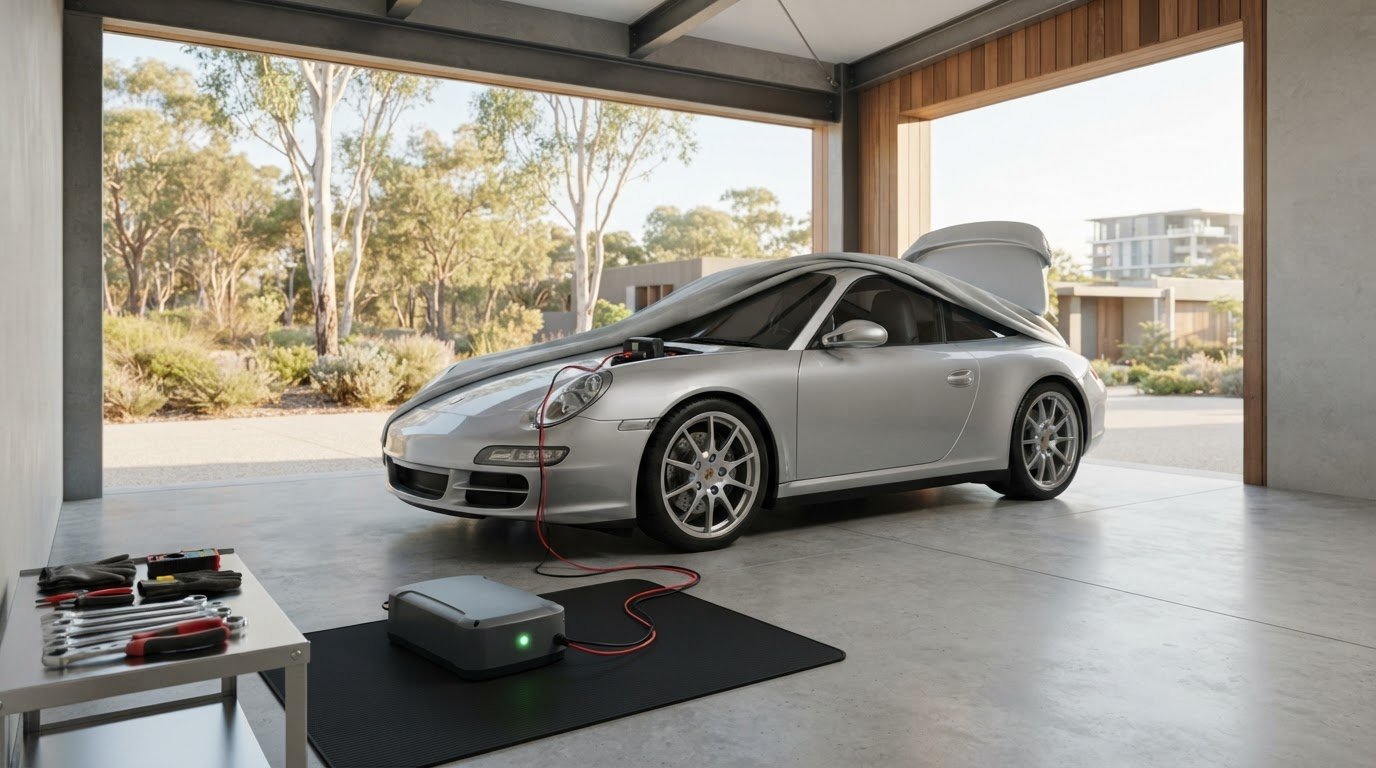
Could a battery tender help protect your car during storage, or create a risk if it’s left connected? A parked vehicle can still draw power for onboard systems, so its battery may lose charge over weeks or months. If you’re planning to leave your car off the road, a long term storage car battery tender may be part of your preparation.
A suitable smart tender can help maintain charge, but the right choice depends on your battery type and the tender’s instructions. A traditional trickle charger works differently and may not be suitable for prolonged connection. Choosing a long term storage car battery tender means checking compatibility and setting it up safely, not simply plugging in any charger and walking away.
This guide explains when a tender can help, how to use one with care and what else to consider before storing your vehicle. You’ll also learn how to weigh battery maintenance against disconnecting the battery and plan a practical storage arrangement in Perth. Allwest Storage & Parking offers short- and long-term car storage, with hardstand and undercover options, so you can consider the vehicle’s storage space as part of your wider plan.
Key Takeaways
- Use a battery tender to help maintain charge during storage, but distinguish it from a charger designed to recharge a flat battery.
- Choose a long term storage car battery tender that matches your battery chemistry and the vehicle and battery manufacturers’ instructions.
- Compare using a tender with disconnecting or removing the battery. Consider vehicle electronics, access to power and your comfort with each option.
- Before connecting equipment, read the manuals and inspect the battery and leads for visible damage.
- Plan battery care separately from your storage space, then compare Perth car-storage options such as hardstand and undercover storage.
Why a car battery can drain during long-term storage
Will your car start after weeks or months without being driven? That depends partly on what continues using power while the vehicle is parked, as well as the battery’s condition and how long the car is stored. A battery can gradually lose charge even when the engine is off, so plan ahead rather than assuming the car will be ready to go.
A battery tender is designed to maintain a battery’s charge while a vehicle is not in regular use. It differs from a conventional charger, which is generally used to replenish a battery that has lost charge. Some smart units can perform both roles, but not all chargers are designed for ongoing maintenance. Check the device instructions and your vehicle’s guidance before choosing a long term storage car battery tender. The Automotive Battery – Wikipedia overview explains the basic purpose of automotive batteries and the different types used in vehicles.
Battery care is one part of preparing a car for storage. The vehicle also needs a suitable place to be kept, but a storage space doesn’t maintain the battery’s charge. Treat these as related planning decisions, not the same task.
What causes battery drain when a car is parked?
Turning off the ignition doesn’t necessarily switch off every electrical system. A clock may keep time, a security system may remain active, and other electronics may retain settings or monitor the vehicle. These systems draw small amounts of power while the car sits unused.
Parasitic draw is the small amount of electricity a vehicle’s electrical systems continue to use after the car is switched off. That draw, combined with the battery’s gradual loss of charge, can leave less power available to start the engine. The risk varies with battery condition, vehicle design and how long the car is parked. For model-specific guidance, consult the owner’s manual or vehicle manufacturer.
When does long-term storage call for a battery plan?
A short spell parked at home may not need the same preparation as a vehicle left unused for an extended period. There’s no single cutoff that applies to every car. Consider the battery’s age and condition, which electronics remain active, and whether you’ll have access to a suitable power supply where the vehicle is stored.
If the battery is already struggling to start the car, leaving it unused may add to the problem. Check the vehicle guidance before deciding whether to maintain the battery, disconnect it or take another approach. Follow the manufacturer’s instructions for any work involving battery terminals, as disconnecting the battery can affect electronic settings and systems.
Make the battery decision separately from the storage-space decision. A tender may help maintain charge when used correctly, while the storage location determines where the vehicle will be kept. In Perth, comparing hardstand and undercover car storage can help you plan the overall arrangement, but neither option replaces battery care.
How a car battery tender works and what to check
A battery maintainer is intended to support a battery’s charge while a vehicle is out of regular use. It connects to the battery and supplies power according to the unit’s design. That doesn’t mean every charger is suitable for leaving connected over time. Names such as “tender”, “maintainer” and “trickle charger” aren’t always used consistently, so the product manual matters more than the label.
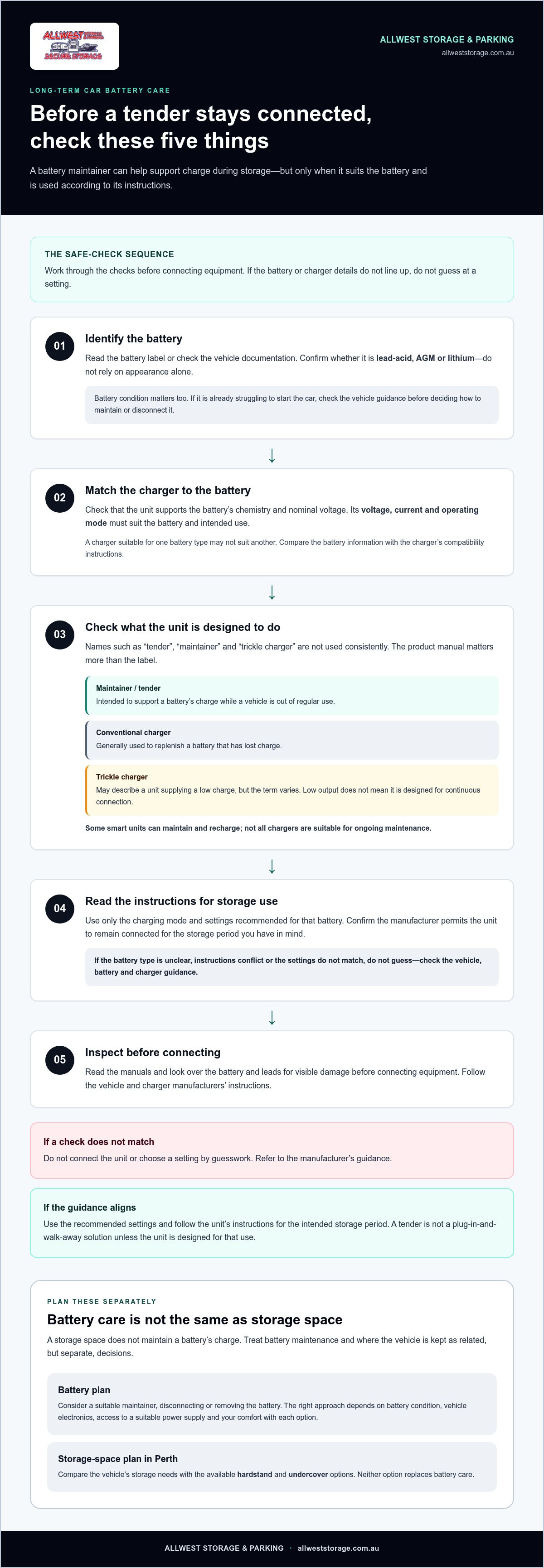
For a long term storage car battery tender, start with the battery, not the sales description. Identify its chemistry and check the recommended charging settings in the vehicle and battery documentation. The charger’s voltage, current and operating mode must suit the battery and intended use. If instructions conflict or the battery type is unclear, don’t guess at a setting.
Tender, maintainer and trickle charger: what is the difference?
A conventional charger is generally intended to recharge a battery that has lost charge. A maintainer is intended to support charge over a longer period. A trickle charger may describe a unit that supplies a low charge, but terminology differs between manufacturers and products. Don’t assume a device is designed for continuous connection because it has a low output or is called a tender. Follow the specific unit’s manual.
Check battery chemistry and charger compatibility
Battery chemistry matters because different types can need different charging settings. Check the battery label or vehicle documentation to identify whether it is lead-acid, AGM or lithium, then compare that information with the charger’s compatibility instructions. Don’t assume a unit suitable for one type will work with another. Follow both the vehicle and charger manufacturers’ guidance before connecting anything.
Use this quick check before selecting or setting up a maintainer:
- Identify the battery. Read its label or consult the vehicle documentation rather than relying on appearance alone.
- Check compatibility. Confirm that the charger supports the battery’s chemistry and nominal voltage.
- Review the settings. Use only the charging mode and settings recommended for that battery.
- Read the operating instructions. Check whether the manufacturer permits the unit to remain connected for the storage period you have in mind.
- Stop if details don’t match. Don’t connect the unit if its instructions and the battery guidance appear incompatible.
This process helps narrow down a suitable option without assuming one model fits every car. It also separates two decisions: choosing compatible battery equipment and choosing where to keep the vehicle. If you’re arranging a place for your car in Perth, Perth car storage options can be part of that wider plan. The storage space itself doesn’t replace battery care.
Battery tender vs disconnecting or removing the battery
A tender isn’t automatically necessary for every stored car. The best approach depends on the vehicle’s requirements, battery type, access to suitable power and your confidence handling the battery. A compatible maintainer can be practical where power is available. Disconnection or removal may suit other situations, but can affect vehicle systems and should only be done according to the manufacturer’s instructions.
Use this comparison as a starting point, then follow the vehicle manual for model-specific guidance.
| Option | Battery compatibility | Vehicle electronics | Power access and practical trade-off |
|---|---|---|---|
| Use a tender | Must match the battery type and the manufacturer’s charging guidance. | Battery stays connected, which may help retain settings, but the vehicle’s requirements still apply. | Needs suitable power where the car is stored. Convenient when equipment and connection are appropriate. |
| Disconnect the battery | Doesn’t require charging equipment, but the battery still needs to be handled as instructed. | May reduce some vehicle-related power draw. Settings or systems may be affected. | Doesn’t need a power supply, but reconnecting and restoring vehicle functions may take care. |
| Remove the battery | Charging or storing it separately still requires guidance suited to that battery. | Vehicle systems lose their connection to the battery, which may affect settings or operation. | Requires safe removal and a suitable place to keep the battery. It’s a more involved option. |
When might a maintainer be the practical option?
A maintainer may be practical if the vehicle manual allows it, the unit is compatible with the battery and suitable power is available at the storage location. Follow the charger’s connection and operating instructions, along with any vehicle-specific requirements. A long term storage car battery tender can support charge, but it doesn’t remove every battery or vehicle-storage risk or guarantee the car will start.
When might disconnection or removal suit the situation?
Disconnection can reduce some vehicle-related power draw, depending on the car, but it may also reset settings or affect electronic systems. Removing the battery adds handling and storage considerations. Don’t rely on a generic procedure: check the owner’s manual for the correct steps and any effects on your model. If the process or safe battery handling is unclear, don’t improvise.
Think through the practical details before deciding: Is compatible equipment available? Is there a suitable power supply? Do you know how your vehicle responds to a disconnected battery? These answers help narrow the choice. Whichever approach you take, keep it separate from the decision about where the car will be stored. A storage space doesn’t maintain battery charge.
How to prepare and connect a tender before storing your car
Set up a tender methodically. The vehicle and charger manuals should guide each step, including whether the battery can remain connected and how the unit must be used. Don’t rely on a generic connection sequence: requirements can differ between vehicles and chargers.
A practical pre-storage checklist
- Read both manuals first. Check the vehicle’s battery-care instructions and the tender maker’s directions. Confirm the recommended connection method and whether the equipment is intended for use during extended storage.
- Identify the battery type. Use the battery label or vehicle documentation, then confirm that the tender supports its chemistry and voltage. Select only the settings specified by the manufacturers.
- Inspect before connecting. Look over the battery, charger leads and connectors for visible damage. Don’t use equipment with frayed, cracked or otherwise damaged leads, or connect it to a battery that appears damaged.
- Choose a suitable parking and charging arrangement. Follow the tender instructions for where and how it can be used. Make sure the setup can be arranged as directed, with connections secure and leads positioned as the manufacturer specifies.
- Connect and power the unit as instructed. Follow the exact sequence in the tender manual. Don’t improvise connection points or settings, and don’t leave equipment connected for longer than its instructions permit.
- Stop if you’re unsure. If the vehicle requirements are unclear or you’re not confident handling the battery or making the connection, don’t proceed. Follow the vehicle and equipment manufacturers’ instructions.
Safety reminder: Stop if the battery, leads or connection appear damaged. Don’t connect or continue using the tender until the issue has been assessed.
Check the setup during storage and before driving
During storage, follow the tender maker’s directions for any checks and the permitted connection duration. Don’t assume every unit is designed to stay attached indefinitely. If the connection becomes loose or you notice visible damage, don’t adjust or repair it while it’s powered. Follow the manufacturer’s safety instructions.
Before driving again, inspect the battery area, tender leads and connection points for visible damage or corrosion. If anything looks concerning, avoid starting the car until you’ve followed the relevant guidance. When disconnecting the tender or reconnecting a battery, use the procedure in the vehicle manual. This can help you avoid affecting vehicle systems or settings through an unsuitable process.
A careful setup is one part of a wider storage plan. The tender and power arrangement must suit the vehicle; the storage space is a separate decision. If you’re planning to store a vehicle in Perth, explore Perth car storage options as you organise where it will be kept.
Plan long-term car storage in Perth around battery care
Storing a vehicle involves two separate decisions: how to care for its battery while it’s unused, and where to keep the car. A suitable storage space won’t maintain battery charge. Likewise, a battery tender doesn’t determine whether hardstand or undercover storage better suits your vehicle and plans. Treat both as parts of one storage checklist, and make each choice on its own merits.
Choose a vehicle storage arrangement that fits your plans
In Perth, Allwest Storage & Parking offers hardstand and undercover car storage, with 24/7 CCTV monitoring. These options address where the vehicle is kept, not its battery charge. Choose the space that suits your storage needs, then make a separate plan for battery care and any equipment you intend to use.
Allwest offers short- and long-term storage, flexible rates and no lock-in contracts. If you’re weighing up how long to store the vehicle, compare the practical differences between long-term versus short-term vehicle storage in Perth as part of your planning. Consider the expected storage period, how you’ll access the car and whether your battery-care approach depends on access to power. Don’t assume that a particular storage arrangement includes battery maintenance.
Make the battery plan part of your storage checklist
Before leaving the vehicle, write down the battery type, the maintenance approach you’ve chosen and the relevant instructions from the vehicle and equipment manufacturers. Keep the instructions accessible so you can follow the same safe process when inspecting the car or preparing to use it again.
- Record the battery details. Note its type and any manufacturer guidance relevant to storage.
- Set out the chosen approach. Record whether you’ll use compatible maintenance equipment or follow the vehicle maker’s guidance on another method.
- Plan access. Think about when and how you’ll reach the vehicle to carry out any checks required by the equipment instructions.
- Consider power separately. If your plan uses a tender, establish whether the required power access and setup are suitable at the chosen location. Don’t assume they’re available simply because the car is in storage.
- Plan for the return to use. Keep the vehicle manual handy for the correct battery reconnection and starting procedure.
For a long term storage car battery tender plan, the storage location and charging setup need to work together without being mistaken for the same service. Perth vehicle owners can choose Allwest’s hardstand or undercover car storage, then organise battery care according to their vehicle and equipment instructions. Explore car storage in Perth with Allwest to plan where your vehicle will be kept.
Set up your next step with confidence
Before the car goes off the road, make a simple plan for who will be responsible for it and what needs to happen before it’s driven again. Note your intended return date, where you’ve kept the vehicle and battery instructions, and any checks to complete before setting off. A clear handover plan is useful if someone else may need to access the car while you’re away.
There’s no single approach that suits every vehicle. Use the manufacturer’s guidance to decide whether a long term storage car battery tender fits your car, and keep battery care separate from your choice of storage space. For the storage side of your plan, Allwest offers hardstand and undercover car storage, 24/7 CCTV monitoring, and short- and long-term arrangements with no lock-in contracts.
Take the next step at your own pace. Explore car storage options in Perth and choose a practical place for your vehicle while you organise its care.
Frequently Asked Questions
Do I need a battery tender for long-term car storage?
Not necessarily. Your choice depends on the vehicle’s battery condition, how long it will be unused and the manufacturer’s storage guidance. A car with a newer battery and a suitable alternative plan may not need a tender, while an older battery may need closer attention. Before choosing a long term storage car battery tender, check the car manual and consider how you’ll monitor the vehicle during storage.
Can I leave a battery tender connected while my car is stored?
Only if the tender’s instructions and your vehicle’s requirements allow it. Check that the unit is intended for the connection duration, compatible with your battery and set up as directed. If the car is stored somewhere you can’t access or inspect, plan how you’ll respond if the equipment or connections show a problem. Don’t assume a tender is safe to leave connected indefinitely simply because it’s designed for battery maintenance.
What is the difference between a battery tender and a trickle charger?
Manufacturers can use these terms differently, so check what the specific unit is designed to do. A traditional trickle charger may supply a continuous low current, which can risk overcharging if left connected. A maintainer is intended to support charge during storage, but its features and permitted connection time vary. Read the product manual rather than relying on the name, and don’t use a charger for extended connection unless its instructions allow it.
Can I use a battery tender with an AGM or lithium car battery?
Only if the particular tender is designed for that battery chemistry and its settings match the manufacturer’s guidance. AGM and lithium batteries shouldn’t be treated as interchangeable with standard lead-acid batteries for charging purposes. Check the battery label and vehicle documentation, then confirm compatibility in the charger manual. If either source rules out the proposed setup, don’t connect it. Use the specified charging approach for your battery instead.
Is it better to disconnect a car battery or use a tender during storage?
Neither option is universally better. A tender may suit a vehicle that permits maintenance charging and has appropriate power access. Disconnecting may suit a different vehicle, but can affect settings or systems and may not be appropriate for every model. Compare the vehicle’s manual, battery condition and storage arrangements before deciding. If you’re unsure how disconnection could affect the car, don’t experiment.
How often should I check a car battery during long-term storage?
Follow the battery and tender manufacturers’ guidance, as inspection intervals depend on the equipment and vehicle. Avoid setting a schedule based on guesswork. Keep a simple record of the last inspection, any visible changes and the next check recommended in the manuals. If you can’t access the vehicle at the suggested intervals, factor that into your maintenance choice before storage rather than assuming the tender removes the need for checks.
Can Perth’s warm conditions affect a car battery in storage?
Warm surroundings can be a factor in battery condition, but Perth’s climate alone can’t tell you how a particular battery will fare. Battery age, condition, vehicle design and the actual storage environment also matter. Check the battery maker’s storage advice and don’t assume an undercover space controls temperature. If the battery is already showing signs of weakness, have its condition assessed before leaving the car unused for an extended period.
Leave A Comment