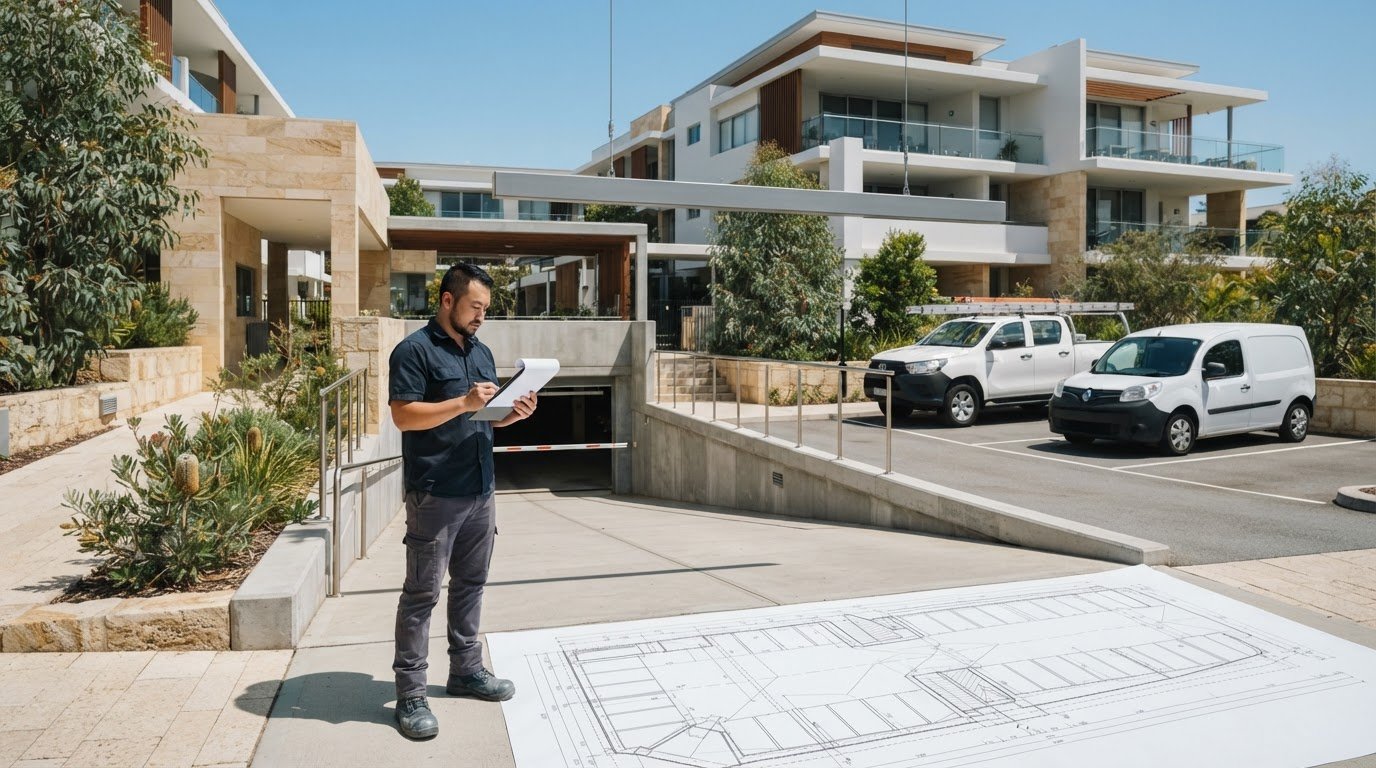
Can your strata company legally ban you from parking your work ute, van, or truck on site? The short answer is yes. Understanding how strata bylaws parking commercial vehicle WA rules apply to your scheme is critical if you want to avoid formal breach notices and escalating neighbour friction.
It’s frustrating to finish a long day on the tools only to find your vehicle doesn’t clear the basement ceiling, or to face strata fines simply for parking in a shared bay. Leaving your livelihood out on the street or verge isn’t a safe option when thousands of dollars in equipment are at risk, but ignoring strata warnings can quickly land you in the State Administrative Tribunal.
You’ll learn your direct rights under Western Australian strata legislation, how to manage standard conduct bylaws versus bespoke scheme rules, and how to request a formal parking exemption. We also evaluate safe, fully compliant off-site parking alternatives that resolve your strata compliance headaches immediately.
Key Takeaways
- Understand how Schedule 2 conduct rules and bespoke strata bylaws parking commercial vehicle WA frameworks define work utes, vans, and trade trucks.
- Learn the legal boundary between private lot bays and scheme common property, including strict prohibitions on using visitor bays for commercial vehicles.
- Follow practical steps to verify your scheme’s registered rules via Landgate WA and measure bay clearances before receiving breach notices.
- Discover the process for lodging formal exemption requests with your strata council before issues escalate to the State Administrative Tribunal (SAT).
- Evaluate the operational advantages of dedicated off-site hardstand or undercover storage for protecting valuable tools and avoiding residential strata friction.
What Defines a Commercial Vehicle Under WA Strata Bylaws?
Western Australian strata legislation does not provide a single, universal definition for a commercial vehicle. Under the Strata Titles Act 1985, governance focuses primarily on land use, dividing property between private lots and shared areas. To understand your parking rights, you first need a clear grasp of what strata title means regarding the physical boundaries of your lot versus common property.
Because the Act leaves specific definitions open, strata companies often rely on local government planning schemes or tailor their own rules. Councils like Armadale and Bayswater define commercial vehicles by their trade use, weight, and overall dimensions. Strata councils regulate these vehicles to protect structural property, preserve residential aesthetics, and prevent oversized trade transport from blocking narrow access ways.
Standard Bylaws vs Bespoke Scheme Rules in WA
Under default Schedule 2 conduct bylaw 1, an owner or occupier must not park or stand any motor vehicle on common property without written strata company permission. While standard bylaws apply to many complexes, schemes regularly register bespoke rules through Landgate Western Australia. Enacting a new restriction on vehicle weight, height, or signage requires a special resolution passed by lot owners. Once registered, these bespoke strata bylaws parking commercial vehicle WA restrictions carry the full weight of enforceable scheme rules.
Common Vehicle Classifications Impacted by Strata Rules
Not every work vehicle triggers a dispute, but certain trade modifications draw immediate strata scrutiny. Councils typically target four main vehicle types:
- Dual-cab trade utes: Standard utes are generally classified as passenger vehicles. However, adding high ladder racks, heavy toolboxes, or full commercial advertising wraps can push them into commercial classifications under bespoke bylaws.
- High-roof commercial vans: Extended-wheelbase vans often exceed standard basement bay heights (typically 2.1 to 2.2 metres), preventing safe basement entry.
- Light rigid trucks: Vehicles with a Gross Vehicle Mass (GVM) exceeding 4.5 tonnes face outright bans in almost all residential strata complexes due to driveway pavement weight ratings.
- Trade and plant trailers: Enclosed box trailers, hydraulic tippers, and equipment carriers parked on common property without written approval regularly trigger immediate council breach notices.
Key Strata Parking Restrictions: Common Property vs Lot Bays
Strata enforcement shifts dramatically depending on where your wheels touch the ground. Your designated lot bay belongs to your proprietary footprint, whereas scheme driveways, turnarounds, and visitor zones remain shared common property. Knowing this boundary is essential when dealing with strata bylaws parking commercial vehicle WA enforcement notices.
Strata companies possess clear statutory power over shared property. While your private lot bay offers greater flexibility, that freedom isn’t absolute. Many contractors assume their titled bay gives them complete freedom, only to receive formal breach notices over structural risk, vehicle overhang, or prominent trade signage visible from the street.
Can Strata Restrict Commercial Vehicles in Your Own Bay?
Your strata company cannot arbitrarily ban personal vehicles inside your titled bay, but they can enforce bylaws that prevent unreasonable nuisance or structural hazards. If a high-roof van or extended work ute overhangs the bay boundary, blocks line of sight, or encroaches on adjacent spaces, the council can take immediate action. Bespoke bylaws also routinely restrict the storage of industrial chemicals, fuel containers, and oxy-acetylene tanks within private residential car bays to meet fire safety codes.
The Strict Rules Around Visitor Parking and Driveways
Visitor bays are strictly reserved for genuine short-term guests; using them as overflow storage for work fleets breaches standard conduct bylaws instantly. When contractors park commercial vehicles in visitor bays or narrow thoroughfares, strata managers can issue breach notices or take the matter directly to the State Administrative Tribunal (SAT) for enforceable penalty orders. Councils can also partner with local councils to issue municipal parking infringement notices on scheme grounds.
Managing Structural and Surface Risks on Common Property
Trade vehicles introduce unique physical risks to residential developments that councils actively protect against through strict bylaws:
- Driveway surface damage: Commercial trucks exceeding residential pavement weight ratings crack pavers and degrade epoxy basement floors.
- Chemical and oil leaks: Bylaws hold lot owners financially liable for professional high-pressure cleaning required to remove stubborn diesel or hydraulic fluid stains.
- Insurance compliance: Scheme insurance policies can deny liability coverage if an unauthorised, heavy commercial vehicle causes damage to common property assets.
Rather than risking daily fines or costly surface repair bills, contractors often turn to secure hardstand storage yards to keep heavy machinery safely off residential property.
Resolving Strata Vehicle Parking Disputes in Western Australia
Receiving a breach notice can halt your daily trade operations overnight. When facing conflicts under strata bylaws parking commercial vehicle WA frameworks, commercial drivers face a choice: negotiate internally, take legal action, or relocate the vehicle off site. Assessing the real-world trade-offs between these routes protects your business from unnecessary downtime.
| Resolution Method | Typical Timeline | Associated Friction | Operational Outcome |
|---|---|---|---|
| Strata Council Exemption | 2 to 6 weeks | Moderate; requires negotiation with neighbours | Uncertain; often denied to avoid setting precedents |
| SAT Application | 2 to 6 months | High; formal hearings, legal risk, neighbour hostility | Binding legal ruling, but prolonged operational limbo |
| Off-Site Vehicle Storage | Immediate (same day) | Zero residential friction; complete peace of mind | Guaranteed compliance and secure tool protection |
Applying for Strata Council Exemption or Bylaw Variance
Start with a professional written submission to the council of owners. State your vehicle’s exact dimensions, registration, and work schedule clearly. Offer operational compromises, such as agreeing not to start the engine before 6:30 AM and strictly keeping all loading activities within your titled bay. Keep in mind that strata councils frequently reject commercial exemptions. Approving one trade vehicle makes it harder for them to deny the next applicant, so councils prefer a strict, blanket refusal.
Taking Strata Disputes to the State Administrative Tribunal (SAT)
Under Section 197 of the Strata Titles Act 1985, you can apply to the SAT to invalidate a bylaw if it is oppressive, unreasonable, or discriminatory. The tribunal acts as the primary resolution body for strata matters across Western Australia. While SAT is generally a no-costs jurisdiction where each party pays their own expenses, filing fees apply under the State Administrative Tribunal Regulations 2004. The tribunal can also order costs against you if your claim is deemed frivolous.
Litigation burns valuable working hours. Preparing evidence, attending mediation conferences, and waiting months for a hearing leaves your work ute or van exposed to daily breach penalties. For active contractors, fighting an entrenched council rarely makes commercial sense when dedicated off-site parking eliminates the problem instantly.
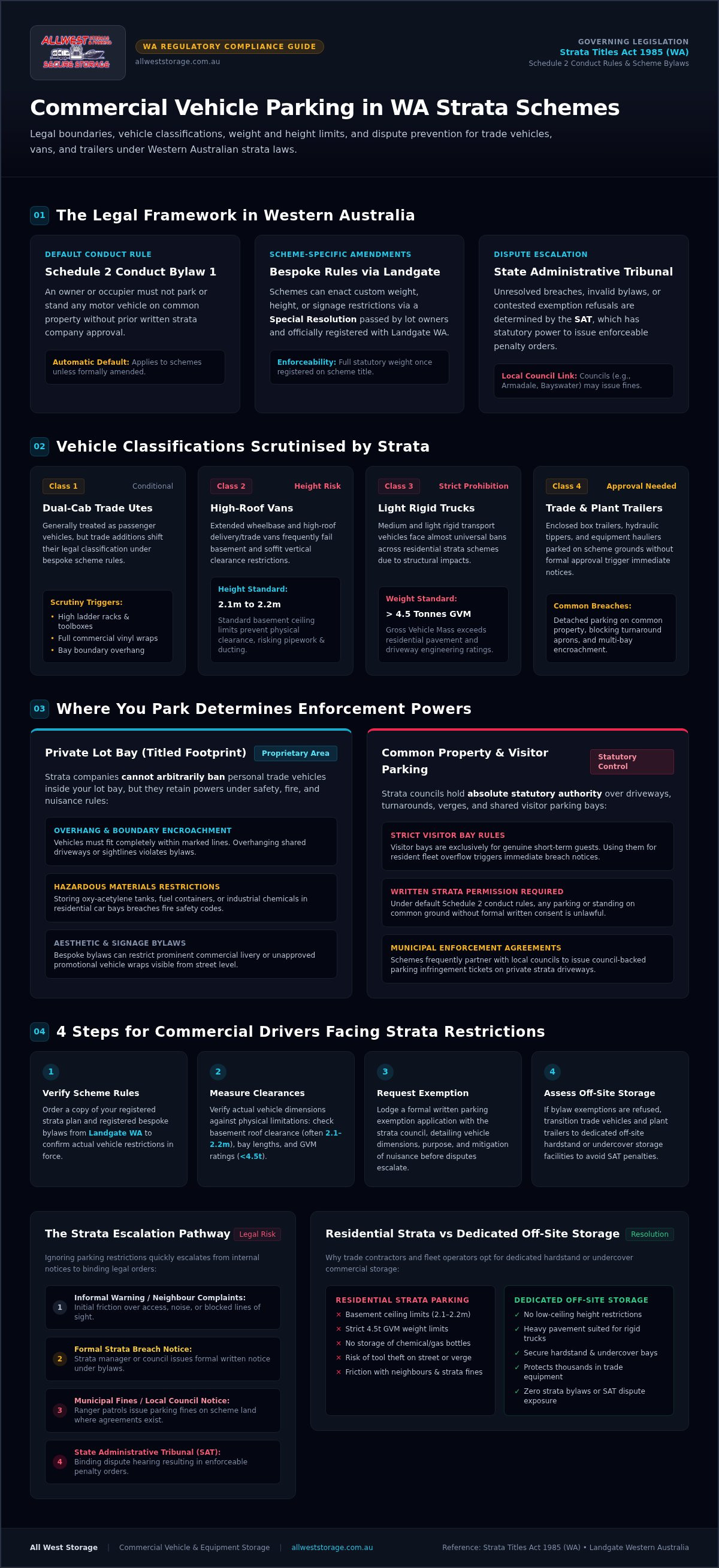
Four Steps for Commercial Drivers Facing Strata Parking Restrictions
Facing a dispute over your work vehicle requires a practical plan. Instead of waiting for council friction to escalate, take systematic steps to protect your commercial operations and stay compliant with strata bylaws parking commercial vehicle WA frameworks.
Audit Scheme Bylaws and Vehicle Specifications
Obtain an official copy of your scheme’s registered bylaws directly from Landgate WA. Informal notices from a strata manager mean nothing if the rule was never formally registered via a special resolution. Next, take physical measurements of your vehicle. Record total length including tow bars, clearance height with roof racks or ladders attached, and width across extended mirrors. Compare these figures against your titled bay boundary lines to confirm whether your ute or van physically encroaches on common property.
Navigate Local Council Verge and Street Parking Rules
Shifting your vehicle out of the strata complex and onto the street often triggers a new set of penalties. Local councils across the Perth metropolitan area enforce strict local laws on residential road reserves:
- Weight and length limits: Most municipal bylaws prohibit parking commercial vehicles exceeding three tonnes or a total length of 7.5 metres on suburban streets for more than one to two hours.
- Verge parking bans: Parking on residential verges without explicit council permits or written adjacent property owner consent attracts immediate council infringement notices.
- Trailer restrictions: Detached trade trailers parked on public roads overnight are heavily monitored and quickly ticketed by local rangers.
Evaluate Off-Site Commercial Storage Alternatives
Leaving an expensive work fleet on unmonitored industrial roads leaves valuable machinery open to vandalism and opportunistic theft. Secure off-site yards eliminate these vulnerabilities entirely. Look for dedicated vehicle facilities featuring continuous CCTV surveillance, wide driveway access, and simple rental terms without lock-in commitments. Positioning your vehicle near major transport routes saves valuable morning travel time before daily jobs. If you need a compliant, reliable solution for your work fleet, explore dedicated commercial truck and vehicle storage in Perth to safeguard your livelihood. Book a secure bay today to resolve your strata parking issues permanently.
Why Dedicated Off-Site Parking Outperforms Residential Strata for Work Fleets
Trying to fit trade operations into residential developments often creates ongoing friction. Strict strata bylaws parking commercial vehicle WA frameworks are designed to prioritise residential quiet over business logistics. Choosing specialised vehicle storage yards removes your work fleet from this tension, delivering security, convenience, and instant regulatory compliance.
Enhanced Security for High-Value Tools and Assets
Parking a loaded trade ute or service van on a residential verge leaves thousands of dollars in power tools, diagnostic gear, and materials exposed to opportunistic theft. High fences and residential security doors don’t stop targeted vehicle break-ins on dark suburban streets. Dedicated commercial facilities replace that vulnerability with 24/7 monitored CCTV surveillance across fully fenced yards. Controlled gate access guarantees that only authorised drivers enter, giving you total peace of mind that your gear remains secure overnight.
Logistical Efficiency and Strategic Highway Connections
Strata basements present constant operational hazards. Steep entry ramps, low overhead fire pipes, and narrow turns risk costly bodywork damage to high-roof vans or commercial trailers. Dedicated vehicle storage solves these physical constraints completely:
- Engineered turning circles: Spacious access roads let commercial vans, heavy trailers, and trade trucks manoeuvre smoothly without complex multi-point turns.
- Strategic freight access: Positioning vehicles near major arterial transport links, such as Roe Highway and Tonkin Highway in Perth, bypasses suburban school zones and morning traffic bottlenecks.
- Quick dispatch: Hitch up your trailer, load your materials, and head straight out onto regional highways without waking up neighbours.
Friction-Free Compliance and No Lock-In Contracts
Moving your work fleet off site ends the headache of formal breach notices, committee warnings, and pending tribunal applications permanently. Your relationship with your strata council improves immediately once shared visitor bays and common driveways remain clear. Commercial vehicle yards match your operational cash flow through flexible weekly or monthly agreements with zero lock-in contracts. You retain complete flexibility to expand parking bays during major commercial projects or scale back during quieter periods. To protect your work assets and streamline compliance, explore convenient hardstand and undercover vehicle parking in Perth.
Keep Your Work Fleet Moving Without Strata Friction
Managing strata bylaws parking commercial vehicle WA regulations doesn’t have to stall your business. Battling strata councils, paying municipal verge fines, or risking tribunal hearings takes valuable time and energy away from earning a living. Removing oversized work utes, service vans, and equipment trailers from residential driveways stops neighbour disputes immediately while keeping your valuable tools safe from opportunistic street theft.
Dedicated off-site facilities provide a practical, permanent fix for trades and commercial drivers. With 24/7 CCTV surveillance, secure perimeter fencing, and spacious hardstand bays near Roe Highway, your vehicles stay protected and accessible whenever your shift starts. Flexible agreements with zero lock-in contracts adapt easily to changing contracts and fleet sizes. Take control of your commercial logistics. Secure your commercial vehicle parking with Allwest Storage & Parking today and get complete peace of mind on every job.
Frequently Asked Questions
Can a WA strata council ban all commercial vehicles from parking on site?
Yes, a strata council can effectively ban them from common property. Default Schedule 2 conduct bylaws prohibit parking on common property without prior written permission. For privately owned lot bays, the strata company cannot arbitrarily ban all vehicles, but they can enforce registered bespoke bylaws that restrict excessive weight, dimensions, or hazardous commercial materials. To restrict your titled bay, the scheme must pass a special resolution registered at Landgate WA.
What constitutes a commercial vehicle under standard WA strata bylaws?
Standard WA strata bylaws do not provide a statutory definition for a commercial vehicle. Instead, default rules govern all motor vehicles parked on shared property. Bespoke strata bylaws parking commercial vehicle WA definitions usually borrow from local council planning schemes. These categorisations typically focus on vehicles used for trade, those exceeding specific gross vehicle mass thresholds (often 3 to 4.5 tonnes), or vehicles fitted with permanent machinery, trade racks, and heavy commercial branding.
Can I park my trade ute on the street or verge outside my strata complex in Perth?
Only if you comply with local government street parking laws. In Perth, most municipal councils prohibit parking commercial vehicles exceeding three tonnes or 7.5 metres on residential streets for more than one or two hours. Parking on road verges without a local council permit or the explicit written consent of the adjacent property owner is illegal. Local rangers actively issue fines for unhitched trade trailers and work vehicles left on verges overnight.
How do I apply for an exemption to park my work vehicle on common property?
Submit a formal written application directly to your strata council or strata manager. Include your vehicle’s make, model, registration, overall dimensions, and gross vehicle mass. Offer clear operational compromises to address common neighbour concerns, such as agreeing to restricted morning departure times and promising not to idle diesel engines on common property. The council must review your request and provide written approval before you begin parking on common property.
Can my strata company tow my commercial vehicle without my consent in WA?
Towing a vehicle from private or strata property in Western Australia involves strict legal parameters. A strata council cannot simply call a tow truck without risking unlawful vehicle interference claims unless their registered bylaws clearly permit it and proper statutory warning notices have been served. In most cases, strata schemes enforce parking breaches by issuing formal warnings, issuing council parking tickets under local agreements, or seeking an enforceable removal order through the State Administrative Tribunal.
What should I do if the strata council issues a formal breach notice for parking?
Review the exact bylaw cited in the breach notice immediately. Check whether the rule is officially registered at Landgate WA or is merely an informal house guideline. If your work ute or van is parked within your titled lot bay, confirm it does not encroach on common property boundaries. Respond to the strata manager in writing with your evidence, or relocate the vehicle temporarily to prevent escalating financial penalties while resolving the dispute.
Why is an off-site storage yard often better than fighting a strata parking dispute?
Off-site storage provides an instant, permanent resolution without the months of delays, application fees, and toxic neighbour friction associated with tribunal proceedings. Commercial vehicle facilities offer dedicated open-air hardstand or undercover bays equipped with 24/7 CCTV surveillance, keeping valuable trade tools protected from street theft. Locating your fleet near major Perth arterial roads like Roe Highway also cuts travel times and ensures seamless morning dispatches, completely bypassing restrictive strata bylaws parking commercial vehicle WA disputes.
Leave A Comment